SocraticGadfly: Federal Reserve
Showing posts with label Federal Reserve. Show all posts

January 28, 2023

It really is about "easy money" — Edward Chancellor

I'm not sure why a few Goodreads reviewers think they know better, but they don't.

The Price of Time: Interest, Capitalism and the Curse of Easy Money

The Price of Time: Interest, Capitalism and the Curse of Easy Money by Edward Chancellor
My rating: 5 of 5 stars

 This is an extended and edited version of my Goodreads review of a book that says, yes, it really is about "easy money" from the Federal Reserve, first with the "Greenspan put," then the "Bernanke bubbles," then Yellen and Powell being afraid to pull away the proverbial punchbowl.

A very good book overall, whose theme for today is “easy money is a drug,” while backing that up with a 4,000 year look at the history of interest rates, tied to discussions of what is a “normal” rate of interest, if there is such a thing, and other factors. The title comes from people as far back as Adam Smith or further nothing that interest was the price people paid on time discounting returns, especially if said time involves risk or anxiety.

Chancellor first goes back to antiquity and the first use of interest, predating Hammurabi’s Code by centuries. He notes, like Michael Hudson, that debt jubilees far preceded their biblical establishment, BUT he gives some details that Hudson doesn’t.

One big thing is that they weren’t on a 50-year or whatever cycle. Instead, a new king implemented them to cut social unrest, etc. Like new Caesars paying off the Praetorians. That's one thing we should remember today. A la "predictably irrationality," having a jubilee on a fixed cycle probably would lead to moral hazard issues, as well as hesitancy to loan near the end of such a cycle, something Hudson doesn't really address. Second, there were two types of debt — barley-based, which were generally “consumer” loans in today’s terms, and silver-based, which were “commercial” loans. Only the barley loans were forgiven. In line with Biden's push to cancel at least part of student loan debt and wingnuts pushing back, that would surely fall under "consumer" debt.  Third, a new king wasn’t guaranteed to do this. 

(Sidebar: If Hudson does want to go hunting for a background to this issue that stands on better ground? Per comments by David Graeber in "Debt," it's the old hunter-gatherer world he needs to look at, and, like the Inuit, preferably looking at a hunter-gatherer world with limited interaction with the agriculturalist world.)

From there, he looks at debt, interest and definitions of usury around the ancient eastern Mediterranean, with some excursion into China. (India doesn’t make his radar screen for whatever reasons.) The basic idea is not that money wasn't allowed to "work," but that it wasn't allowed to become too greedy in how and how much it worked.

Then, he starts early modern history where knowledgeable people would expect: John Law and the Mississippi Bubble, with details on just how bubbly it was. From there, it’s off to Walter Bagehot, his Bank of England as “lender of last” resort and just how much that’s abused in modern times. That includes even abuse in Switzerland, regarded throughout the Western world as a model of probity. Along the way, he loops in discussions on economists in the 1600s, notes on how “easy money” led to Fugger wealth and more.

NOTE: Chinese tankies will HATE this book because of the chapter “Financial Repression with Chinese characteristics.”

For more on this, see my full review and click the "spoiler" link to toggle it open. The TL/DR? Beijing has willingly been inflating bubbles at least as big as in the U.S. There's plenty of evidence for it, and most of it, albeit perhaps not always with his level of detail, I've seen before here.

Refuting people who challenge Chancellor's ideas on easy money? Chancellor’s short and sweet discursus on Iceland eating its shit, taking its haircut, and doing well today.

Finally, in his postscript, Chancellor speculates if central banks will offer their own digital currencies to drive out private crypto. It's speculative, but worth pondering. Before that, Chancellor notes just how bubbly crypto is, and how it's essentially deliberately designed to be that way.

I don’t think I’d ever even read a newspaper piece by him before. But, per Chancellor’s Wiki page, he is indeed insightful. His political positions would seem to be, in US terms, mainstream liberal to the left side of that, and minus most neoliberalism. And, per his previous two books also ultimately being about bubbles, the global economy is either going to be facing a Long Unwinding, if the Fed holds the course, or else more Fake Growth. That said, while he got the last three global bubbles right, his defense of voting Leave, and calling out economists who warned about its problems, appear to have been more miss than hit on the prognostication side. 

In essence, to riff on something from 15 years ago? We may be facing some sort of "Great Unwinding" to fully deal with 20 years of Fed problems. That said, the inflation rate has started dropping again, so it remains to be seen how long the Fed will stay the course and what its landing spot is.

View all my reviews

February 02, 2019

Is the dollar about to lose its perch as world reserve currency?

The some kind of Socialist, some kind of Marxist economist Michael Hudson thinks so, seeing the Britain-France-Germany workaround on the American sanctions against Iran announced on Thursday being a kind of wedge.

I don't think so. Rather, I think this is as much wishful thinking, which he does from time to time, in my opinion.

OK, here's the skinny.

There's three currencies, two of them state-backed, that have the possibility. None of them will become an official, or even a strongly quasi-official, world reserve currency before 2040.

First, referencing those countries above, is the Euro.

From my understanding of the EU, this could only happen officially by vote of all EU members who use the euro. That's less likely in the next 20 years than herding cats successfully.

Second, the yuan. Nope. That would require it to be depegged from the dollar. Anybody who thinks that happens in the next 20 years, thinks Trump is a free-trader.

Besides, China is doing better, per N+One, halfway down or so, with the Asian Infrastructure Development Bank giving it leverage against the World Bank.

The third is the non-state collection of electronic ledgers known as crypotocurrency.

That ain't happening, either.

The way most bitcoin systems are structured, none individually are elastic enough to get anywhere near that big even as unofficial reserve currency.

Collectively? Dude, these are libertarian wet dreams. No chance they unite into one massive megacoin.

And, as an official reserve currency? It's part of their duty as nation-states for their governments to crush bitcoin precisely because it's stateless.

File 13 this idea, Michael.

If you were engaging in sardonic humor about Trump being a deliberate wrecker of the dollar as a reserve currency, it really didn't come off that way.

==

And, while you're at it, File 13 your love for Modern Monetary Theory. Go read some Doug Henwood on that. (I'm eventually going to have to do a separate piece on this.)

Doug's piece is actually very interesting. I didn't know that Hudson is NOT the No. 1 touter of MMT at Missouri-Kansas City, which Henwood calls the Vatican of MMT. I also didn't know that Yves Smith of Naked Capitalism is a fangirl.

In usual Henwood style, Doug can be scathing. (He can be when he's wrong, as well.):
MMTers extend this hubris about the precision and power of policymaking to the realm of interest rates, which they think the central bank is completely in control of and should be kept as close to zero as possible.
That right there is silly. I don't need Doug to tell me that:
Without higher interest rates to compensate for greater default risk or longer maturities, there will simply be no one willing to buy the bonds or issue the loans.
The MMTers answer is for the Fed to be the purchaser of last resort.

Gee, isn't that something quite similar to Quantitative Easing?

Otherwise, Doug's even better further in, when he criticizes the MMTers for being lackadaisical about inflation.

Then, tying this back to Hudson's thoughts on reserve currencies, Henwood notes other nations don't have the same degree of currency-printing freedom as does the US.

Henwood then notes that a jobs guarantee program is in no way dependent on MMT.

One last thought, per Henwood: If Stephanie Kelton truly believes that just following MMT will solve climate change, she's either a tremendous idiot or an incredible liar.

See more MMT refudiation here.

And, stuff like this on Twitter is laughable.
Geez. Back at you.

And, that's that.

March 21, 2017

OK, Greens: Positive ideas to reform the Federal Reserve, not trash it

I am not in the camp of some Greens, and some other left-liberals and beyond, who adopt a quasi-Libertarian (small or capital 'L") and quasi-conspiratorial take on the Federal Reserve. Indeed, I met one of those libertarian folks at an early 2009 rally and protest outside the Dallas Federal Reserve.

The reality is (with reference to Wiki's page on the Fed):

1. We need some sort of national banking system. Per Lincoln's comment about replacing McClellan, if you want to replace the Fed, what will you replace it with? Outside the Great Depression, and to a lesser degree by far, the Great Recession, almost all of American’s major financial storms came about because we had no national banking system. That includes the Panic of 1837, the Panic of 1873 and the Panic of 1893 — the latter two were both worse than the Great Recession, while the former lasted longer and the latter, at its worse, almost matched the Great Depression in its severity. There was also the brief, but sharp, Panic of 1907.

2. The Fed did what it could post-2009 on the economy, due to Dear Leader not proposing a large enough, vigorous enough relief/stimulus package and Republican Congresscritters blocking later efforts to expand that. To the degree the Fed, whether the national “The Fed” or the regional banks, had problems and contributed to the Great Recession, Obama can be faulted along with the majority of both parties in Congress for not taking a look.

3. An(other) allegedly progressive Democratic president, Wilson, gave us the most business-friendly, banker-friendly alternative on a national banking system he could devise. That’s especially true of the various regional Federal Reserve banks, like the Dallas Fed. Given that their presidents rotate on and off the board of the national “Fed Open Market Committee” and that these regional Feds are almost totally the captive creature of private-sector financial interests, this is a problem indeed.

This fact is illustrated by the Internet. “The Fed” has a “.gov” suffix on its board of governors URL. Regional Feds like “The Dallas Fed” have “.org” suffixes, as does “The Fed” itself outside its board of governors. (Links for all regional Feds are on the Wiki page near the top.)

Of course, this just underscores the truth behind the old adage that the Fed, at the national level, likes to pretend it’s a public entity when that strengthens its powers, but a private entity when that works better.

4. Back to history, briefly Before Tommy Wilson, TR — even though he had to send himself as "his man" to visit J.P. Morgan, hat in hand, in 1907 during the "Panic" of that year — refused to touch the issue, just as he refused to touch a 16th Amendment for an income tax.

The reference is to the 1902 Northern Securities trust-busting legal procedures, when Morgan said, why can’t T.R. send his man to my man and we’ll just fix things up?

The oft-maligned Taft gets credit for both doing that — an income tax amendment — and reducing a high tariff, even though that involved tradeoffs to get the 16th Amendment voted out of Congress and sent to the states.

Anyway? Greens and independent-minded left-liberals and beyond? Rather than gutting the Fed, talk about how you would reform it to make it better.

My thoughts?

Reform of the Fed must, must, must start with reform of the regional Feds. And, that reform must include taking at least part of the private sector’s sole power at the regional feds away from it. Period and end of story.

The U.S. is the only major nation whose central bank is a public-private hybrid, let alone one with that much regional power.

A minimum for reform would be that one-third of the board of each regional Fed is a public-sector presidential appointment. (Currently, per Wiki's article on the structure of the fed and regional feds, three board members are bankers appointed by member banks, three are non-bankers appointed by member banks, and three are non-bankers appointed by the national fed.)  Given the Fed’s “dual mandate,” at least one of the presidential appointments to each regional Fed board would be an official representative of the Department of Labor. Another could be an official representative of the U.S. Treasurer, or the Department of the Treasury.)

The national board of governors "exercising oversight" over regional Feds and their boards is not enough, even if that's in conjunction with it appointing three board members.

That would make 12 instead of 9 members of each regional fed's board. I'd be OK with banks appointing one more Class A member to offset that.

Given the New York Fed's outsized role in the nation's finances, I would say five presidential appointments, not three, would be needed.

The president of each regional Fed would have to be a presidential appointment as well. Having the board of a regional Fed appoint the president is not good enough. I'd be OK with the national board of governors and regional board making nominations, but, this would have to be the president's call. Tim Geithner's role running the New York Fed make clear how important it is for this to be a presidential appointment. An additional restriction might be that nominees by a regional board for the presidency could not be an employee of a bank that was a member of that regional Fed

Second, the stipulation of the Department of Labor, above? That should apply to the national Fed's board of governors, too. And, given that the Treasury actually prints our banknotes, as well as pressing our coins, the Treasurer of the United States should sit as an ex official member of the board of governors too. If the current Fed wanted an expansion from seven to nine governors rather than the replacement of two, that's fine.

Given that the national board of governors is already short two members, I think presidential appointment powers for the two national members would of course go along with ex officio status, and that the appointment of regional presidents, with a nomination process, should not be subject to Congressional approval.

Note: None of these reforms would preclude something like 49 other states creating their own versions of the Bank of North Dakota. (Note: By that bank's enabling statutes, and even more by how it was treated by others lending institutions at its creation, its powers are actually fairly limited; progressives, Greens, left-liberals should not think that such an institution is a panacea for communitarian ideas, though it may well help. It is NOT a statewide credit union, though there would be nothing legally stopping other states from doing that with their state banks, if they formed them.)

That then said, communitarianism, especially in its more ardent versions, is probably another area where I'm not fully comfortable being in the Green Party saddle. And, despite that he blocked me on Twitter, I can still be mensch enough to say that a lot of Greens need to read or listen to Doug Henwood, or someone similar, to get real left-liberal and beyond understanding of modern America's financial system and what's realistic and what's not on changes to it. Trying to do ever more things by barter, or communitarian banking, or similar?

First, that's not realistic. And, related, what do you do if you think you got ripped off on a barter? Revert to the law of the jungle or similar? If you're a nonviolent Green, do you tighten your circle of trust ever more? Per this link, many communitarian groups wind up failing, above all because of the amount of hard work involved. Also, at a small-scale level like that, there's less room for error, and less room for modern social welfare. That's why, contra an Occupy movement myth, small businesses aren't automatically better than big ones.

Next? Short of a full communitarian community, your local trade association, if it has moved beyond barter to private money, can't have that money "translate" if it's not accepted by central banks, whether it's some "community bucks" or Bitcoin.

And, that's a good thing! It's called "rule of law." I don't want anarchy in the banking system, or in general, whether it's proposed by hardcore libertarians or by anarcho-Greens. Pass.

Second, IMO, in the more extreme forms, that's a communitarian parallel to states' rights stances; what it really does in the end is further weaken "the mystic chords of memory" from the peroration of Lincoln's First Inaugural Address. I no more want a Republic of Greater Portlandia than I do a Republic of Texas. And, related to that, as Thomas Frank pointed out on the original Occupy movement, a communitarian focus runs the risk of withdrawal from national issues that may not be of community concern. (I know that some — even if nowhere near all — people who might like a Republic of Greater Portlandia knows the city, and definitely the state of Oregon, have criminal justice problems based on the high degree of whiteness.)

One of those "someone similar" folks to Doug Henwood would be Michael Hudson. He's a left-liberal, but, unlike Henwood (self-putatively), I don't think he's a "beyond." Anyway, Hudson, in this great piece about how he is a heterodox economist and more, notes that in a monetized (that's as in money-based, not barter-based, or similar) society (but not necessarily a capitalist one (scroll down to near the bottom, if you don't understand that "banking and finance" aren't the same as "capitalism") somebody has to provide credit. Better the government, especially if we pull the influence of private bankers over regional Feds, than private bankers.

(Hudson is more critical of identity politics than I am, but that's in part because, as he notes, leadership of specific identity politics groups within the Democratic Party has been taken over by neoliberals. I'm not sure how critical he is of the general idea of identity politics, but I fear he might be a big Henwoodian in that way, trying to reduce everything to classism. After all, his father was a Trotskyite.)

I'm not expecting people who comment on the current banking system of the United States to have the same level of understanding as a potential nominee to a regional Fed board membership. I am "expecting" you to have more knowledge of how banking works than did Andrew Jackson. If not, I respectfully suggest you follow Wittgenstein and stop talking; please don't have some of the same unrealistic ideas as the Zuccotti Park Occupy folks did on finance and economic issues in general.

As for antipathy to banks, not just their modern American abominations in Manhattan? Banking, including transnational banking, precedes modern capitalism. After all, the likes of the Medici and the Fuggers were in place more than 500 years ago, serving a system that was still basically mercantile and only proto-capitalist. Beyond that, the Soviet Union had a central bank. A banking and finance system is NOT the same as capitalism. And as for "fiat currency," lest any Greens are going down THAT libertarian rabbit hole? The Chinese were printing paper money 1,000 years ago.

Getting more into the weeds, your local bank, even if it's only a state bank and not a national bank, needs somewhere to both invest some of its reserves and have a backup source of liquidity. Even a credit union needs some of that; as Henwood had no problem in pointing out to the Occupy kiddos, credit unions are not autarkic investment and savings institutions.

==

Sidebar: Shock me that at least one Green peddling this nuttery (FB status is posting as "public," so I'm violating no confidences) is a 9/11 "truther." Said person, per my normal practice, is already blocked.

April 12, 2016

Reform the Federal Reserve

Bernie Sanders has talked a lot about breaking up "too big to fail" banks, but given that such power resides largely with the Federal Reserve System, which is less quasi-governmental than even Amtrak or the Postal Service, arguably, shouldn't he focus more on an overhaul of the Fed?

Yes, it's not an easy sound bite, but, a push is out there to do just that — namely, to stop the essential ownership of regional Feds by private banks, along with other reforms. Proponents say it would make it a more public institution, like that in other developed nations.

Of course, this all goes back to so-called "progressive" Woodrow Wilson.

By the time he took office, it was clear that some sort of national banking system was needed. Teddy Roosevelt, surprisingly, took a pass after the Northern Securities trust-busting and his dust-up with J.P. Morgan, only in turn to have to go hat in hand to Morgan during the Panic of 1907.

Taft got the income tax amendment past Congress and off to the states, something with TR also failed to do and for which Woody Wilson is wrongly given credit.

Which leads to the Federal Reserve. It was arguably the most conservative solution to the nation's banking needs available. That said, under the cover (the white hood, maybe?) of being a "progressive," Woody Wilson was still very much a states-rights Democrat. Getting an American version of the Bank of England was never on his agenda.

I would be a bit concerned about single terms for Fed governors, but everything else in the proposal sounds very good.

As for Sanders, he's the only one of the five mainstream party presidential candidates to indicate even a degree of serious interest in the proposal.

Puff Hoes gets one thing wrong. The Fed is "nonpartisan" only in the sense its beholden to a neoliberal, labor-unfriendly fiscal policy that's the key point of leaders of both mainstream parties.

December 17, 2012

I'll personally kick Obama in the nads if ...

If this rumor/speculation is true and Tim Geithner is his choice to replace Ben Bernanke to run the Fed.

Incompetence, Peter Principle, arrogance, ego, elitism, etc., etc ... dammit, I'm running out of adjectives to describe Geithner.

But, William D. Cohan lays out a strong inside-the-Beltway case for Little Timmy both wanting, and probably getting, the job:
The usual list of highly qualified candidates to replace Bernanke -- including Lawrence Summers, the former Treasury secretary and Harvard University president; Janet Yellen, a current vice chairman of the Fed; and Alan Krueger, the precocious chairman of the White House Council of Economic Advisers -- misses the person who probably wants it the most and continues to have Obama’s ear on a regular basis: Geithner.

Last spring, Geithner told Obama he wanted to leave Treasury as soon as possible and return to New York so that he could rejoin his family, while his youngest child was still in high school. But Obama prevailed on Geithner to stick around until after the election. And he remains in Washington to help Obama negotiate a deal on spending and taxes with Congress. 

Had Geithner been serious about wanting to leave town, he probably would have thrown his hat into the ring to become president of Dartmouth College, his alma mater. But that position went to Philip Hanlon, the provost of the University of Michigan, without Geithner’s name being mentioned. Expect Geithner to seek a short-term sinecure at a liberal think-tank, such as the Brookings Institution, or to return to the Council on Foreign Relations, or to cash in as an adviser to a hedge fund (as Summers did at D.E. Shaw & Co. after he left Treasury) while he awaits the possibility of getting nominated as Fed chairman. 
Doorknob help us all ... the Fed will be cutting all sorts of backdoor deals with the banksters. Even more so if Jaime Dimon is named Geithner's replacement at Treasury.

That said, be honest. Even if you're an off-the-boards Obamiac, would such a move really surprise you?

The only possible condolence is that he might be better at the job than Summers. But, you know? I'm not even sure about that.

October 21, 2012

Dear #RonPaul and #Paultard #goldbugs — what is #fiatmoney?


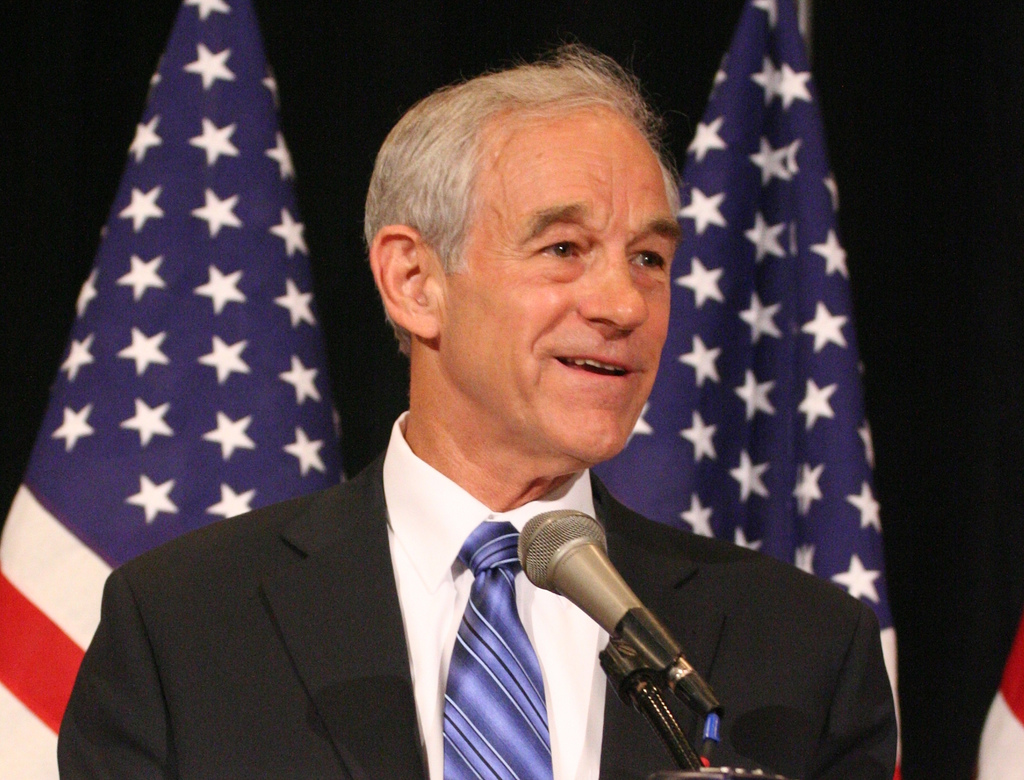
Ron Paul, looking about as clueless as his
self-deluded followers./Photo via Wikipedia.
The answer, the real answer and not your made-up answer, as to what currently constitutes fiat money in the United States, is what I’m going to give you right now as part of calling you out on both your hypocrisy but also your shallow thinking.

In today’s United States, fiat money is not just the Federal Reserve Notes you profess to hate. It’s also bank checks, credit cards and debit cards. And that’s not just because they’re dependent on fiat money or a fractional banking system.

Even if they were based on the gold standard, or gold and silver, because those three — bank checks, credit cards and debit cards — are not immediately payable in specie, they’re also fiat money.

Period. End of story.

Therefore, Rep. Paul and Paultard groupies, you should, if you’re logical not only want to destroy the Federal Reserve System, you should also want to destroy the entire banking system of the United States, the entirety of Internet commerce, and a significant fraction of “meatspace” commerce. I know you don’t, because, Rep. Paul, you’ve gotten online “money bombs” for years.

That said, let’s go to point No. 2, where you’re guilty more of shallow thinking rather than hypocrisy.

And, that is in the issue of non-fiat money.

Gold has very little intrinsic value. It’s only given a largely speculative value on things like commodities exchanges because of human greed. Its fellow precious metal, silver, has much more intrinsic value.

That said, other substances, some of them compounds, some of them elements, have far, far more intrinsic value than gold

So, Rep. Paul and Paultards, if you really want to end fiat money, instead of being goldbugs based on non-rational greed, here’s what you should propose as currency/monetary standards instead:

1. Petroleum. The American economy of the last 120 years would be dead and unrecognizable without it. Beyond the automobile and the airplane, don’t forget plastics, fertilizers and much more. Of course, if you think “fiat money” has wrecked the United States, that would be nothing compared to a monetary system under the control of OPEC.
2. Uranium. Without it, and even more the transmutation of U-238 into Pt-239, we couldn’t have been warmongers par excellence for the last 55-60 years. The US has a fair amount of uranium. Of course, unless you want a radioactive Fort Knox, where do you store it?
3. Lead. See “uranium” and extend further back in time US warmongering and imperialism.
4. Silicon. Without it, there’s no computer revolution, no Internet revolution, etc.
5. Lithium. Without it, we’re not going to have a green revolution in terms of rechargeable batteries, etc.

I could cite several more examples, but, if you want a monetary standard for non-fiat money to be relevant to the economy, these and other substances are far more relevant than gold.

Oh, and try reading some history, too. China was using paper money 1,000 years ago, when Europe was in the Dark Ages.

Or combine history with philosophy. You might, just might, realize that money itself is a “fiat” replacement for barter.

July 25, 2012

#RonPaul Fed audit bill doesn't go far enough

Oh, Ron Paul's bill — now overwhelmingly approved in the House — calling for a regular, extensive audit of the Federal Reserve is nice enough, I suppose. (And this is likely the last time I agree with  Paul on anything.)

But, as the Geithner/Barclays/Libor fiasco at the New York Federal Reserve shows, auditing only "The" Fed, and not the regional Feds, or at least the NY Fed with its special oversight of Wall Street, isn't good enough.

How many people realize that the 12 regional Feds are almost totally private entities, yet have major powers themselves? From Wikipedia's entry on the Federal Reserve System:
The Federal Reserve System's structure is composed of the presidentially appointed Board of Governors (or Federal Reserve Board), the Federal Open Market CommitteeFederal Reserve Banks located in major cities throughout the nation, numerous privately owned U.S. member banks and various advisory councils. ...  The Federal Reserve System has both private and public components, and was designed to serve the interests of both the general public and private bankers. The result is a structure that is considered unique among central banks.
And, there's the problem.

Now, unlike Paul,  and many of his goldbug wingnut followers, I don't want to abolish the Fed, not in the sense of getting rid of a central bank entirely. That's even more retrograde than the gold standard.

I do, though, want to reform the current Fed.

We don't need to have 2/3 of the board of each regional Fed nominated by private banks, with half of those,  or 1/3 total directly controlled by them and the other half (1/3 total) allegedly representing "the public." Really, this means banks control 2/3 of the nine board members.

Instead, give one of those three votes to credit unions, one to savings and loans, and maybe one to pension funds. That's just for starters.

There's much more that's needed. I'm not sure that we don't even need to have a fully nationalized central bank like the European Central Bank. Because, here's the ultimate problem with the regional Feds:
The Federal Reserve Banks have an intermediate legal status, with some features of private corporations and some features of public federal agencies. The United States has an interest in the Federal Reserve Banks as tax-exempt federally-created instrumentalities whose profits belong to the federal government, but this interest is not proprietary. In Lewis v. United States, the United States Court of Appeals for the Ninth Circuit stated that: "The Reserve Banks are not federal instrumentalities for purposes of the FTCA [the Federal Tort Claims Act], but are independent, privately owned and locally controlled corporations."
Further details partially qualify that, but, there you go ... for all intents and purposes, the regional Feds are primarily private entities.

I do know that we ought to have the Fed chairman term-limited. Yes, Bill Clinton was gullible enough, and neoliberal enough, to keep appointing Alan Greenspan. But, assuming it was neoliberalism as the primary culprit, term limits would have nipped that in the bud.

Now, if we can't "reform" the Fed, then I say —replace it! But don't abolish it and replace it with nothing.

January 25, 2012

Bernanke continues to put incremental stamp on Fed

First, with inflation hawks like Richard Fisher now off the Federal Reserve's policy board, Fed Chairman Ben Bernanke can stop worrying about their hyperfears about nonexistent hyperinflation.

So, he can also say interest rates will stay near zero, albeit indicating he expects recovery to be slow.

More importantly, in a sense, is this increased transparency:
In a separate set of statements, the Fed said that 11 of the 17 members of the committee expected that the Fed would raise interest rates at the end of that period. It noted that the committee expects growth to accelerate over the next three years, from a maximum pace of 2.7 percent this year to a maximum pace of 3.2 percent next year and up to 4 percent in 2014. 
Alan Greenspan never would have even considered making such an announcement.

Instead, he would have kept inner workings of the Fed secret, mumbled some shit-in-one-hand, St. Alan of Greenspan oracularity to Congress on the other and pretended he knew what he meant.

Of course, Bernanke has prodded Congress to do more for the economy than it has. That's not happening, at the earliest, before most Congressional GOP primary races are out of the way, and even after that, is likely to still have a fair degree of GOP BS, only a shade or two lighter on tea party dogma.

But, without getting specific, Big Ben said the Fed will consider more stimulus moves if necessary. Again, having the likes of Fisher out of the way  helps.

But, not so good news from the Fed for Dear Leader. The unemployment rate is only expected to drop to 8.2 percent during the year. I'm sure Obama would feel better, even with Richie Rich Romney or Newt-bar Gingrich as his opponent, if it were below 8.0.

September 21, 2011

GOP vs Bernanke gets ugly ... over next to nothing

Ben Bernanke and the Federal Reserve plan a timid, and likely limitedly effectual, effort to further stimulate lending by addressing longer-term interest rates.

Bernanke and the non-callous/nutbar Gang of Three inside the Fed rightly justifies it:
“Growth remains slow. Recent indicators point to continuing weakness in overall labor market conditions and the unemployment rate remains elevated,” the Fed said in a statement that listed its reasons for worry about the anemic condition of the American economy. “Household spending has been increasing at only a modest pace in recent months.”
Before we get to the GOP, let's look at the Gang of Three, namely Richard Fisher, president of the Federal Reserve Bank of Dallas; Charles Plosser, president of the Federal Reserve Bank of Philadelphia; and Narayana Kocherlakota, president of the Federal Reserve Bank of Minneapolis. Fisher is an attention-craver, as Texans know. He's probably pimping to be Rick Perry's Secretary of the Treasury. Plosser and Kocherlakota are U of Chicago alums; nuff said.

That said, let's look at the GOP letter to the Fed.
1. It claims the Fed hasn't articulated goals; a lie.
2. It claims quantitative easing hasn't worked; a lie. (It would have worked better with additional other effort by Obama, including running over the GOP more, but that's another story.
3. It claims potential harms from further Fed action. Versus further GOP nonaction?

We're at the point where "The Fed" is now a dogwhistle for wingnuts, like "socialism," "birth certificate," etc.

But, back to the NYT link at top. By itself, this move probably will be of limited effectiveness. And, that leads to the issue of how much the Obama "jobs bill" will do. And, how serious he is about real tax reform behind the "Buffett Rule," especially if/when his Wall Street masters get antsy.

That makes it clearer yet that this is GOP politics. As it won't likely have a big bump, there's little downside. Remember, this is the same GOP that has created two Fed vacancies by refusing to approve largely neoliberal Obama nominees.

The real problem? We have two economies, more and more. Per an AP story, talking about a housing recovery, but only for houses for the rich:
The (rich-others) divide is also making credit a perk of the rich. Mortgage rates are the lowest in decades. But what good are absurdly cheap rates if you can’t get a mortgage? The banks aren’t granting credit to anyone “who even has a smudge on their application,” says Jonathan Miller, founder of real estate consulting firm Miller Samuel. Applications for new mortgages languish at 10-year lows.
Bernanke has in the past consistently been cautious on where to trod, and said that Congress needs to take more action. While his Fed predecessor bears plenty of blame for the crisis we're in, and he does a bit himself, Bernanke is right. Ultimately, the Fed can only do so much outside of a political solution.

There is an interesting twist to all of this, on the potentially more serious side. Yahoo says the Fed move could hurt large insurers. Of course, many of them have had underfunded their obligations for a decade and more. Another example what too little regulation from the feds combined with too many guarantees produces. That's especially true on things like annuities, which are being marketed too much.

So, let's outsource FIRE industry CEOs.

At the same time, Bill Clinton makes a good point. As long as interest rates are near zero, we shouldn't worry quite so much about the deficit.

March 15, 2010

Chris Dodd contines to sell out consumers

I don't know what Dodd continues to vainly chase Senate GOP votes by watering down his consumer protection bill again and again.

To me, if a bill creates a new Consumer Financial Protection Bureau, even if it's housed inside the Fed, it needs to provide funding for that agency, right? Well, isn't that the angle to use Senate reconciliation procedures?

And, if not, is The One ready to go crusading for this bill after health care? Make Republicans defend not wanting to protect consumers?

That said, even a bill that has a Consumer Financial Protection Bureau, if it's inside the Fed, is too weak. The Fed's charge is, above all, monetary policy. To the degree it's a regulatory agency, it's supposed to focus on larger banks and related financial institutions. It's not designed to focus on mortgage brokers who peddled many of the subprime loans in the first place.

Anyway, read the whole analysis piece; it looks at several main areas, including derivatives, consumer abuses, executive compensation, legal authority and the "too big to fail" issue.

On most of these issues, not just what I mentioned above, it's too weak.

January 20, 2010

Stockman says tax the banks

Yes, that's David Stockman, the hard-core conservative and Reagan's first OMB director, saying exactly that. He says the Fed is largely to blame for this need:
The baleful reality is that the big banks, the freakish offspring of the Fed’s easy money, are dangerous institutions, deeply embedded in a bull market culture of entitlement and greed.

But, he also notes the Fed isn't likely to change, so this is the best answer.

December 25, 2009

No trusting the Fed

David Sirota notes that the Federal Reserve has $400 million a year it distributes around the country for "economic research" and rightly says that we probably shouldn't trust the Fed any more than Bush-Cheney claims about Iraqi smoking guns and mushroom clouds should have been trusted.

December 02, 2009

Go, Bernie Sanders, go!

The Vermont senator has put a hold on President Barack Obama’s nomination of Ben Bernanke to another term as chairman of the Federal Reserve Board.

I love this line from the story, which says Big Ben will surely got an eventual confirmation:
Mainstream senators give credit to Bernanke for pulling the economy out of the deepest ditch since the Great Depression.

First, there’s the implication Sanders is not “mainstream.”

Second, there’s the convenient overlooking of Big Ben partially driving the economy into that ditch in the first place.

November 19, 2009

Reich: Raise interest rates!

Yes, you heard me right. Former Labor Secretary Robert Reich says raising U.S. interest rates might be part of what’s need to make the “Wall Street recovery” into the “Main Street recovery.”

Of course, Reich should recognize that President Barack Obama cares little more for bottom-up Main Street recovery than did Reich’s old boss, Bill Clinton.

(When the Slickster “fulminated” about how his presidential program was captive to the bond market, at the start of his first term, he was pulling off his first great presidential acting job. He knew Jackson Stephens too well from his time in Little Rock to really be that surprised.)

And, Big Ben Bernanke probably never learned the biggest lesson from his study of the Great Drepression, and that is that we didn't get too much recovery then, either, until it got to Main Street.

October 22, 2009

Federal Reserve wants to 'review' banker pay

Yeah, right. I'll believe this when I see it.

Also, per the story, "review" does not mean "regulate." I'm not the only skeptic:
"I'm impressed, but I am skeptical . . . What is new is the Fed seems to be interested in doing anything about it," said Dean Baker, an economist and co-director of the Center for Economic Policy Research, a liberal group. "I'm glad to see it, but it's a story of which you have to be skeptical."

Maybe it's part of a larger power struggle/big by the Fed.

September 26, 2009

Audit the Fed? Heck, yes

What once seemed like just another in a long list of crazy Ron Paul ideas now has the backing of Barney Frank — regular auditing of the Federal Reserve. After its contributions to the 2008 financial crisis, its lax oversight of its own bailout help, and President Obama wanting to give it even more powers, this is an essential idea.

But, but, but, … the devil is hugely in the details.

Does the audit only include “the Fed,” for example? Or does it cover the 12 regional Feds? After all, it was the NY Fed, under Obama’s worst Cabinet choice, Treasury Secretary Tim Geithner, and not “the Fed,” that was a major contributor to the financial meltdown. If at least the NY Fed isn’t under the audit scrutiny, then it’s still pretty weak tea.
-END-

July 28, 2009

Fed more mistrusted than IRS

But, the detailed results and public comments from a new Gallup poll still probably won't dissuade President Barack Obama from renaming Ben Bernanke as Fed chairman.

Did FBI or other feds deliberately want Spitzer out?

Yes, yes, the former NY Gov should have kept his pants on, but, near the end of this fascinating story, in which Eliot Spitzer describes how effed-up the Federal Reserve has been since Paul Volcker was replaced by Alan Greenspan, then Ben Bernanke after him, we get some speculation on that. (Of course, Greg Palast can put on the tin-foil hat with ease ... )

July 26, 2009

Roubini sez re-appoint Bernanke; ugh

Well, Nouriel Roubini has been right about a lot of things related to the current recession, but not this one.

Sure, he possibly may have kept this recession from being worse; even then, was his solution the best? And, as Roubini notes, he helped get us here in the first place. In fact, he got enough wrong in 2006-08, what’s to say he won’t fuck up more if reappointed?

Of course, inside the “bipartisan economic policy establishment” that we have today, maybe you can’t find a better person to run the Fed than Ben Bernanke. Of course, that’s an indictment of the bipartisan economic policy establishment.

May 28, 2009

Fed as umbrella risk regulator? No thanks

President Barack Obama wants to give the Federal Reserve Board the job of being the nation’s overall risk regulator.

Sounds good, no?

No.

For decades, the Fed chairman, in testimony before Congress has always whipped out the word “private” in referring to its private-public status when fending off further Congressional regulation or investigation of IT. That would only happen in spades after this.

We’d probably wind up with an 1830s-style Bank of the United States.