SocraticGadfly: pop psychology
Showing posts with label pop psychology. Show all posts

January 04, 2019

My anti-self-help help for you

Tis the season ....

For a crapload of self-help books to start the new year. (Including self-help books that claim not to be. More below.)

Ignore most of them.

First, check blurbs.

If somebody like Tony Robbins touts them, put them down. And run away.

Second, look at titles or excerpts online, on authors' pages or Twitter accounts.

If the author talks about "winning" life? Run away. That's late-stage capitalist bullshit. Beyond that, it's a sociologically and philosophically shallow. It's also an invitation to psychological problems if one is not resilient, and therefore anti-helpful.

If the author talks about "hacking" life? Run away. It's like the above put through a Silicon Valley blender.

If the title talks about "laws," and gives the impression their are certain immutable laws of human nature, obedience to which will improve your life? Run away. If this were true, one such book would have been written 5,000 years ago and we would all be much better off. It's like a religious claim run through the self-help world filter. (Think of AA's 12 steps, OK?) And, I'm far from alone on that pick-up; I've seen it more than once in one-star reviews by others of self-help books.

If the title has a number in it, anywhere, like how many of these immutable laws there are? Run away. Numbers and listicles are an old marketing hack which the Internet has only made worse.

In addition, most of these books are written for people who are comfortably over the "Kahneman line" on income — in other words, they make more than enough for money itself to be a major factor in happiness or contentment, and probably do so in pretty secure jobs. If you're working in the dying newspaper industry, or a corner of the SEO world that will soon prove to be semi-fraudulent, these books aren't for you. Unfortunately, those are often the people suckered by hopes of a quick fix.

Let's take an example by James Clear, whose new "Atomic Habits" says one key to self-help is replacing "I have to" with "I get to."

That may well be true. But, does it solve problems?

Let's take a couple, of him making $33K and her $23K with three kids.

"I get to worry about trying to save 3 percent of my income and I get to ignore saving 10 percent."

"I get to worry about my kids getting sick because, with the amount of deductible on my insurance, we can't afford a trip to the hospital unless it really needs the ER."

"I get to worry about finding a new job over the age of 50."

"I get to thank James Clear for his brilliant, privileged insights."

Etc., etc.

Shit, James Clear's Habits Academy is ONLY $299. Of course, it's not individual ... it's podcasts or videos for that price. But, it IS the "premier training platform." It has attestations from people with first names! It IS based on "proven scientific research" (primarily from social psych experiments that have failed at least one replication attempt, no doubt).

===

A lot of this has been amplified by the growth of the positive psychology movement, which has its own issues, including Marty Seligman's ties to SERE reverse engineering, plus being, arguably, more crassly capitalistic than the general self-help movement.

The American self-help movement, going back to people like Fulton J. Sheen, Norman Vincent Peale and Og Mandino, has had a bit of Social Darwinist background to it. Or, "economic barbarism," to riff on a Twitter discussion yesterday. Often, this is unstated, but, nevertheless, it's there. The focus is on individual betterment, with societal betterment ignored. (Some more liberal self-helpers may give lip service to this, but they're the exception.) Comments like "winning" life are a reflection and embodiment of that, as I see it, and I'm pretty sure I'm not alone.

And, this is America, so such books have to have pseudo-statistics. Clear says that if saying "get" instead of "have" makes you 1 percent better per day, just compound that over a full year.

First, he doesn't prove it will make you 1 percent better a day, he just uses that as a starting assumption. If that actually were true, per the "immutable laws" paragraph, we would have just one book about this.

Second, better than what? That's never stated.

Third, it assumes that such betterment is readily quantified.

Fourth, it assumes that people like me won't ask those rhetorical questions I just asked.

Even among places that sound better, like Cal-Berkeley's Greater Good Science Center, there's a lot of touting of pretty cheap versions of positive psychology and such. Its staff's recommendations for top books of 2018 have Steve Pinker's cluelessness about the Enlightenment, Positive Psych books, and the latest by "we're all in sales now" Daniel Pink. Weirdly, in 2016, at least, different staff members picked books that directly contradicted each other, the last on the list being one I actually might read. And, a 2012 book on oxytocin was arguably scientifically out of date at the time and certainly is now. It's more a "possessiveness molecule" than a love molecule.

(Also sad: One of the top "practical Stoicism" philosophers is a disciple of one of the top "immutable laws" self-help authors. Sad, but ... not really a surprise, when you think about Stoicism, its Logos, and other related ideas.)

===

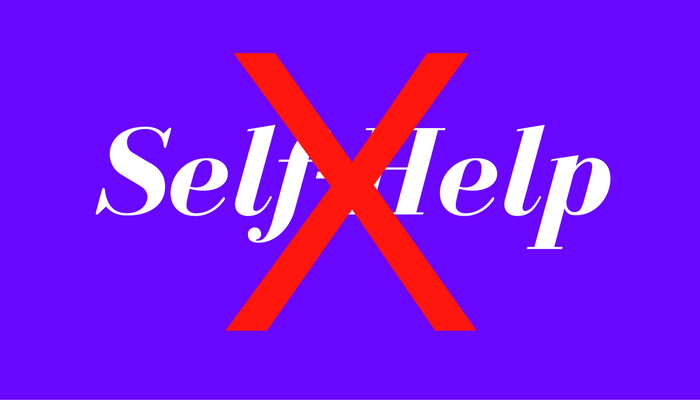
Note: The person from whose Medium site I kyped the picture says "just say no to self-help," then goes on to talk about "hacking your life" and the "one thing you need." It turns out she's written 11 books, or rather, "books," (see below) offers "coaching" and other things, but will tell you to say no to self-help.

Of course!

You should instead pay for "other-help." That's where the Tony Robbins types make their money. Videos and podcasts. Personalized emails, or pseudo-personalized. All things web so they can help you (remove money from your wallet). And, no, I don't believe that you can have PTSD symptoms for 30 years, possibly 40, and magically have them disappear in six weeks, ether. Sorry, Mary Schiller. (And, reading a bit more of that comment on your breathless blurb of another person's self-help book [or is it other-help] no. Especially not with that guy babbling about "Divine Mind" and the other New Age BS,. and charging $3,000 to listen to you. (And writing three books, even though he claims to have the one true thing.) Even sadder is, if per her autobiography and my reading between the lines, she thinks that having a New Agey "it happened for a reason" revelation about why she was sexually abused, run like hell from her. Karma is more offensive than Christian original sin. Run like hell from these people, beyond the issue of them wanting to rip you off. They will fuck up your life.

And, no, I'm not saying that because I take PTSD lightly. I'm saying it, from what I know, for exactly the opposite reason. I simply do not believe that a child sexual abuse "survivor" who was then further traumatized in a first marriage could magically heal in six weeks. Period. Rather, that PTSD is stuffed down some New Agey rabbit hole. If it doesn't bite you again before you die, consider yourself lucky.

Most of her alleged "books" are 30 page pamphlets. Even in modern e-book publishing, calling them books is a stretch. Whether it's a lie or not? YMMV. And multiple ones from them are about making money. And, that money-making doesn't heal PTSD either.

But, that's why self-help / other-help (flip sides of the same coin) are so uniquely American. They're highly predicated on capitalism. Capitalism plus a quick fix.

That's America's cultural DNA, or at least its majoritarian cultural DNA, in a nutshell. Why are lotteries so popular here? Quick-fix capitalism.

(Way back when, Og, Fulton and Norman, as far as I know, weren't peddling tschotschkes along with their books. Maybe that's because, pre-Internet, they didn't know better. Imagine an Og Mandino set of pamphlet-length e-"books." Fulton J. Sheen self-help T-shirts with inspirational messages. [Or cassocks like that for hipster priests.] Norman Vincent Peale doing TED talks. [Remember, the E in TED stands for "entertainment." No, really. It's not "education."])

October 15, 2018

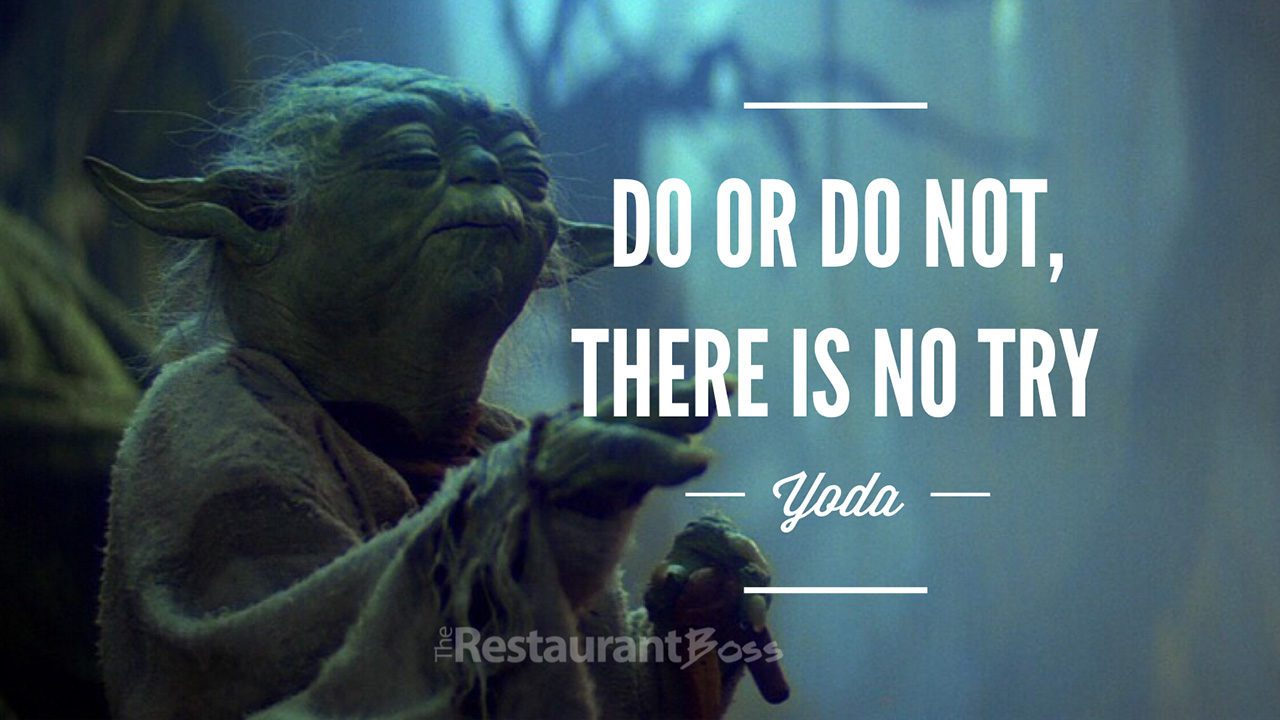
Calling bullshit on Yoda's "no try"

As this blog simmers and marinates more over the years, I've added more non-politics and non-sports stuff to it.

A fair part of those additions are personal thoughts related to psychology and sociology, and they're only going to grow as I get older. Because there's a lot of bullshit out there that needs to be countered.

Per the header?

"Do. Or do not. There is no try." — Yoda, from "The Empire Strikes Back."

This is New Agey bullshit from George Lucas. No, it's not even that. It's just recycled "business world positivity" bullshit that was espoused by Dale Carnegie, Napoleon Hill, Norman Vincent Peale and many others in the past, and on to Tony Robbins and others today. Sadly, many people who think this will force them to be better employees or whatever buy into this without reckoning with other issues.

The reality is much different.

There are many things we try to do, but where are attempts are blocked by forces beyond our control.

I try to grow rich, but I don't have inside connections, or 130 other people have already marketed my brilliant idea, or I don't have a dad named Fred Trump, or whatever.

I try to hook up with Kate Upton, but her liking rich, handsome athletes like Justin Verlander is beyond my control. Ditto for me trying to win Giselle; she has this thing for a Patriots quarterback. Ditto for me trying to woo Gabrielle Union away from Dwyane Wade. Or telling Khloe Kardashian that I'm better than BOTH Lamar Odom and Tristan Thompson. Or that Miss Universe Amelia Vega should dig me over Al Horford.

I try to make cool sci-fi movies, but I didn't marry Marcia Lucas, and no other film editors who know what I should be doing better than I do myself will touch me with a 10-foot pole. Put that in your pipe and puff it, George. (And, yes, from people like Mark Hamill as actors, and other directors who know the backstory, this is all true; Marcia edited the original Star Wars, especially, into being an actual move; George was semi-fucking-clueless.)

Beyond running into obstacles I simply cannot overcome, there's pure, dumb luck. People like Bill Gates admit that luck played a role in their fiscal success. (That's why Gates favors keeping estate taxes, or even going back to where estate taxes were 20 years ago; so do many other rich.)

Beyond that, there's the whole issue of "success." Too many people are afraid of failure. Too many others treat too much of life as a competition. And they, like the business gurus, cite bullshit like this. Beyond the general competitors, there's the Randians, Social Darwinists, etc.

So, in reality?

"There is fuck off. There is no succeed or not entirely on your own skill, without luck."

May 20, 2013

Pop psychology #happiness #fail

This list of 22 traits of happy people was posted by a friend of mine on Facebook. It sounds nice, but it's trite, and some of it actually conflicts with what other happiness researchers, or "researchers," tell us. Fortunately for psychologists, economics is still listed as a social science, or social "science," to keep psychology from being the most unscientific field in that domain.

A few specifics about this list?

8. Never make excuses.

Uhh, wrong? Er, wrong! Per happiness guru Marlin Seligman, tools such as "minimization" (which certainly involves excuse-making) are big, big, big, in promoting one's own happiness.

10. Wake up at the same time every morning.
Have you noticed that a lot of successful people tend to be early risers? 

First, "happiness" isn't the same thing as "successful," if it's being defined as something like business success. Second, waking up at the same time is not the same as being an early riser. Third, Ben Franklin, author of "early to rise" as a maxim, did no such thing himself.

19. Live minimally. 

But, there are rich, and at least somewhat materialistic, people who actually are happy. And, up to a certain point, even in America, more income does buy a better sense of well-being.


2. Treat everyone with kindness.
Did you know that it has been scientifically proven that being kind makes you happier? Every time you perform a selfless act, your brain produces serotonin, a hormone that eases tension and lifts your spirits.

Oh, doorknob, the "your brain is a sponge on neurochemicals" claim. It's been getting outdated for nearly a decade.

May 14, 2013

No, we're not all working in sales these days

A former boss of mine told me that, a few months ago, when I announced I had been named editor and publisher at my current newspaper gig.

I am, in part, in sales now myself. That, I acknowledge.

So, I checked out a book at the nearest big-city library recently, that purported to have some new insights on sales.

First of all, after reading the first chapter, I noticed on the dust cover that he had previously written some pop science bullshit book to the effect of how right-brain people will rule the world in 50 years or similar. Skeptical antennae up.

Second, in the second chapter, he claimed teachers are in sales. He even got two teachers quoted as talking about "moving" students. Skeptical antennae way up.

So, went to Amazon (sorry, not doing the book the favor of giving it a link) and read reviews.

Less favorable reviewers, like me, noted:
1. The fusion of "sales" and "persuasion"
2. That the alleged "new stuff" wasn't
3. The pop-sci angle.

I want to focus on No. 1.

I'd agree that all of us are, part of the time, "persuaders." We're not sales people, though. And contra Net Economy 2.0 claims about multitasking, we're not all on our way to becoming sales people.

Here's how I define sales:
1. There has to be a transaction involving some material change
2. Between people of at least semi-equal sociological or psychological status.

I don't know if a quasi-official labor psychology or labor sociology definition of "sales" or "sales careers" exists, but this is my working one.

By this definition, teachers aren't sales people on either grounds.

They may get "warm fuzzies" from motivating kids, but that's not a material transaction. And, because of the unequal, legally-stipulated school classroom setting, there's no sociological or psychological equal footing.

Indeed, beyond a very general persuasion, teachers who talk about "moving," let along about "selling" in terms of their students are actually approaching the world of indoctrination, where I stand from. (That's not to mention that it's kind of scary that teachers today actually believe something like this.)

Meanwhile, back to the world of newspapers. When I, as part of wearing my publisher's hat, talk to local businesses about ads, yes, I'm selling.

When I, wearing my editor's hat, talk to readers in an op-ed about what I think they should do, or how I think they should think, I'm persuading, or at least trying to. The two are not the same thing.

And, contra advertising sales and other sales "gurus," who drink too much from the waters of pop psychology, the word "try" is a perfectly legitimate verb. There is no "you are doing X" vs. "you are not doing X" dichotomy. In an op-ed, I regularly try to persuade people. At the time, or immediately afterward, I have no way of knowing whether I'm totally successful, totally unsuccessful, or somewhere in between.

That's true of many things in life that are complex tasks. We try to do them, and we don't know immediately whether we fully succeeded, partially succeeded, or didn't succeed at all.

And, rejecting bullshit like that is probably part of why I don't think "we're all in sales."

I have other reasons for rejecting this idea, too.

A lot of people who peddle it are either the Silicon Valley type libertarian businessmen (not "-people" because they're almost all men) who peddled shite like Web 2.0 in the first place. Or, if not them, the peddlers are people like Tom "My Head is Flat" Friedman, who believe that not only are we all sales people, we're all budding entrepreneurs, waiting to blossom like a million post-Maoist blooms.

And, another corollary of that is the boom in career recruiters. (Note: If you've sent your resume off to a career reccruiter, and in months ahead, you notice that they're looking for new recruiters on a regular basis, that's a big red flag, isn't it?

In short, the "we're all in sales" is at bottom line the idea that "we're all commodities now." It's about the hollowing out of traditional humanist values, traditional liberal ones, and also some traditional conservative civil-religion American ones. (This is yet another argument for multiparty parliamentary government in America; tea partiers could ditch the GOP more readily, as true progressives could do with neoliberal Democrats. Because if anybody embodies the belief that "we're all in sales now," it's America's Tweedledee and Tweedledum political parties.)

Unfortunately, there's danger of this continuing to grow, grow, grow in coming years, if what I'm reading on a social media discussion about one private liberal arts college is becoming ever more true in general.

I "get," in a way, State U. becoming ever more wrapped into the academy-as-business model, and teaching classes that way, and promoting the general commodification of our modern world. I kind of "get" Ivys and other large, rich private schools doing the same. ("Get" does not mean "like.") I do NOT "get" small, private liberal arts colleges going down this road. It totally destroys what that sort of college education, and college experience, is supposed to be about.

Without naming which college is involved, even though the social media discussion is set to "public," let's just say that it's a member of the Five Colleges group.

Now, add this: Another college cheating scandal, or mini-scandal, at the University of Albany. Will students like this, if they even halfway get away with it, then take the lesson to the workforce, and try to bribe bosses for favorable reviews, bonuses, promotions, etc.? And, back at the colleges and universities, will at least a few low-paid adjunct faculty ditch some of their idealism, say "what the fuck," and stick out a hand themselves for ignoring such cheating when they find it?

After all, if it isn't illegal, isn't this just another form of sales? Per my definition, something of material value is changing hands, and college students, unlike K-12 ones, are legally adults and not required to be in whatever school they're attending, so there is no relationship imbalance.

And, related to that, we don't all want to be, nor are we all temperamentally suited for being, "entrepreneurs," either. It's how Maggie Thatcher wrecked Britain and how today's GOP, with the "lite" connivance of many neoliberals, is wrecking America.

To sum up: This mantra is about commodifying the non-material, including human lives, and hypercapitalizing what is material. And, per the two teachers quoted above, its insidiousness is already spreading.

But, back to individual lives.

If we're "all in sales," the next logical thing is that we should all be prepared to be "on."  And ready to make a sales pitch. And, if you can't be "on," often enough or well enough, maybe your stress/anxiety levels start zooming?

Of course, to some degree, this is nothing new. I said that this idea went against some traditional conservative civil-religion American values. But not all of them, and not among all conservative Christians.

The "success gospel" has been based on this for decades. And, if you believe somebody like Og Mandino, in "The World's Greatest Salesman," "persuasion" has been getting fused or confused with "sales" for 2,000 years. (And, the fact that old Og is kind of a biggie among older 12-Step folks is another reason to focus a skeptical eyeball on him and his contribution to this nonsense. As well as it being a reason to focus a skeptical eye on "success gospel" churches and preachers any time they try to moralize.)

December 03, 2011

#OWS: Does it help to call Wall Street 'sociopaths'?

This meme seems to be doing nothing but gaining energy the last couple of months. It's the claim that leaders of Goldman Sachs, JPMorganChase, top hedge fund managers, etc., are all sociopaths. But, the claim is usually much more scattershot than that. Rather, it's that about anybody who works on Wall Street is a sociopath.

First, this seems to be a pop psychology, rather than real psychology, use of the word "sociopath." In short, it's not a lot better than name-calling. Let's take a look at the actual personality disorder.
The Diagnostic and Statistical Manual of Mental Disorders, fourth edition (DSM IV-TR), defines antisocial personality disorder (in Axis II Cluster B) as:[1]
A) There is a pervasive pattern of disregard for and violation of the rights of others occurring since age 15 years, as indicated by three or more of the following:
  1. failure to conform to social norms with respect to lawful behaviors as indicated by repeatedly performing acts that are grounds for arrest;
  2. deception, as indicated by repeatedly lying, use of aliases, or conning others for personal profit or pleasure;
  3. impulsiveness or failure to plan ahead;
  4. irritability and aggressiveness, as indicated by repeated physical fights or assaults;
  5. reckless disregard for safety of self or others;
  6. consistent irresponsibility, as indicated by repeated failure to sustain consistent work behavior or honor financial obligations;
  7. lack of remorse, as indicated by being indifferent to or rationalizing having hurt, mistreated, or stolen from another;
B) The individual is at least age 18 years.
C) There is evidence of conduct disorder with onset before age 15 years.
D) The occurrence of antisocial behavior is not exclusively during the course of schizophrenia or a manic episode.
Now, it's certainly possible that a fair number of people on Wall Street, or business CEOs in general, meet that definition. But, do all of the "bad ones" qualify as sociopaths?

A. Were they acting this way since high school?
B. Did they meet three of the subcategories under A in definitions? Probably not No. 1. Probably No. 2. Probably not No. 3 or 4. No. 5, maybe or maybe not, depending on exact definitions. No. 6, no, unless breach of fiduciary duty to shareholders. No. 7, yes, in many cases, as in Loyd Blankfein "doing god's work."

So, that leaves us with one semi-definite, on No. 2, one definite, on No. 7, and some maybes. That's not clear-cut. So, unless high school friends of Loyd Blankfein, Jamie Dimon and others pop up with tales from their high school days of setting cats on fire or something, they're probably not sociopaths in a clinical sense.

Which is ... GOOD!

No, not good in the sense of justifying their behavior, but exactly opposite.

If they're NOT sociopaths, then, they DON'T have a clinical mental illness as an excuse for their behavior. At least not in any measurable sense. Surely, even the most latitudinarian judge, in terms of responsibility and mental health, would not allow narcissistic personality disorder to be a defense at either criminal or civil trial.

That said, this also shows the limitations of the Diagnostic and Statistical Manual of Mental Disorders. Other than psychotic disorders being worse than neurotic ones, the DSM doesn't attempt to put disorders on any sort of gradient.

Second, a person can be greedy to the point of hypergreedy, if you'll allow me to invent a term, without being sociopathic. If, you hold along with me, that morality isn't necessarily rooted in gods, theology or metaphysics, and per the Euthyphro Dilemma, can't be, then, you should also accept that a secular equivalent of sin in general, and the "Seven Deadly Sins" in particular, is capable of being postulated.

So, let's just call these folks Greedy with a capital G. Then, let's stop trying to explain them in terms of mental illness and start explaining them in terms of immorality. Period.

Or, per a Wired story that says nice guys often do finish "last" financially, let's call them assholes. Or capital-A Assholes:
(B)eing disagreeable doesn’t mean you behave like Ari Gold. It doesn’t mean you are a sociopath or intentionally inflict pain on others. Instead, those on the disagreeable spectrum are generally pretty decent folks, described by their peers as mostly amiable. However, these disagreeable people do consistently exhibit one special trait: They are willing to “aggressively advocate for their position during conflicts.” While more agreeable people are quick to compromise for the good of the group — conflict is never fun — their disagreeable colleagues insist on holding firm. They don’t mind fighting for what they want.
Again, being an asshole is NOT the same as being a sociopath. But for men at least, it's worth an extra $7,500 a year, on average, the story says.

Anyway, psychopathologizing Wall Street leaders just doesn't fly in my book. It's not that the worst of Wall Streeters are amoral in some mental illness sense. Rather, they usually know they're being exploitative, they don't give a fuck, and they simply don't give a fuck that you're mad they don't give a fuck.

In the land where all morals are reduced to issues of mental health, the merely neurotic instead of psychotic will be kind.

May 15, 2011

Positivity BS

Tali Sharot, in talking up the desirability of semi-blind, semi-irrational optimism, shows he has never read Barbara Ehrenreich. He's also never read more serious studies on the benefits of pessimistic thinking.

With the BS he offers new college grads, she needs to. Helicopter-mommed students need a good dose of both reality and humility.

Beyond that, the idea of think everything will be rosy? It's a small-scale, individualized version of American exceptionalism. Also, it at least opens the door to some version of social Darwinist thinking, or, among people of certain religious mindsets, success gospel thinking.

Now, in the past, friends and coworkers have known me to promote a certain amount of positivity. That said, mine was of the level of "things will most likely turn out OK in the end," and not, "I'll make senior partner at a major law firm within 10 years."

Second, there's a difference between talking positivity to a small group of friends, where a certain level of realism, and a certain level of "hedging," can be seen. vs. mass psychologizing of 10,000 college grads.

Finally, per the advantages of thinking more realistically at times, "positivity" of Sharot's type can often be denialism. That includes denying these realities — helicopter-mommed students running the asylum, possibly not learning that much.

January 07, 2011

Army: Be all your Higher Power can be

Happiness guru Martin Seligman, who first allowed ideas from his learned helplessness discovery to be psychologically reversed engineered as the basis for the CIA's torture program, has now gone one step further.

Calling soldiers his 1.1 million guinea pigs, he now wants the Army to "be all its Higher Power can be," in essence, claiming that "spirituality" will help troops overcome PTSD.

Hogwash:
Bryant Welch, who also served as APA president, said, "personally, I have not been able to find a meaningful distinction between [positive psychology] and Norman Vincent Peale's Power of Positive Thinking. Both emphasize substituting positive thoughts for unhappy or negative ones."

"And yet the US military has bought into this untested notion to the tune of [$125] million," Welch said.

PTSD "is is not a mental state that can be treated by suggesting to the patient that he or she simply re-frame how they think about the situation, as Dr. Seligman suggests," Welch added.

And, it's just part of a trend. Seligman has previously sold out to corporations. Now, it's our increasingly corporatized military.

What would really help PTSD in the military? Adequate head protection and armaments would be a start. Not fighting unnecessary wars would be better yet.

Update, Jan. 7: Here is a sample of specific questions; by asking about things like religious service attendance, it's clear this goes beyond "spirituality" and ventures into the realm of unconstitutionality.

More here noting how these questions, AND other issues behind them, are clearly a religious test, and therefore unconstitutional. It looks like the Military Association of Atheists and Freethinkers is eventually going to have to sue.