SocraticGadfly: slavery
Showing posts with label slavery. Show all posts

July 22, 2026

R/AskHistorians mods are pretendian leftists as well as unethical

A couple of years ago, I was banned from the subreddit because I challenged their claims that every European interaction with American Indians was genocidal. Read more here.

About 9 months after that, one of the mods — without disclosing that they were one of the mods — used Reddit research tools to ask me and other people banned from the sub about our experiences.

I reported that person, Sarah Gilbert, as a Cornell prof, to the people overseeing the research project. Those people said it was an accident and did nothing further, including not throwing out my responses. As I noted, this meant, accident or not, that the research was not appropriately "blinded."

OK, I had already thought their leftism was kind of an identitarian tribalism. I actually, before being banned, called them "librulz" and "pseudoleftists."

A few weeks ago, looking up possible critiques of Edward Baptist's "The Half Has Never Been Told" and Sven Beckert's "Empire of Cotton," I come across a piece from R/AskTribalistHistorians. [sic]

And, they throw both under the bus, specifically using a critique by a pair of economic historians who are clearly mainstream neoliberals.  Here's an academic piece on the same subject by the pair, Alan Olmstead and Paul Rohde. Interestingly, they list Beckert among people assisting them, but not Baptist. From my own email interactions with him, he probably told them to fuck off.

Further refudiating these non-leftists and neolibs and upholding the broad thesis of Baptist and Beckert? Mark Peterson, in "The Making and Breaking of the American Constitution," notes that in 1860, MISSISSIPPI had the highest per-capita income of any state. Yes, today's "at the bottom" Mississippi. Also, remember that, whether at 100 percent or 3/5 a person, that per capita included Black slave numbers. Toss that out, and it's even worse. (Note: The Census had per capita income estimates by region, not cold facts by state, but the Lower Mississippi, led by Mississippi cotton and Louisiana sugar, led the country.)

In any case, my first impressions of r/AskTribalistHistorians got confirmed. 

June 08, 2017

#Hillsplaining and gubernatorial slave labor

If you've been #woke on Twitter the past 24 hours, you know that old comments by Hillary Clinton, about her and Bill having the Arkansas governor's mansion maintained by slave labor, have been making the rounds. They've done so primarily for her patronizing — or would that be matronizing? — Hillsplaining.

Also noted on Twitter has been that James Earl Carter had similar care when guv of Georgia. However, his story is different. A female inmate who cooked for the mansion once asked for $250. Eventually she told him that she still owned $750 in fines and would be released when it was paid, and that she had $500 already. Whether loan or gift, she got the other $250 from Carter.

So, let's assume every post-Civil War governor who went on to become, or seriously run for, president, had inmate labor — the one type of slavery the 13th Amendment still allows — maintaining the big house.

What would they say?

Rutherford Hayes — "I know you're inmate labor, but could you also become a presidential elector? I need just one more!"

Grover Cleveland — "I'd love to pay you, but I'm running for president on a campaign to end free silver, so I cannot."

Teddy Roosevelt — "That's a bully job you're doing there. If you'd like, I can get you into the Army and serving in Brownsville. I'll forget about you when you're dishonorably discharged in a decade."

William Howard Taft, as governor-general of the Philippines: "I must thank MacArthur for subduing these folks."

Woodrow Wilson: "I'm the governor and you're the slave, I mean, inmate. Be grateful I'm not wearing my Klan robes."

Calvin Coolidge: "I'd really prefer a white slave. Can't we arrest some of those Kennedy Irish? Oops, I've said too much for me."

FDR: "You have one job — hide Lucy from Eleanor. Fail, and you're back to being a field slave."

Ronald Reagan: "Aren't you Stepin Fetchit? I know I saw you on some movie back lot."

Bill Clinton: "Wait until Hillary comes home! Boy, are you in trouble then. And what was your name? Rector? Ricky Rector?"

George W. Bush: "Shape up or I'll make you cackle like Karla Faye Tucker."

More seriously, it's neither a laughing, nor a -splaining, matter, especially not for modern Democrats. It undercuts true rehabilitation goals. It undercuts outside paid labor. And, all of this is doubly true of private prisons.


August 30, 2016

Thoughts on Colin Kaepernick and the Star Spangled Banner (updated)

As Colin Kaepernick pledges to continue to remain seated during the National Anthem, here's a few quick thoughts.

First is the "why now" question. I don't know, but let's hope the MSM asks. That said, it appears at least tenuously connected to Black Lives Matter issues.

And, Francis Scott Key's song has plenty of room for fodder here.

First, as The Intercept notes, the third verse salutes the killing of slaves. Or rather, slaves attempting to escape to the British vessels that bombarded Fort McHenry and led to Key's words.

But, other people have other reasons to balk at the song.

The fourth stanza, per Wiki, is explicitly Christian, claiming America's motto is "In God is our Trust." And, now you know where Salmon P. Chase was inspired to inscribe our coinage in 1864; "In God We Trust" likely started with Key.

Update: Per Yahoo, Drew Brees, I "get." (I don't "accept," though, especially as Kaep had already said this isn't anti-military.)

Richard Sherman, with:
"At the same time, you’ve got to honor your country."

Still gets it half-wrong, as I see it.

That's just the old "my country, right or wrong," in new dress. And, it's kind of surprising coming from him.

And Jerry Rice [Tap-Dancing with the Stars?] has reportedly now taken the Sherman fade route. As has Tiki Barber. Maybe when black athletes get rich enough (see Jordan, Michael) they start shading their opinions more, or at least get tempted to. Jordan has now finally found a voice and LeBron James never ignored his. That said, if Kaep were the starter in the Bay???

And, Rodney Harrison has really doubled down on teh stupidz, saying Kaep isn't black. I guess Obama isn't either? 

Ken Silverstein notes that peer pressure can be pretty big as part of the Kaepernick ... "lynching," to quote one of our nation's Nine in Black.

On the side of sanity, fortunately, Jim Brown (no surprise) totally supports him.

May 30, 2016

A few late curmudgeonly thoughts on #MemorialDay

1. While I appreciate people remembering loved ones who served in the military (like my sister), or loved ones who served in the military and are now dead (like my dad), that is NOT what Memorial Day is about.

It's about honoring those who died in war, and them only, ultimately.

2. Speaking of, let's remember what war started Memorial Day.

2A. Let's remember which side in that war created the day — the Union.

2B. Let's remember why that war was started — over federal limits on slave expansion vs. Southern fire-eaters' demands for 'positive protection." Don't believe me? Read the CSA Constitution and state articles of secession. I've blogged about that briefly here, and in much more depth here, while adding in discussion about the Stars and Bars, the Confederate battle flag and quasi-national flag, as a symbol of racism, here.

2C. Let's remember what that war ultimately became — a fight to end slavery.

2D. So, no, small-town Deep East Texas VFW, it's NOT "The War of Southern Independence." Our country has already let losers write too much of the history here.  That's why, as I've said here, Appomattox Day needs to be a national holiday too.

2E. So, the picture above is what Memorial Day is ultimately about. Don't forget it.

3. And therefore, MLB, get rid of the faux Memorial Day celebration along with the fugly hats.

September 11, 2015

Antonin Scalia — fundamentalist

The Supreme Court associate justice, well-known for his forceful (if often vague and sometimes changing) exposition of a doctrine of Constitutional law jurisprudence known as "originalism," would surely reject the charge of being a fundamentalist.

But, in my first essay at the new philosophy-related webzine, The Electric Agora, I argue that this is indeed the case. I argue that there are definite parallels with religious fundamentalism, especially in its Christian fundamentalist stripe, and that Scalia's line of thinking, rather than being new, arguably goes back to Chief Justice Roger Taney of Dred Scott fame.

I also argue, following on my review of his most recent book, that pop historians of a certain stripe, like Joseph Ellis, perpetuate the fundamentalist type textual reification of the Constitution, and the reification of the thought and intent of the founders, as expostulated by the likes of Scalia, Samuel Alito and others. On the Christian fundamentalism side, my inspiration in part comes from the selectivity of the fundamentalism of anti-Constitutional Rowan County Clerk Kim Davis and her backers, or eggers-on.

Anyway, if you're looking for more in-depth writing on the intersection of philosophy with the social sciences and the arts, head to The Electric Agora.

June 24, 2015

#Slavery, the #ConfederateFlag, and symbols of racism

The severe whipping at left is, of course, a symbol of racism. So, too, is the whip at right, used to inflict wounds on the slave pictured at left.

Why pretend otherwise?

This was the reality of race-based slavery in the U.S. and elsewhere in the New World for centuries.


The iron mask and collar, at left, was also an image of slavery. It's an image of control, of a master's power over even a slave's voice.

And, if, per the above picture, a whip was not deemed sufficient to control slaves, something almost medieval, like this adaptation of a cotton screw press, was another instrument of punishment, and an image and symbol of slavery.

But there are more.

I suggest going to this page of images from the University of Virginia for more "enlightenment" on images related to slavery. Since U.S. slavery was race-based, and from there went on to a belief in the mental inferiority of an invented "race" called black, these are all also symbols of racism.
But, they're not the only ones.

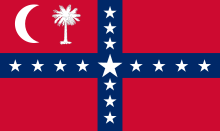
This, too, is a symbol of slavery — the original Confederate battle flag at left. And, it didn't really appear out of nowhere — note its broad similarity to South Carolina's flag of secession, at right, and the rectangular version was proposed as a CSA flag.

The "St. Andrews Cross" or battle flag has 13 stars, for the 11 seceding states plus the attempts in Missouri and Kentucky; South Carolina's 15 are for all 1861 slave states.

This shows, first, that the Confederate battle flag, while created for battlefield visibility, and for more distinction from "Old Glory" than the original Confederate governmental flag, the "Stars and Bars," that it was already being adapted to politics early on. And, when it was decided to move on from the Stars and Bars, for a more Confederate-looking flag?

This, "The Stainless Banner," incorporating the battle flag, became a symbol of racism on May 1, 1863. It was followed by "The Blood-Stained Banner" on March 4, 1865.  (The Stainless Banner is an all-white union, if  it's hard to tell.)

Given that the constitution of the CSA, as well as documents of secession of several Confederate states (including Texas), explicitly mention slavery as a prime reason for secession, there you are.

And, that is seemingly that, is it not?

Well, if you're the likes of William Lloyd Garrison, there were other symbols of racism. Ditto if you're a critic of some Supreme Court cases, like Plessy v. Ferguson. Or, of certain presidents, like Woodrow Wilson.

One of those images of racism, at least for some, whether today or in the past, is at left. The other, whose text begins with "We The People," and then called people enslaved by race "three fifths of all other persons" for census and apportionment purposes, nothing more, and most of the First Peoples as "Indians not otherwise taxed" and excluded from citizenship, is at right.

Indeed, Garrison called that symbol at right "a covenant with death" and "an agreement with hell." While hyperbolic, he's at least partially right, and it's not just the constitution itself. As Lincoln knew, and as this book and others document, the North had its own share of racism, and its own share of profit off Southern slavery.

None of this is to "excuse" the Confederate flag, in any of its forms. Or the racism behind it.

It is, though, to invite us to reflect on Lincoln's Second Inaugural Address, and his growth in recognizing that black people were people, even as he still had room to grow before his assassination.

Namely, this, reflecting on his version of "Divine Providence" affecting both sides in the Civil War. One need not be a theist to accept the broad outlines in this.
He now wills to remove, and that He gives to both North and South this terrible war as the woe due to those by whom the offense came, shall we discern therein any departure from those divine attributes which the believers in a living God always ascribe to Him? Fondly do we hope, fervently do we pray, that this mighty scourge of war may speedily pass away. Yet, if God wills that it continue until all the wealth piled by the bondsman's two hundred and fifty years of unrequited toil shall be sunk, and until every drop of blood drawn with the lash shall be paid by another drawn with the sword.
Just as Booker T. Washington called his autobiography "Up from Slavery," an "autobiography" of the US must be the same.

Speaking of such issues, whether Lincoln would have done THAT much better than Andrew Johnson on Reconstruction, I don't know. I do know it would have been impossible for him to do worse.

May 25, 2015

#MemorialDay, aka the #TeaParty national day of distortion

As you think about Iraq War or Gulf War veterans, especially those who were killed in combat, today, let's not forget how and why Memorial Day started.

It was created to honor the nearly 400,000 Union dead from the Civil War.

You know, the war that had the ultimately result of ending slavery.

The war that was fought over the right to slavery in the first place, an issue tea partiers will deny until they turn red in the face.

That’s despite the Confederate constitution mentioning the actual words “slave” or “slavery” several times.

Like this, from Article I:
Section 9
No bill of attainder, ex post facto law, or law denying or impairing the right of property in negro slaves shall be passed.
For one.

And this, from Article IV:
Section 2.
1. The citizens of each state shall be entitled to all the privileges and immunities of citizens in the several states, and shall have the right of transit and sojourn in any state of this Confederacy, with their slaves and other property: and the right of property in said slaves shall not be thereby impaired. …
 3. No slave or other person held to service or labor in any state or territory of the Confederate States, under the laws thereof, escaping or lawfully carried into another, shall, in consequence of any law or regulation therein, be discharged from such service or labor: but shall be delivered up on claim of the party to whom such slave belongs, or to whom such service or labor may be due.
For another.

And this:
Section 3.
3. The Confederate States may acquire new territory; and Congress shall have power to legislate and provide governments for the inhabitants of all territory belonging to the Confederate States, lying without the limits of the several states; and may permit them, at such times, and in such manner as it may by law provide, to form states to be admitted into the Confederacy. In all such territory, the institution of negro slavery as it now exists in the Confederate States, shall be recognized and protected by Congress, and by the territorial government: and the inhabitants of the several Confederate States and Territories, shall have the right to take to such territory any slaves lawfully held by them in any of the states or territories of the Confederate states.
For a third.

That's despite the declarations of secession of Georgia, Mississippi:
Our position is thoroughly identified with the institution of slavery-- the greatest material interest of the world.
South Carolina:

The slaveholding States will no longer have the power of self-government, or self-protection, and the Federal Government will have become their enemy. 
Texas:
The controlling majority of the Federal Government, under various pretences and disguises, has so administered the (laws, etc.) as to exclude the citizens of the Southern States, unless under odious and unconstitutional restrictions, from all the immense territory owned in common by all the States on the Pacific Ocean, for the avowed purpose of acquiring sufficient power in the common government to use it as a means of destroying the institutions of Texas and her sister slaveholding States …
 based upon an unnatural feeling of hostility to these Southern States and their beneficent and patriarchal system of African slavery, proclaiming the debasing doctrine of equality of all men, irrespective of race or color
And Virginia, all mentioning slavery, often a dozen or more times. More here. And here.

The reality of Memorial Day?
  

First, the Thirteenth Amendment, ending slavery:
Section 1. Neither slavery nor involuntary servitude, except as a punishment for crime whereof the party shall have been duly convicted, shall exist within the United States, or any place subject to their jurisdiction.
Section 2. Congress shall have power to enforce this article by appropriate legislation.
The first time the U.S. Constitution used the actual word, rather than euphemisms to shield thin Southern skins.

Then the Fourteenth, for civil rights for all: 
Section 1. All persons born or naturalized in the United States, and subject to the jurisdiction thereof, are citizens of the United States and of the State wherein they reside. No State shall make or enforce any law which shall abridge the privileges or immunities of citizens of the United States; nor shall any State deprive any person of life, liberty, or property, without due process of law; nor deny to any person within its jurisdiction the equal protection of the laws.
THAT's what Memorial Day is about. 

The real problem is tea party "Lost Cause" types don't want to admit that the South — and its ideology — lost, period. And, too many Northerners were too indulgent of them too soon after April 9, 1865, part of why we need a national Appomattox Day.

This is why it matters when we talk about who started Memorial Day and why — including black Southerners reburying Union dead with honor.

March 09, 2013

Thomas Jefferson, racist hypocrite

Master of the Mountain: Thomas Jefferson and His SlavesMaster of the Mountain: Thomas Jefferson and His Slaves by Henry Wiencek

My rating: 4 of 5 stars


This is at times a great book, and throughout, it's a thought-provoking and challenging book.

I couldn't quite rate it five stars, though, for a couple of reasons.

One is that he does appear to have committed intellectual plagiarism in not better referencing Annette Gordon-Reed's research on Jefferson's relationship with Sally Hemings.

Second is that, per some criticism, he appears to have vastly oversimplified the issue of Kosciuszko's will. On the other hand, Gordon-Reed has led the charge against Wiencek (more below), and he notes Jefferson's own son apparently was not unduly worried about Kosciuszko having multiple wills.

Third, per critique by Paul Finkelman, Wiencek may have been too kind to the younger Jefferson. Yes, he excoriated the slave trade at the time of the Declaration of Independence; yes, he pushed for a slave-free "Old Northwest." but, that was about it. Finkelman notes he was a "racist" and a "creep." While Wiencek looks "bluntly" at Jefferson's record, for some reason, he never uses the word "racist" in the book himself.

Fourth, he may, or may not, have oversimplified other things. Did Edwin Betts deliberately, or accidentally, omit things like whippings of small boys at Monticello's nail-making shop?

Overall, this book is at the edge of four stars, maybe 3.75, with allowances for everything above. And, not all the criticisms of Wiencek are right.

Take, for example, the "4 percent profit" statement. Wiencek shows it was more than a back-of-the-envelope calculation. That's based on things like Jefferson using slaves as collateral for loans from Dutch merchants, precision in to whom he rented out his slaves, the diversifying of economic activity at Monticello and more. That includes issues of Jefferson's instruction on how much and how severely to use the whip and more.

And, once he gets to the late 1780s and beyond, Wiencek does pick up to some degree on Finkelman's point of view.

Now, on to illegitimate complaints, in my opinion.

Complaints about him distorting the historical record at Monticello? I think James van Loewen, if he writes another "Lies ... " book about American history, would probably, and probably rightly, blast Lucia Stanton out of the water. Methinks she has a fair degree of Jeffersonian detachment, and doth protest too much.

Gordon-Reed? Other than the intellectual plagiarism, or whatever one should call it, I think she's full of hot air. She didn't romanticize the Thomas Jefferson-Sally Hemings relationship as much as Fawn Brodie did, but she romanticized it more than enough. Without using Finkelman's word "creep," Wiencek portrays him as being at least near that in his later relations to his own kids.

Ta-Nehisi Coates at Atlantic Monthly also says she's been way to charitable to Jefferson.

Per Coates, and myself, I reject Gordon-Reed's "presentism" claims. With George Washington, Edward Coles, the French Revolution (until Napoleon) and more, we have many, many white Americas and Europeans (don't forget the 1772 Somerset ruling in Great Britain essentially abolishing slavery in the Isles themselves) who knew slavery was wrong back then.

This all said, I'd like to see Finkelman write a book specifically about Jefferson himself.

As for the rest of this?

I'm suspecting antipathy from the "academy" toward a non-academic historian, just like Jared Diamond's new book has gotten from cultural anthropologists.


View all my reviews

December 03, 2012

Talk about getting Thomas Jefferson wrong

Corey Robin, even if he has written in The Nation, comes off as a conservative apologist for Thomas Jefferson, in an article that almost sounds as if George Will had written it.

Ignoring the reality of ongoing cruelty in both word and deed by Jefferson, documented in this NYT op-ed by Paul Finkleman, rightly titled "The Monster of Monticello," Robin basically tries to make Thomas Jefferson into Abraham Lincoln, first, and second, believe Jefferson's thought was frozen in amber after he wrote the Declaration of Independence in 1776.

His main claim is that Jefferson was worried about what would happen upon the event of black emanicipation and freedom.

Yes? Well, so was Lincoln. Per Finkelman and his NYT op-ed, the fact that Jefferson was focused on black freedom, not black slavery, doesn't lessen his cruelness as a slaveowner. A piece like Robin's would be better read for those who criticize Lincoln the man, or worry that Lincoln the movie is too hagiographic.

The critics, of the movie, the president himself, or both, also ignore Lincoln's genuine evolution on the issue. Jefferson, meanwhile, can only be described as devolving, not evolving.

As for Robin's appeal to Jefferson's words of the Declaration of Independence?

Jefferson wrote the Declaration of Independence 50 years before he died. Appealing to it wipe out a clear legacy of both later writings, and actions, which point in a clearly contrary direction?

Meanwhile, the Volokh Conspiracy tries to claim that because Lincoln, in 1858 comments about Jefferson, appealed to his sentiments? Lincoln's comments, too, were about the Jefferson who authored the Declaration, not the Jefferson who threatened to sell slaves "down the river," so to speak, etc.

And, don't forget he wrote the Kentucky Resolutions, which even more than Madison with the similar ones for Virginia, were the first articulated argument for nullification.

I do mean it about Lincoln, though. He was sincerely wrestling with a post-slavery world back in the 1850s, during the Lincoln-Douglas debates. No, he wasn't the most "advanced" person on racial thought then, but he was legitimately struggling with this issue more than Jefferson, because he was looking forward to slavery's eventual end, while Jefferson was engaging in hand-waving bullshit, to be blunt.

Between Jefferson being a hypocrite about miscegenation worries after having fathered multiple children via Sally Hemings (will Robin deny that next?), his nullification ideas (and his decades-long cowardice on not owning authorship) and more, he is arguably one of our five or so most hypocritical presidents ever, and that's saying a lot. 

Update: Robin thinks I've seriously misread him. Given that he has multiple posts on interpretation of Jefferson, explicitly attacks Finkelman, and has raised the eyebrows of other commenters than me, I think not. Also interesting that he references Notes on the State of Virginia without finding anything untoward about Jefferson there.  

May 14, 2011

The South originally wasn't a 'one-drop' land

In the latest installment of its "Disunion" op-ed series about the Civil War, the New York Times describes how racial lines were a bit more fluid in the antebellum South.

But, the thread of the end of slavery, and its rigid borders, changed everything.

Read the column for a how a Louisiana white family with black ancestors in its bloodline reacted.

January 15, 2011

Confederate California

No, this isn't alt-history. But, it's new to me. The Disunion "section" within the NYT's Opinionator column notes that, after its statehood in 1850, some Southerners surreptitiously brought slaves to California. And, a secessionist flag was briefly raised in 1861.

April 07, 2010

RIP Wilma Mankiller — but no hagiography

A great activist for both women's and Native American rights has passed away.

That said, even Wilma Mankiller wasn't perfect.

Descendants of Cherokee-owned black slaves remain excluded from tribal rolls, despite many of them having Cherokee blood, analogous to descendants of white-owned black slaves, and also despite many a Cherokee having a dash — or well more than a dash — of white blood.

Unfortunately, Salon's story says nothing about the struggle of the slave descendants for recognition, nor about Mankiller's role in denying them this status.

The story has its complexities, in that the "white father" government in Washington, after forcing the Cherokee to accept that slavery was over (in 1866! the Cherokee remained holdouts!) also tried to push them into accepting the freedmen as part of the tribe. That said, due to the amount of racial commingling already among the Cherokees, why they resisted this already back then, I don't know, other than to say this is yet more evidence that racism is not confined to Caucasians.