SocraticGadfly: OPEC
Showing posts with label OPEC. Show all posts

October 04, 2022

Wave bye-bye to those cheap gas prices — the why behind that

An OPEC+ oil production cut is coming right up, reports say.

This benefits two countries: Saudi Arabia, the leader of OPEC, and Russia, the +.

The Russian benefits are obvious: Increased pain on the West, along with, perhaps, letting China and a few other countries know they can't exploit its predicament too much. (Since Russia is also a net food exporter and Xi Jinping is blowing his top about Chinese food security, this has other angles, too.) Currently, Russian oil has been trading at as much as a 30 percent discount. So, tightening the market means the degree of discount will also drop.

The Saudis? Mohammad bin Salman, fresh off his international diplomatic immunity from being named prime minister, can keep Warmonger Joe Biden dancing like a fist-bumping yo-yo. This has added importance with the breakdown of a ceasefire in Yemen.

This is beyond the issue of simply addressing sagging gas prices.

The story above notes that purely domestic American issues had already brought a halt to declining gas prices in much of the country, though some stores here on the Red dropped a cent again in the last few days. It's ... interesting that Nevada (and I assume the story is overlooking Hawaii and Alaska) has the nation's most expensive gas outside of California.

And, although Inflationary Joe hasn't much reduced food inflation, even with the drop in gas prices, his chances of doing so decline even further with this. And, of course, Democratic Congressional political chances. (Hit the polls at right to offer your thoughts.) This will probably also further crimp the possibility of massive LNG exports to Europe this winter; my take on that is here.

Climate Change Joe, meanwhile, is talking about trying to limit American oil majors from exporting refined gasoline. Good luck with that one.

What about the Strategic Petroleum Reserve? Biden can still release more from it, but — and I did not know this before — due to various national and international legal obligations — it can't go below 250 million barrels. It's just short of 420 million now. 

In other words, at Gas Pump Joe's rate of 1 million barrels a day during past releases, he's got a bit under six months' cushion left. Vladimir Putin will still be rolling dice at that time.

And, the real issue is not just the SPR, but the psychology behind it. As Biden's margins get narrower, getting the SPR closer to its 250 million barrel flatline, the market-influencing power of releases wanes.

Will oil hit $100/bbl, as this story speculates? I doubt it, at least not hitting there and staying there, but trading in the $90-100 range? You bet.

Meanwhile, a final thought on the first story. So-called "NOPEC" legislation to sue OPEC for market manipulation? Even if it DID pass Congress, it's nugatory. How would the US enforce it? Especially since it has opted out of so many international institutions. And, if it tried to, Saudi investments in US defense kit would dry up and blow away to Beijing.

In similar veins of stupidity, first referenced by me a week ago, is the EU's attempt to put a price cap on oil that originated in Russia, as a backdoor sanction. Here is how stupid that is.

July 17, 2022

Saudi Peak Oil is here!

Or, to be more precise, the announcement that is will be here in 2027 is now here. That's straight from the spavined mule's mouth of Muhammad bin Salman, who announced as part of the Biden Suck-Up Summit that Saudi oil production would max out in 2027 at 13 million barrels per day. OilPrice notes that Saudi Aramco can't ramp up faster than that. It also notes that other Gulf states don't have as much spare capacity as they've often claimed in the past. 

Sidebar: This why the Saudis say they won't seriously ramp up production without the agreement of OPEC+. Remember, warmongering Democrats, that that "+" is Russia. And, per that OilPrice peach, Riyadh and Moscow seem to be, and claim to be, on relatively good oil terms right now.

Even if you're not one of the Merikkkans who think oil is a divine righ, know that this is another issue where I as a third party voter don't see much daylight between Rethuglicans and Democraps.

For example, Obama's vaunted EPA gas mileage standard increases? First, they let SUVs continue to go by lesser pickup mileage standards and even allowed the gap between the standards to widen. Dear Leader also allowed a massive loophole for flex-fuel vehicles. And, how many of you actually put E85 in your Ford Edge that's labeled as dual fuel? Here's a list of that and other loopholes. Note that that link contradicts neoliberal Dems who say that Europe and Japan rely primarily on much higher fuel taxes to force more efficiency; actually, they also have mileage standards that beat ours. More here on what's wrong with the E85 loophole and the calculation behind it.

And, related to THAT?

Sidebar 2: Democrats' ripoff version of the #GreenNewDeal officially has "oily" hands, and like Dear Leader's energy strategy, is "all of the above.

“This president seems to be incapable of doing any of the hard work which needs to be done for the American people,” said Corbin Trent, co-founder of the No Excuses PAC and former spokesman for Rep. Alexandria Ocasio-Cortez. “We need an all-encompassing US energy policy … a Green New Deal — which includes gas and oil.”

See paragraph 3, above. (Of course, per new DNC policy, he's pushing against an open door.)

And related to THAT?

Sidebar 3: Trent, also founder of Justice Democrats (blech) has shown an amazing ability for grifting while claiming to promote pergressuve Dems. He probably learned some of that from his boss, whose "origin story" has gotten a critical examination in these pages before."

==

Is this "real," or just MBS posturing?

Years and years ago, I was a regular commenter at, and occasional contributor to, the old Oil Drum website on peak oil issues. Still remember Jerome á Paris, Going West and others. One big item of discussion there on a regular basis was just how much, and how quickly, the Saudis could ramp up Ghawar. We have an answer, it seems.

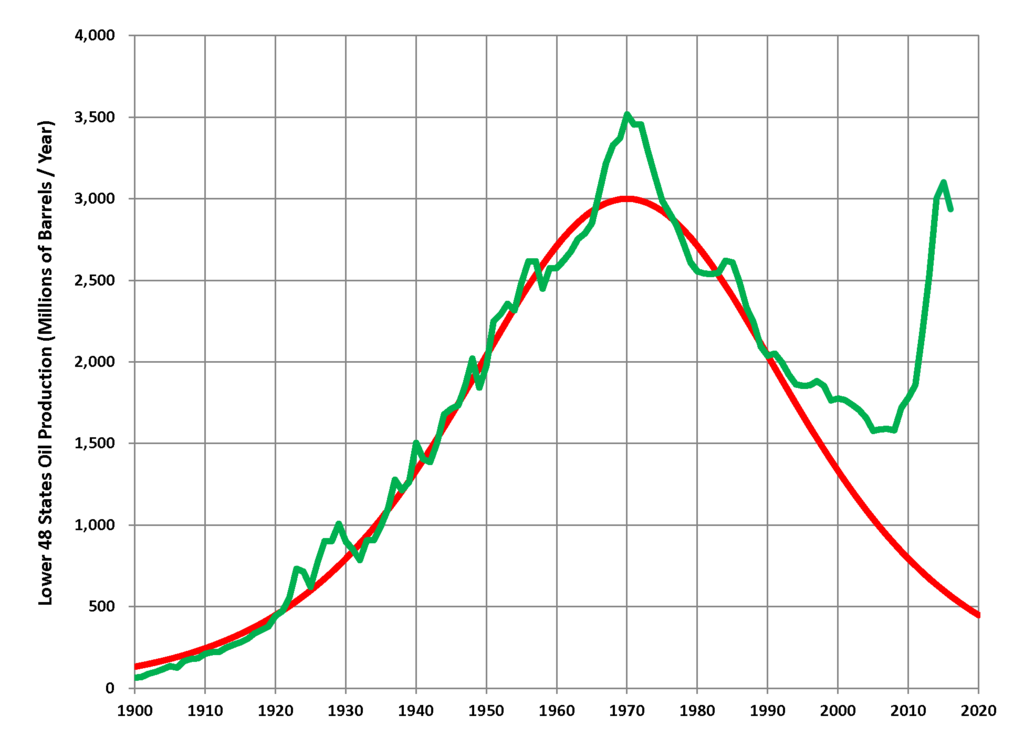
As for the theory of Peak Oil? King Hubbert based his calculations on rational economic actors, but capitalist greed doesn't work that way. The Wall Street quants et al who lost their shirts in the Permian, along the "tragedy of the commons" greedy idiot drillers, did nothing to disprove peak oil. Beyond that, per Wiki's chart, we never actually have passed the 1970 peak anyway. (Red is his idealized projection, green is actual.)

World peak oil, as also discussed at The Oil Drum, was kind of a mug's game due to lack of transparency in most OPEC nations and beyond.

June 02, 2022

Russia-Ukraine, Week 11B: Don't cream your panties about Saudi oil, Blue Anon

Reuters, referencing a semi-breathless Financial Times piece (and FT itself if you subscribe) should be read carefully.

The Saudis will ONLY pump more oil, at least a significant greater amount, IF Russian production falls significantly. Unless Warmonger Joe sells Zelenskyy long-range bombers that can hit the Caspian, let alone West Siberian drilling, that output ain't falling significantly any time soon.

So, the EU can claim it wants to cut itself off from Russian oil by the end of the year, but SOMEBODY's going to have to buy this.

Now, by the time you read this, we'll be seeing more of just what actually has been promised in stone and what's in wiggle room. The only thing officially scheduled was a modest increase of 430K bbls/day, which as that piece notes, OPEC members will probably struggle to meet right there. I'll eat my hat if there's anything much more than that.

So, going by West Texas Intermediate, average prices may fall below $110. Not below $105. Period. IF OPEC can find bigger increases, it's not happening until the end of July at the earliest

I wrote the above last night. And, this morning, a new, not-paywalled FT piece confirms me. No big production hikes at all, and the July and August ones will only be moderate, 650K bbls/day instead of the planned 400-430. And, international oil prices, which had fallen on the original news, crept back up a bit.

(And, after I blogged this, US gas companies spit in our faces with another 20 cent hike as WTI approached $120/bbl. That said, that's below the $147/bbl of 2008, even without adjustment for inflation. Gas prices stayed lower, though, showing this was an oil speculation bubble that quickly burst.)

So, enjoy losing 50 or more House seats, BlueAnon. (See poll at right.)

And, remember that Biden not just talking about what should be in peace talks, but actually calling for them, like the Goldilocks Three Bears (plus Pope Francis) will lower oil prices.

October 07, 2020

Fricking frackers shooting themselves in the foot again

In the oil patch, TWO factors happened this year: COVID and OPEC+.

Although the latter's actions, of Saudi Arabia and Russia losing trust in each other, and both wanting to bury American frackers, of "opening the spigots," did technically happen after the start of coronavirus in China was driving oil prices a bit lower, it was largely independent of that.

And, although they partially pulled back, and partially in response to a Trump request, those days are over, too.

So are the days that hinted that American drillers, especially frackers, would learn from this. (Have they ever in the past?)

Oil production has started inching up again in Texas.

Even as WTI prices fell back below $40/bbl.

Are the two correlated? Most likely.

The increased production is probably not the only thing driving the price slip, or maybe, to put it another way, it by itself has not caused the degree of the price slip. But, it's a factor.

Wayne "God loves free markets and Andrews Texas" Christian, head of the Railroad Commission, dissed going back to its 1930s production control roots this summer, saying North Dakota and others wouldn't play along.

Left unspoken? Christian not asking for federal, nationwide production controls. Now, that said, between the PPP and elsewhere, lots of oil people both big and small got government prop-up money. But, once again, the lack of a national energy policy was the bottom line. The Federal Energy DE-Regulatory Commission continues to to just that.

Meanwhile, as readers of this blog, DeSmog Blog and elsewhere know, frackers have a lot of money on the books to Wall Street banks, a lot of it coming due within nine months or so. So, they're looking for any angle possible. 

What they really should be looking for is a bigger sucker to buy them out.


Of course, since they're getting We the People to pay for their abandoned well clean-up, they're probably hoping for more PPP-like help from suckers of both duopoly parties in DC. That DeSmog Blog link refers to their loans on the books, and self-bonding on well cleanup, among other things.

Specific to fracking, it notes that more wells, deeper wells, and shorter-lived wells (any regular reader here knows that I've written before about how part of the reality behind the fracking hype is a short-term production spike that then quickly declines again) means more orphan wells.

Also per that link, the real problem isn't suckers in DC claiming to represent We the People. It's suckers (or willing sellouts) like Wayne Christian in Austin, and counterparts in places like Denver and Santa Fe. If frackers can dump old wells on state agencies, they will. Period.

Remember that when your neighbor bitches about cleanup after abandoned wind turbines. Especially if they have a gas lease.

April 21, 2020

Glenn Hegar bemoans the oil price catastrophe;
still no Abbott call for a special session


For years, I've bemoaned one of Texas' quieter GOP lying sacks o shit, Comptroller Glenn Hegar. He's been basically a one-note liar, and that lie has been that the Texas economy is not oil-dependent. And, to the degree many Dems in Texas have played along, this is a duopoly lie.

Well, Monday evening, after the May futures contract for West Texas Intermediate went negative and punched him in the face, Glenn's lying chickens came home to roost and he pumped out this presser:
(AUSTIN) — “Today’s market activity was unprecedented and likely indicative of very limited storage capacity. May contracts traded well into negative territory as the market prepares to shift focus to June contracts. While down somewhat, June contracts traded in a relatively stable range. While this unprecedented volatility is concerning, the greater impact to Texas will come if demand remains historically low for a prolonged period of time and supply gluts continue to strain storage capacity.
“Severance tax reductions would primarily affect the state’s Rainy Day Fund and State Highway Fund, and to a lesser extent general revenue available to meet budget needs. Contraction in the energy industry also will affect other sources of tax revenue, including sales and franchise taxes.
“The Texas budget is based on the average price of oil in each year of the biennium, thus daily market activity doesn’t significantly affect revenues, which are forecast based on average prices rather than spot prices or prices for specific futures contracts. That being said, given the historic nature of today’s market moves, we are carefully monitoring trading as June contracts come into focus. Should prices remain depressed over a long period of time, we anticipate the impact will be reflected in a reduction in the revenue forecast we'll be releasing in July." 
OK, let's look under the hood.

The first sentence is a "no shit Sherlock."

The last sentence of the first paragraph is the start of hand-waving. That is because traders, as well as the general public, weren't looking at June futures. It's hand-waving in another way. As I blogged six whole weeks ago, already seeing the oil economy blowing up from both the early coronavirus news AND the OPEC+ disintegration — disintegration happening in part due to a global oil surplus, the surplus is going to get bigger. Already a month ago, OilPrice.com, per that blog post, predicted 3 million barrels a day by the end of June.

At that same link, I called you out as a lying sack o shite then for claiming "the fundamentals of the Texas economy remain strong."

And, the fundamentals were weak then and abysmal now.

First, the OPEC+ cuts. They've already been at least partially priced in the market, per this piece. It also notes that OPEC, Russia and Mexico can no more achieve a 20 percent cut in a matter of days than the US can. It will take weeks to safely shut down that many wells. Also per that piece, the 20 percent cut includes previously pledged cuts and other things.

Reality? The global trim will be 1/3 the projections.

First, part 2. That same piece notes that producers right here in my and Glenn Hegar's Tex-ass are refusing to budge on making big cuts today, tomorrow or weeks from now. That's because the independents have their backs against the wall and even small cuts on marginal wells, on either fracked or conventional oil, will kill them. (Also, per the "hot oil" days of the 1930s, I do agree that it would be "interesting" to see the Railroad Commission try to enforce any cuts.

Third, you have the "energy independence" bullshitters like this retired Army colonel who should know better.

Second paragraph? Standard government presser pablum. But, here in Tex-ass, it's also being used as a "marker" for next time Democrats in the Lege want to tap the Rainy Day Fund.

Third paragraph.

May futures contract prices as of end
of day, Monday, April 20.
Average prices? Many people are predicting the spot market will regularly have $15 oil next month. I expect June futures to be below $20 well before the late-May call. And, Chicago Merc has July and August futures below $30. Indeed, as of noon Tuesday, the June futures had dropped below $15.

And worse yet as the day wore on. By the end of day Tuesday, the June crude oil option was $13 and change and ALL 2020 MONTHLY OPTIONS were below $30.

Dude? You need to release an updated revenue forecast before the end of May, NOT July. Look west to New Mexico.

Speaking of, Gov. Strangeabbott needs to look west, too, and call a special session of the Texas Legislature. With the two-year budget cycle, no off-year short session unlike NM, and with the Lege not having the constitutional power to call itself into session, there WILL be blood for oil — blood of the people who will be most hurt when the Lege whacks away in 2021.

Meanwhile, a bigger bag of wind, and a big bigot, Railroad Commission Chairman Wayne Christian (name fits as in Religious Right wingnut, hates #TehGay, etc.) has appointed a capitalized Blue Ribbon Task Force for Oil Economic Recovery. It's an entirely industry-led group. It will surely refuse to address the main problems with drilling even before the coronavirus, namely, as reported here before, that many wells:
1. Are producing something closer to condensate than oil;
2. Are cannibalizing other wells;
3. Have an increasing water cut.

But, it's not just oil. As Wall Street on Parade notes, commodities futures of all sorts are collapsing. Notably, ag prices. I've read about Californians plowing under lettuce. Now Floridians are plowing under truck farm crops. Which means that Texans surely are.

November 18, 2016

The Saudis have oil supply 100 percent backward

As various general news media and oil-watch outlets heat up over Saudi Arabia's attempt to get an oil production freeze from OPEC members and, it hopes, from Russia as well, looking back in hindsight, maybe Ali Al-Naimi should have gone back to old Saudi ways rather than venture into a brave new production world from which his successor, current Saudi oil minister Khalid al-Falih, is trying to pick up the pieces.

That said, it wasn't all his fault. His predecessor, Ali al-Naimi, recently noted that, in late 2014, as an oil oversupply already loomed, fellow OPEC members refused to tighten the taps. Al-Naimi started the decision to keep oil flowing without taking all the hits on cuts itself, and even pumping more.

Al-Naimi led the Saudi oil desk for 20 years, and in previous world, or OPEC, gluts, as the biggest producer, and for his whole time, the so called "swing producer" for the world, would tighten its own taps only. But, largely to smack down US shale oil, he said no.

I think he got it totally wrong.

He should not just have done previous Saudi-style cutting, but even more.

One of the elements of American shale oil is that its success is somewhat a will-o'-the-wisp and certainly short term. Yes, fracking shale formations will produce more oil than conventional drilling, and in tight formations will produce oil where it couldn't be gotten with a conventional process.

However, it doesn't produce that much more oil in wider shale formations, let alone in fracking to improve on non-shale drilling. It does produce some more, but not an incredible amount.

Rather, part of its dazzling effect is simply to increase the flow rate of oil in production. That's it.

If the Saudis had been smart, they would have whacked their production twice as much as in the past, let the price hit $100/bbl, and let many of America's newly-fracked oil wells pump themselves halfway dry in half a dozen years, if that long.

KSA then swoops in to pick up the pieces.

That's IF a "little" new shale oil find in the Permian doesn't totally upset oil production applecarts.

December 09, 2015

#Oilprices: Searching for new lows?

Regular readers may take note of the quarterly poll on oil prices I've been running here the past couple of years. Having been at two places in the heart of the Permian Basin, one near the heart of the Barnett Shale (yes, primarily gas these days, but also oil), and one at the edge of the Barnett Shale, I know a little bit about oil.

That said, while oil prices have three weeks to rebound, my current poll doesn't have a vote for as low as they are now. Oil fell below $37 a barrel on Tuesday, for West Texas Intermediate, before ending at $37.51.

And, it could get worse, if you're not a driver, in the short term. How worse? Something like $32 a barrel ... or lower. Commodities futures speculators are about to have to eat their hats, it seems, as places for storing surplus oil are running out.

So, what's the longer-term outlook? (By that, I mean the next 2-3 years, not long-term.)

Tom Kloza of OPIS, one of the more rational people in oil commodities analysis, thinks a fair amount of rebound could start happening in the second half of next year, and we possibly get above $60 a barrel by early 2017, as his video at the second link shows.

Personally, color me skeptical. For one thing, other analysts and Wall Street banks disagree with him. And, Energy Secretary Ernest Moniz is among those saying that, so far at least, U.S. oil production's retrenchment has been slow and limited.

Beyond that, Kloza does mention in passing the possibility that something like Brazil devaluing its rial, its currency, as something that would drive oil prices into the $20s, but doesn't dive into that in great detail.

That said, speaking of devaluations? It seems to have helped Russia weather the storm somewhat. Meanwhile, the Saudis are also working on getting more into refining and its added value. More on both countries' situations here.

August 18, 2015

#Oilprices continue to tumble to $40; fallout for Texas and #txlege?

Seven weeks ago, when I created my latest quarterly poll on oil prices, as shown at right, I was definitely being more conservative than Wall Street bulls. But, I thought I had potential price ranges pegged about right.

Little did I know.

Oil prices have given up $15/bbl in that time period, falling to a low not seen since the Great Recession.

Neither the bulls nor I foresaw one thing: that China would officially admit its economy is struggling. That, in turn, sawed some floor from underneath the bulls and has become a bit of a self-fulfilling prophecy.

Nobody knew for sure about any Iran deal at that time, though I expected something to happen, and bulls certainly should have. But, maybe I should have made even more allowance for that.

ISIS turned out to be — so far — overstated as a threat to oil prices.

Other market fundamentals, such as Gulf states within OPEC, above all Saudi Arabia, seeking to control supply and pricing, remain unchanged. So, too, does current North American unwillingness to let that fact fully take root.

That said, I and other bears appear to be right overall.

Analysts are predicting supply will remain high and prices relatively flat not just for the rest of this year, but two-three years ahead. That's in part because, sometime in that period, but nobody is sure when, more Iranian oil will be coming in market. (Maybe this is why Texas Ag Commish Sid Miller supports "Muslim peace" with nukes; see here for more.) It's a more severe version of George Bush's idea 15 years ago on oil price control.)

Meanwhile, a sub-$40 floor for oil prices is being discussed by many people.

What's this mean locally?

1. Texas state-level elected officials need to pull their collective heads out of their asses. (But they probably won't for some time.)

2. This is more clear proof that Texas needs an every-year Texas Legislature. It's ridiculous that the only way to deal with this is via a special session, and that in Texas, only the governor can call one.

3. Banks and other lenders will be calling in more loans, which could have a domino effect.

4. Investors, per that link above, will remain skittish about oil because of volatility.

5. A recession in Texas is more likely unless No. 1 happens, and soon.

==

There's other talking points here.

1. Even if the US, or at least Texas, were a unified, state-controlled market, it's still not Saudi Arabia, despite puffery of the last couple of years.

2. Besides the Saudis as the biggest swing producer, China must now be viewed for the next 18-24 months as the "swing consumer" par excellence. The US economy is so big, and so oil-dependent, that a stutter won't affect demand too much. But, a true recession in China would probably ding world oil demand pretty good.

3. What's continued $40 oil mean in Russia? I certainly don't want to poke Vlad the Impaler Putin with a sharp stick, but it's a very serious issue.


June 02, 2015

Don't expect much more change in #oilprices

Yes, the oil market can be volatile at times, with commodities traders and their hoarding against future shifts adding to the mix.

But, OPEC's strategy, or more specifically, the strategy of Saudi Arabia and other Arab Gulf core members of OPEC, to play Whack-a-Mole with US shale production, seems to have worked, and the June 3 OPEC meeting is expected to say the course. That's even as OPEC members are currently pumping 1 million barrels a day above targets. And, as US oil production hit a 43-year high, indicating Whack-a-Mole may come back up, especially if it's true that many of the idled/capped wells were already in decline, which of course is a big issue with shale wells, the narrowness and steepness of their production curves.

Yes, the US has plenty of fracked-and-capped wells ready to restart production, but the forced cuts in shale production have had their effect. And, while Western oil companies may squeeze a little more efficiency out of future well drilling, more of that's likely to come in the pricier offshore exploration.

Through the rest of the summer, I'd venture West Texas Intermediate trades in a band of roughly $59-$66.

Indeed, once OPEC's lesson-making sinks back in again, oil prices might even fall.

February 23, 2015

How long before oil supply hits equilibrium?

That is, of course, a major question right now.

Besides particular wells in various "tight" oil formations, like the Eagle Ford in South Texas, the Wolfberry in the Permian Basin and the Bakken in North Dakota, that will continue to produce because they've already been drilled, the other big controlling factor is a place called Cushing, Oklahoma.

That's where a nexus of North American oil pipelines meet and empty their content, if it doesn't have a different immediate final destination, into a complex of storage facilities.

Storage facilities that are filling up rapidly because those already-developed oil wells continue to produce, and at a high initial rate, like most shale oil wells.
"With total crude stocks now about 425 million barrels and Cushing north of 46 million barrels, WTI is looking increasingly mispriced high above $52 per the April contract," said Jeffries Futures analysts in a note to traders.
Indeed, the note says that some commodities futures traders will probably bet on oil going higher with another drop in the rig count.

Folks, that means nothing, for the reasons just noted; we still have excess supply in current production, and that's probably not going to change for a few months. Meanwhile, producers in the US are scrambling for other storage facilities as Cushing nears being filled to the brim, currently at about 80 percent.

Unfortunately, people who write for websites like Slate, which should be hiring or retaining people that know better, someone like Daniel Gross, who puts himself out as a brainy business and investment consultant, is clueless about oil production, as shown here in Slate, believing (I guess, it's hard to tell for sure), that you just shut off a well, like a light switch, after it starts producing, ignoring the problems with capping and respudding, especially in shale oil, and also ignoring the problem with "lease-to-drill" issues. Admittedly, those are more punitive, or have been, with gas rather than oil, but can't be ignored in either sector.

The fact is that oil and gas, as vital commodities, are non-solids. One can stop digging at a coal mine (or an iron ore mine for steel) quite easily. One does not just "shut off" an oil or gas well.

Of course, many speculators are betting they can sit on this crude long enough to wait out the continued surplus, and then sell at higher prices.

Probably not. West Texas Intermediate, currently in the low $50s, won't rise more than $10/bbl for six months, maybe longer. And other storage facilities may also be full by then.

Gross then shows even less understanding of the oil patch with this:
What we’re seeing, I’d argue, is an example of yet another type of American business exceptionalism.
No, it’s nothing of the sort. That said, some oil companies are gambling that they can use this to force new market efficiencies in their production of tight oil, and thereby stay even with the Saudis.


I’d bet, just as much as futures speculators are betting on being able to round up adequate storage at Cushing or elsewhere, that both Daniel Gross and said oil companies would be wrong. As rain.

That said, I have little sympathy for oil futures speculators who may well be betting wrong, unless they get a very favorable, and long, lease contract.

I discussed some of this (with less detail, and with skepticism about President Obama's backbone) two months ago.

That said, per the graphic at left, right now, it's definitely unprofitable to mine for tar sands. And, contra former Texas Speaker of the House Tom Craddick, and perhaps contra claims that $45 is the break-even point here in Texas, as I previously blogged, right now, it's borderline unprofitable to be producing oil here in Texas, unless it's what's left in conventional plays.

That graphic comes from "the letter O" in an A-to-Z encyclopedia of the current oil situation from Canada's newsmagazine, Maclean's. The whole encyclopedia is well worth a read.

So, Daniel Gross? Even if US producers squeeze a full $10/bbl of "efficiencies" out of shale oil production, it will still cost them more than Mexican oil production. They could squeeze out $15/bbl and it would cost as much as Libyan oil production.

They could squeeze out $20/bbl in "efficiencies" (which no way is happening) and still cost more than the OPEC average, and still cost more than $10 a barrel more than the Saudis' average cost.

So, Daniel Gross, and others who think like him? Buy.A.Clue.

Meanwhile, the International Energy Agency expects crude prices to average $55/bbl for this year, and not to get above $70 for some time. Oh, and $100 oil? Not even on its current horizon.

The IEA story is worth a read right there. Going by Brent prices, which it expects to only get to the low-mid $70s by 2020 (yes!), this is not a one-year slump, it's potentially a multi-year readjustment.


And, the IEA is right to be concerned. Its U.S. counterpart, the Energy Information Agency, says current stockpiles are at an 80-year high for this time of year.

So, major new shale field work is likely just going to have to wait until current shale wells play out. That said, given predictions that both the Eagle Ford and Bakken might peak by the end of 2016 (which the current supply glut has probably pushed back a year or two) by 2020, things may pick up more and more. In the meanwhile, the US could be facing the biggest slump since the 1990s era after the end of the Iraq War.

Cheaper fracking sites may be profitable if $45 is indeed a break-even point, but newer exploration isn't going to happen in any great amount, if the IEA is right — because there will be no demand for it. US EPA gas mileage requirements will continue to rise. Older cars will come off the road in Europe and the US. Driving miles will remain flat in both countries. To the degree emerging economies buy cars, it will be inexpensive, economy ones with better fuel mileage than ever.

As for geopolitics? Russia as we know it can't live in $70 oil. Yes, it is still technically profitable at that point, but with the national budget highly dependent on oil revenues, that's not high enough, not if it's lasting 5 years. Either Putin finishes the move to full dictatorship, or he's thrown out of office well before 2020. More thoughts on this in a future post.

January 15, 2015

$40 oil, or why Glenn Hegar could be even wronger than rain

I've already dissected how I think Texas Comptroller Glenn Hegar's biennial budget estimate is probably $2 billion too high, if not more. (See new poll on right to vote on where you think oil will be on March 31.)

That said, that was based on the possibility that oil would not get above the low $50s in the first half of this year, and not break the middle $60s before the end of the year.

Well, what if even THAT was too optimistic?

What if oil sits in the low-mid $40s for 4-6 months, and doesn't break a flat $60 on a regular basis until the end of the year? That's especially if market psychology (as well as general first-quarter lulls) says  "keep it there."

The EIA has also weighed in, expecting the average 2015 price to be about $55.

What if even THAT is too optimistic. What if, per new estimates by British Petroleum, oil stays below $60 for three years?

Oops in spades. And that's the starting point of this post and some speculative thinking.

Add in that even more flush U.S. shale oil operators may not have money to buy out the weakest, at least not right away. Add in that major banks, both Texas-based and even bigger national players, are likely to tighten lending wallets, especially on "market mentality."

Add in that it, per the first link, with more info here, could take 4-6 months to soak up most the current excess supply.

That's especially true when, per the first link, nobody in the US has actually started sopping up any excess yet:
Oil output, however, is still at a record level. In the week that ended on January 2, when the number of rigs also dropped, it reached 9.13 million barrels a day, more than ever before. Oil companies are only stopping production at their worst wells, which only produce a few barrels a day – at current prices, those wells aren't worth the lease payments on the equipment. Since nobody is cutting production, the price keeps going down; today, Brent was at $US47.43 per barrel and trends are still heading downward.

So, yeah, 4-6 months is probably the correct time frame, for, let's say, mid-40s prices. Well, the state of Texas, Glenn Hegar, and even more so, the one responsible adult running Texas government, Speaker Joe Straus, had better hope that 4-6 months — and not something worse — is the correct time frame.

Because we haven't tackled one last point. 

And, the biggest issue. Financial reserves, not monetary ones.

The petrostates of the Middle East, in general, are flush with cash and can afford to burn money for some time. And, Saudi Arabia can really afford that much burning. Plus, some of the Gulf states have lower per-barrel prices than it.

Russia is also a petrostate, but cannot afford such money-burning.

The US is not a "petrostate," even if it's producing as much or a bit more oil than Saudi Arabia.

Publicly traded companies have shareholders to whom to answer, and debt to service to third parties — those Texas and national banks. Privately traded companies still have debt to service.

Yes, both of them also have leases to keep active. But, smaller companies, per my note above, may have to take a hard look at their lack of financial reserves, and negotiate lease buyouts.

Or, like subprime home mortgage holders facing balloon notes, some of the smaller oil companies may have to swallow even harder and do the equivalent of tossing the front door keys on the kitchen counter or in the mail slot.

That's what could be afoot. And, if that's what's up?

Well, in that case, Hegar's biennial revenue estimate could be off by $3 billion, not $2 billion. Beyond a deepened loss of oil and gas revenue will be lost sales taxes from oilfield-related businesses. And, there will be new unemployment claims, as the layoffs are already starting. And less retail, dining and entertainment spending.

Meanwhile, a note to the American Petroleum Industry: now is not the time to be greedy on a wish list.

That said, I'll end this with one last thought. Older Texans remember the savings and loan debacle of the 1980s. I'm not saying that this will be anything like that. But, as compared to previous oil price slumps, because shale oil requires more investment, political leaders should not bank on any "rosy scenarios" offering easy relief. And, they should doubly not bet on frivolous tax cuts that are based on "rosy scenarios."

POSTSCRIPT: What if what I wrote above is itself still too optimistic? There are summer 2015 futures contracts out there, already, for $20/bbl oil.

Meanwhile, Boone Pickens, per this piece, either has a "trick oil knee," or onset of some age-related mental decline or something else, if he really thinks oil will get back to $100 within 18 months, let alone 12.

Pickens has probably also been trumped by the biggest drop in active rigs in six years. The fact is that this is different than 2009, where the Great Recession cratered economies. Yes, there seems to be new signs of slowing growth in both Europe and China. But, not THAT slow. This is still mainly due to an industry-created surplus that's been building for six months. It's going to take 3-4 months to cut the spigots back enough to where that surplus can be mopped up over another likely 6-8 months. So, that's 9-12 months out before we're back to June 2014.

And, Texas Monthly is now weighing in, saying there's a fair possibility of a 1980s-style full oil bust.

December 09, 2011

Obama: Jobless could hit 8%

That's the claim Dear Leader will make on "60 Minutes" Sunday, according to CBS transcript excerpts.

How realistic is this? With what caveats? And, what would that mean for his re-election?

The last first.

No-brainer against a wingnut. Solid winning odds against a Romney, unless the Mittster actually shows some creativity somewhere.

Now, the first and second.questions.

It's moderately realistic. If hopes get up, more people who have removed themselves from job hunting will get back in the game. My guess? September 2010 will be at 8.2 or 8.3 percent. Still improvement. Some increase in hope. Obama will take it and, of course, spin it.

Speaking of "spin," how much of this will be in the interview?
“For individual Americans, who are struggling right now, they have every reason to be impatient. Reversing structural problems in our economy that have been building up for two decades, that was going to take time. It was going to take more than a year. It was going to take more than two years. It was going to take more than one term. Probably takes more than one president.”
Reversing structural problems? This from the man who has given the back of his hand to Occupy Wall Street? From the president who rejected calls for direct jobs programs as part of his stimulus package? From the health care president who let insurers write much of Obamacare? Not to mention the man who's repeatedly caved to Republicans. AND, the president who thinks more people going to college is the answer when, in many cases, we have a glut of college grads right now.

Puhleeze.

The caveats? I mentioned one already, more people looking for work again. Others include the eurozone and oil prices. I think the economy can still limp on at up to $110/bbl, but not above that.

That, in turn gets back to what many Peak Oil watchers have been saying, that whenever the whole world seems to start to ramp up at once, it gets tripped up again by surging oil prices.

So, Obama's re-election prospects are in the hands of OPEC, followed by China and the EU, quite possibly. We know there will be no new U.S. structural reform to help.

June 25, 2011

More on the maybe not-so-dumb Obama-IEA oil dump

That joint agreement by the United States and the International Energy Agency to release crude oil from strategic petroleum reserves? The one that had everybody scratching their head over its timing?

Well, there's more to it. As in, this may have been the equivalent of a pool bank shot, primarily involving Washington, the EU, speaking through the International Energy Agency, ... and the Saudis.
As early as May 11, Mr Obama telephoned King Abdullah of Saudi Arabia to “discuss bilateral issues”, according to the Saudi press agency.
Boom ...

And, this wasn't a spur-of-the-moment thing:
For three months, dozens of senior oil officials from the US, South Korea, Germany and Japan worked secretly to execute what was one of the most daring moves by the International Energy Agency since its creation in 1974.
And, that's about the time we first started bombing Libya, on the usual delusional American belief that we'd topple Gaddhafi in a week or two.

There's one "interesting" part. In a story about how the Commodity Futures Trading Commission is investigating "suspicious" trades in oil just before the decision was announced, it notes the Saudis had already agreed to a production increase.

Maybe the White House thought it would take too long. Or that it would be of too low a quality compared to Libya's vaunted low-sulfur crude.

Or maybe all involved wanted to send a double-slapdown message to ... ohhh ... Iran and Venezuela?

Per the FT article linked at top:
In early May, Mr Obama dispatched a team of senior advisers to the region, including Michael Froman, White House deputy national security adviser, Daniel Poneman, deputy energy secretary, and Neal Wolin, deputy treasury secretary, for talks with Riyadh, Kuwait and Abu Dhabi.

Washington found the Saudis willing to ensure adequate supply.

The IEA nonetheless decided to send a clear message to the market that it was ready to act. On 19 May, at the conclusion of a regular meeting of its board of governors in Paris, the agency said: “We are prepared to consider using all tools that are at the disposal of IEA member countries.”
Venezuela and Iran, along with Algeria, were the three hardliners in the most recent OPEC meeting against raising production.

At the same time, Western nations didn't want to look like this was being done for too narrowly economic reasons, but, after the Saudis couldn't "carry" OPEC with them, decided to act. Japan, Britain and South Korea were other major "movers" on getting the IEA to act.

The primary beneficiary? Most of Libya's oil, of a very high quality, goes to Europe. So, even though the White House started the ball rolling, Europe had good reason to jump in, via the IEA.

The U.S.? Well, analysts as far away as Hong Kong are saying this will be the gateway for more "quantitative easing," but by different name and means. In fact, Forbes calls it QE2.5. If that's the case, and if it actually gets Obama himself, not just Fed Chairman Ben Bernanke, to do something more in the way of stimulus-like action, then that's good.

September 10, 2009

OPEC – don’t dump climate change on us

That message, not any major changes in output, was the big news from Wednesday’s OPEC meeting.

Rather, I would think that climate change initiatives would benefit OPEC members. They’ll get a steady, longer-term oil price, which may bring technology to squeeze a few more barrels out of aging fields while also given them more time to diversify their economies.

December 02, 2008

Is OPEC imploding?

Jim Jubak has the answers to both questions.

Shorter version? Yes on the implosion, and no, especially assuming Peak Oil is lurking, it’s NOT good for us in the longer run.
If you believe in some version of peak oil, which I do, then a post-OPEC free-for-all in the oil markets looks like a disaster. As it becomes more and more expensive to extract conventional and unconventional oil, the world is already looking at a bad case of underinvestment. The International Energy Agency has warned that a huge supply crunch awaits the world on the other side of the current supply glut because of underinvestment in new supplies of oil. Lower oil prices would just make that underinvestment worse.

Read the full story for more on Jubak’s answer to Question No. 2, as well as fallout within OPEC, and the Russian oil bear outside, on Question No. 1.

July 29, 2008

Oil will NOT be $78 a barrel

I don’t care what OPEC President Chakib Khelil claims.

Khelil is right that geopolitical tensions have some influence on oil prices. But not that much.

As I blogged recently, Iran issues probably add about $10/bbl to oil’s price and Nigeria another $5. You could throw in another $10 for invading Iraq and $5 for increased US military use of oil and that still only gets you down to $95 from the actual price of $125, and I suspect I’m crediting too much to Iraq.

July 10, 2008

OPEC claims it can grow production until 2030

Umm, sure you can. This actually sounds like more Saudi oil propaganda.

As for the talk that OPEC can boost nonconventional resource production, the only OPEC member with huge nonconventional resources is Venezuela and its heavy sour oils. And it remains an open question whether or not Hugo Chavez’s nationalization of Venezuelan oil drove away enough expertise to hinder development of those oils.

June 26, 2008

Oil spikes, GM craters, Dow slumps

GM hit its lowest price in more than $50 years and oil crossed the $140/bbl mark, all combining to drive the Dow to a 2008 low, below 11,500.

Oil surged on talk of Libyan production cutbacks and talk by OPEC that prices could break $150. While other news has played up the talk of Libyan cutbacks due to possible terrorism-related sanctions, to me, the OPEC talk was the big thing.
Chakib Khelil, president of the Organization of the Petroleum Exporting Countries, said he believes oil prices could rise to between $150 and $170 a barrel this summer.

Remember, this comes directly on the heels of a pledged production increase by Saudi Arabia.

Khelil cited the strength of the Euro and weakness of the dollar, among other things, but the Algerian energy minister may also have been doing some muscle-flexing against Riyadh:
“The Saudis go out of their way to have this specific meeting outside the OPEC frameworks, and if you’re the OPEC president, you want to be important, so you come out of it and say $150 to $170,” said Roger Read, an analyst at Natixis Bleichroeder in Houston. “He’s trying to prove he matters and OPEC matters and the Saudis don't make all the decisions.”

If Read’s right, Khelil accomplished what he intended.

Meanwhile, GM stock sagged to a point not seen since 1955. It’s so bad that Goldman Sachs issued an unusual “sell” warning.

Elsewhere this week, I’ve heard some analysts claim that GM may burn through almost all of it’s capital by the end of 2010. So, if the Volt fizzles, it’s bankruptcy?

Seriously, who would be dumb enough to lend GM major amounts of money right now?

To complete the trifecta, Citigroup hit a 10-year low. The usual for the financial sector — mortgage derivates exposure.

June 22, 2008

The ‘real’ price of oil – about $85 per barrel

I put “real” in scare quotes because, of course, the actual real price of oil is what is being paid for it today.

That said, here’s my take on all the burdens, with price, a barrel of oil carries in the way of overhead.

• Speculation — $15
• Dollar inflation — $10
• Iraq invasion premium — $10
• U.S. military oil use in Iraq — $5
• Iran-related instability — $10
• Instability in Nigeria, etc. — $5

That’s a total of $55/bbl, which would give us a price of $85 a barrel, otherwise.

Of that, we can pin about half that on Bush’s invasion of Iraq. Obviously, we have $15 directly related. I’ll add $5 each from Iran instability and speculation, and another $5 as negative feedback from that to dollar inflation. That makes $25 as a broader-market war premium.

That said, the other $10 of speculation money is legitimate, if you’re a speculator. It’s largely based on Peak Oil fears gaining broader acceptance, despite the efforts of traditional Big Oil and part of OPEC to sweep that under the rug.

And, speaking of that, to look at things from the demand side, speculators are exactly right, also.

Kevin Drum somewhat trumpets a relatively minuscule 2 percent drop in highway miles, albeit while admitting it’s just a drop.

And, that’s the whole point. The American public is comfortable with the denialism of American political leaders and oil companies on Peak Oil. As for the latter part of the equation, it’s easier to blame Big Oil conspiracies (even if ExxonMobil is selling all of its gas stations), or now, the conspiracy of speculators, rather than admitting that worldwide discovery and production of halfway easy oil has definitely peaked.

In other words, the small minority of Americans who have actually heard more than two sentences about Peak Oil and tried to listen for more than 2 minutes have stopped listening soon enough thereafter, for the most part.

The sheeple want Washington leaders, above all a president who, as their “civic religion” leader, will soothe them with anodyne, rather than, like Jesus or an Old Testament prophet, actually challenge their complacency and self-delusion.

Call it a spin-off of American exceptionalism.

May 21, 2008

Pander alert – Congress moves to sue OPEC

A bipartisan clusterfuck in the offing as Congress votes to subject OPEC to U.S. antitrust law.
“This bill guarantees that oil prices will reflect supply and demand economic rules, instead of wildly speculative and perhaps illegal activities,” said Democratic Rep. Steve Kagen of Wisconsin, who sponsored the legislation.

First, what proof does he have that oil is NOT following “supply and demand” right now? Has he not hear of Peak Oil? Has he not considered the possibility?

Second, people are willing to pay the prices on the demand side, obviously.

Third, unless it targets foreign countries’, or nationalized oil companies’, investments in the U.S., it’s legally unenforceable.

Fourth, it’s a waste of hot air instead of actually discussing the “what ifs” if Peak Oil is actually being entered right now.

Fifth, the White House is right; shutting down foreign-owned refineries in antitrust suits would only exacerbate the problem.

Sixth, the stupid cutesy name of NOPEC is enough to make me barf.

It would also create an ad hoc Justice Department task force that would probably undergo bureaucratic metastasis, and it would push through ad hoc changes in the Sherman Antitrust Act.

If legislation is the proverbial sausage making, then this baby makes Oscar Meyer braunschweiger look like USDA Prime porterhouse.

And people wonder why I am not likely to vote for either major party. That said, I want to see the Senate vote on this issue, specifically Schmuck Talk Express™, Just.Another.Politican. and Bill Clinton II vote on this baby. (Or try to dodge voting on this baby.)

Meanwhile, a moron in Chicago believes that the U.S., et al, actually have the willpower, or the raw power, to form an OPIC of oil importers.

Pander alert update: Congress grills Big Oil.

Hypocrisy alert update: Big Oil says open ANWR, stop “restricting” Colorado oil shale (it isn’t, other than reasonable environmental restrictions), etc.

Meanwhile, although the poll I wrote a week or two ago about expected Labor Day gas prices threatens to become out of date, give it your best shot.


Free polls from Pollhost.com
By Labor Day, oil prices will be ....
$125/bbl $130/bbl $135/bbl $140/bbl $145/bbl $150/bbl or more