SocraticGadfly: Counterfactual history
Showing posts with label Counterfactual history. Show all posts

July 12, 2024

Alt-history: Kinky Friedman as Texas Gov


Kinky Friedman, who (in)famously, and hilariously, ran for Texas governor in 2006, and who passed away a couple of weeks ago, probably could have had the job if he had serious-ed up at some point.  That said, per that link, years of hindsight later made me realize that, at some point, he thought he might just win, that scared the hell out of him, and refusing to serious up was the antidote.

Texas Monthly offers its thought on what would have happened had he won. It first notes that he shot himself in the foot on at least one occasion when he DID get serious, per his "crackheads and thugs" comment. 

Personally, I thought he had no idea what his constituency was. If he really believed it was the Venn diagram overlap of people who wanted both legal marijuana and organized prayer in public school, it was pretty small.

And, it was pretty weird for a Jew who traded on his Jewishness to want prayer in public schools, but I digress. Back to the Monthly.

Good alt-history only changes one big thing. This changes one moderate serious one, by having state officials rule against Strayhorn Rylander on having "Grandma" as part of her ballot listing. It then moves from alt-history to alt-degeneracy with having Friedman challenge Democrat Chris Bell to a drinking contest to combine their campaigns.

After that, it gets seriously non-serious. And, so, we'll ignore analyzing that laugh track piece and look at reality.

Other than taking up the idea of Rylander not being "Grandma" (and using that to camouflage multiple marriages, too), here's the serious skinny.

It involves Kinky getting serious. Versus the other three, as I noted at the time, he had openings. Beyond that, his schtick wore thin with repetition anyway.

Other than the laugh track, per link No. 3, the first part of getting serious was, per link No. 3, figuring out your constituency. Since Kinky ran later, twice, and as a Democrat both times, that's easy. So, going more serious than the Monthly, we get Kinky to realize that Democrats don't back school prayer. But, would he have? After all, in 2006, some people were pushing him as being to the right of Tricky Ricky.

That said, alt-history also has to have some chance at really happening. Given that Kinky was still supporting prayer and the 10 Commandments in school as late as 2013, and went beyond that on religious intolerance by saying "love Jesus or go to hell," this had about as much chance as Kinky kicking away a rescue dog in Utopia. That second link in the paragraph is an adapted version of a newspaper column I wrote about his campaign. Sadly, per that first link, he almost won the Dem primary for ag secretary in 2010. (Contra Gilberto Hinojosa, skipper of the SS Texas Democratic Minnow, that's another sign of the ongoing weakness of the party statewide.)

Beyond that, the Monthly is laughable in another way. IF Kinky got just serious enough to be elected, by inciting non-Grandma and Tricky Ricky to attack each other even more, by knowing his constituency, and by belittling Bell, there would have been no second term.

First, he had no coattails, so no help in the Lege.

Because of that, the Lege would have dramatically tightened ballot petition signature rules for independent candidates. Kinky as incumbent would have gotten on the ballot again. Nobody else.

Second, the wingers would have co-opted his "five Mexican generals" on the border, or more serious versions of that.

So, the only real alt-history questions are:

1. How little would Kinky have gotten done in his solo term?

2. How badly would he have gotten crushed in 2010?

3. Who would the GOP crusher be?

That last one's the curious one.

In reality, Kay Bailey Cheerleader Hutchison challenged Tricky Ricky in the 2010 primary. Would Perry have been hors de combat after the 2006 loss, or stubborn enough to try again and possibly lose anyway? Would some other non-Bushie GOPer make the run? (In reality, Perry took 51 percent in a three-way primary. Debra Medina, No. 3, was a Tea Party nutbag.) As in, would Strangeabbott have thrust himself forward four years early? Can't see who else it would have been; John Cornyn wasn't leaving the Senate.

In this, we'll say that relative unknown Abbott has to go to a runoff against Hutchison, where he wins. Little else changes in Texas politics.

And, with all of that said, also consider this more of a takedown obit than my original.

March 06, 2024

Top blogging of February

Unless noted otherwise, all posts are from February.

No. 10? A Texas Progressives roundup that began with Christofascist Tim Dunn.

No. 9? I didn't start this until March 5 and a post from yesterday is already in the top 10, so skipping.

No. 8: The climate crisis of a full 12 months over 1.5C.

No. 7? The whackadoodle in my Texas HD-68 race.

No. 6? Laughing at, and wondering at, Greg Abbott's and Ken Paxton's dueling anti-endorsements. (That's what they are, really, is anti-endorsements.)

No. 5? My thoughts on the "interesting" Reddit IPO.

No. 4? A venture into alt-history, specifically thoughts on a different possible turnout for England's Glorious Revolution.

No. 3? Visiting Bombay Beach, California, and mulling issues related to climate change and the demise of the Salton Sea. An essay in photojournalism as part of it.

No. 2? Via Moss Robeson and Ivan Katchanovski, how the US didn't want a peace deal at the Maidan and ditto in spades for Ukrainian fascists.

And No. 1? 

Drumroll ....

How Jeff Goodell hit some foul balls and pulled punches in "The Heat Will Kill You First."

February 26, 2024

Alt-history — wrong Cromwell in the succession?

By succession, I'm talking succession to The Protectorate that eventually was established in 1650s England to replace the beheaded King Charles 1. And, that means the succession to Oliver Cromwell.

As with a similar piece a week ago, I'm here because of a new book in my reading.


The Blazing World: A New History of Revolutionary England, 1603-1689The Blazing World: A New History of Revolutionary England, 1603-1689 by Jonathan Healey
My rating: 5 of 5 stars

A little bit dense, but not unduly so, and informative throughout. For me, it was most so on the period from the Second Civil War of 1648 through the end of the Protectorate.

I had not realized how, in 1648, much of Parliament was still willing to treat with Charles and on lenient terms.

On the Protectorate, I knew the basics: Rump Parliament, Charles' execution, Cromwell off to Ireland to become a four-letter word, Cromwell scuffing with various Parliaments, then son Richard unable to hold power. But the details of the different Parliamentary arrangements at different times in the Protectorate? How Cromwell was often more Independent, less Puritan, on the degree of religious tolerance he was ready to show? That and more was new.

So were some of the fine details of William vis a vis James II/VII. And, that should be enough without spoiling anything.

View all my reviews

First, a couple of more detailed notes that I learned about the Protectorate years in the book.

The biggest is that he was himself offered the crown. 

In early 1657, a backbencher in Parliament, Sir Christopher Parke, offered up a new constitution. Yes, on paper. For Anglophiles in America who don't know their British history enough, during both the Commonwealth after Charles' execution and the Protectorate, England (and Scotland and Ireland to the degree covered by the Protectorate) had a written constitution. Although the Heads of Proposals had not been formally adopted, as I see it, it was a de facto constitution before the Instrument of Government, though it was never actually adopted by a Parliament. But, I digress.

Parke's proposal had two main constitutional items. One was that it would bring back a House of Lords. (The Protectorate had a unicameral, Commons-only Parliament.) The second is that Cromwell would get the crown.

But, it actually limited Cromwell's powers more than the Protectorate, in part by increasing parliamentary power separate from a Protector-King, and by scaling back the size of the army, the New Model Army that had put him in power, that chased most MPs out of what became the rump, and that insured the Barebones parliament wouldn't sit long. It also, outside of constitutional structure, scaled back the religious tolerance of the Protectorate. In addition, even though hereditary, such a crown would be based on the will of the people as expressed in Parliament. To extend this fully, it extended the logic of the deposition, if not the execution, of Charles.

So, the "grandees" of the army hotly opposed it.

And, Cromwell was irate, blaming them for all the problems of the Protectorate. He also claimed that he had been offered the crown already with the never-adopted Instrument. (As to that matter, looking at the actual text of the Instrument, to riff on C.S. Lewis about Jesus but with better grounds, Cromwell was either loony or a liar, and I'm pretty damned sure which of the two it was. Why he made this claim, I have no idea and Healey doesn't venture one.)

He eventually refused, but more because of religious Independents like Baptists and Quakers than the army. Shades of Caesar, but with shades of sincerity, Parliament offered it again, more than once. Finally, the offer was withdrawn. The rest of what became known as the Humble Petition, though, and thus as England's, and by extension, the forerunner of the United Kingdom's, last written constitution was accepted, including the "Other House," which was not going to be called a House of Lords.

Digression done. Fast forward 18 months.

Cromwell, in his upper 50s, had already been ailing at the time of offer of the kingship. Some speculate that, in addition to not wanting the restriction on powers, and in addition to seeing the idea of kingship judged by god in 1649, he didn't like the hereditary thing.

If so, then why didn't he seek out another successor than son Richard? As Healey states, Richard wasn't a soldier and so didn't have an army base of support. Add in that Oliver had plumped for the army as his support in 1657. He had, it seems, two better and more logical choices. One was younger son Henry, though it appears he had no desire for the position. Another, whom Healey says would have been a better Oliver Cromwell had he been in that position then, was John Lambert. Unfortunately, over the 1657 crown proffer, and Lambert's vociferous opposition to the crown from the start, an already decaying relationship between the two totally imploded.

Others? Charles Fleetwood appeared to have his chance, but demurred even more than Cromwell's son Henry. Desborough couldn't get the army behind him when, even more than Fleetwood, he led it to desert Richard, and wasn't of a governing sort anyway.

Both of them were related by marriage to Cromwell. Lambert had that lack of relation as an additional handicap.

But, the ultimate fault lay with Oliver himself, with his ongoing triangulations seeming to shift base from year to year.

February 13, 2024

Alt-history: Legitimate Monmouth, no Glorious Revolution

By Monmouth, I'm talking about the 1st Duke of Monmouth, aka James Scott, aka the oldest bastard of England and Scotland's (no UK then, remember!) King Charles II.

I was inspired to this by a book I just read on Stuart England (again, just England, so doesn't start until 1603, and ends 1689, with William fully grasping the kingship).


The Blazing World: A New History of Revolutionary England, 1603-1689The Blazing World: A New History of Revolutionary England, 1603-1689 by Jonathan Healey
My rating: 5 of 5 stars

A little bit dense, but not unduly so, and informative throughout. For me, it was most so on the period from the Second Civil War of 1648 through the end of the Protectorate.

I had not realized how, in 1648, much of Parliament was still willing to treat with Charles and on lenient terms.

On the Protectorate, I knew the basics: Rump Parliament, Charles' execution, Cromwell off to Ireland to become a four-letter word, Cromwell scuffing with various Parliaments, then son Richard unable to hold power. But the details of the different Parliamentary arrangements at different times in the Protectorate? How Cromwell was often more Independent, less Puritan, on the degree of religious tolerance he was ready to show? That and more was new.

So were some of the fine details of William vis a vis James II/VII. And, that should be enough without spoiling anything.

View all my reviews

The biggie against legitimizing him is that Charles never married Lucy Walter, thogh Monmouth pushed claims there had been a secret marriage on his father's deathbed, shortly before proclaiming the standard of revolt against his uncle, James II/VII, and claiming the kingship shortly thereafter.

Two questions, with some background first.

First, Charles had earlier sent his brother into exile, when, several years after the Treaty of Dover, Charles' new kindness to Catholics got enough backlash by James trying to push it more than Charles, that Charles sent him out of the country for his own safety if nothing else. A few years after that, when Charles was in a severe illness that looked like it might cause long term incapacitation, or even be fatal, James returned from the Continent without authorization. And made a muck of things while trying to run a quasi-regency. When Charles recovered, both over the muck and over James not asking permission to return first, he exiled him again. This is all tied to the Exclusion Crisis earlier, and the Test Act and the Popish Plot, which is when James was sent abroad.

Did Charles think at that point about making a claim to secret marriage? Walter was dead and couldn't deny it, and Charles had long ago basically told Queen Maria Braganza straight up that his mistresses came first. The only other thing Charles needed was a priest who would have been with him at this time of exile and willing to perjure himself by swearing he'd performed the marriage.

Option B? Could Charles have made a deal with Parliament to legitimize Monmouth anyway? (Some other countries allows such legitimization, or, in the case of Tsarist Russia, asked fewer questions about bloodlines.) Parliament probably would have attached several conditions, such as further expanding the Test Act. With that, I think it would have been possible.

This would have avoided the whole Glorious Revolution, for better and for worse.

Monmouth had legitimate issue, and his eldest son, 1st Earl Dalkeith, also did.

That said, there were others to oppose this, starting with Dutch Stadtholder William and wife Mary, who stood to be the biggest losers.

Would Parliament become more quasi-democratic more quickly, or more slowly, is one question.

And, without the later Hanoverian succession, would the United Kingdom (I assume that still happens, in part for part of the reasons it did in reality, for island unity against the Yorkists) gotten less entangled in Continental affairs?

October 21, 2019

Imagine no American Indians

Per a Quora question about the most important single issue in "American" history, the header says what this is about.

Imagine a "New World" that would indeed be new by, as well as for, Euro-Americans because nobody came here from Siberia 20,000 or more years ago.

Think of how different the New World is with no pre-European population. (I’m setting aside whether or not Polynesians sailed to South America; if they did, it seems unlikely they left permanent genetic descent, and besides possibly bringing the sweet potato [history still disputed], left little cultural descent.)

First, a bunch of charismatic megafauna would have stayed alive, such as larger-sized bison, Columbian mammoth, New World camels and maybe even saber-toothed cats, among others.

Now, humans.

Erik the Red left Greenland mainly because of the end of the Medieval Warm Period, but early Inuit helped speed him along. Would he have stayed otherwise? Maybe.

Leif was sped off by people who were likely Algonquin-speaking Indians as well as climate, just like Erik, plus being that much further from Europe and European supplies. (As far as we can tell, neither Norse settlement made their own iron.)

Probably climate would have driven both away.

So, Columbus would have come to an unpopulated world. Without the help of Caribbean natives, he would have found no gold.

Would he have made a second trip? Unlikely.

So, next? Pedro Cabral gets blown off course just as in reality. Do the Portuguese stay with no American Indians? If so, do the Spanish follow? Are the French and English then likely to follow?

With no easy New World gold or silver and nobody to tell them where to look, no natives to enslave, and less reason to enslave Africans, the New World is populated and developed but slowly.

And, without American Indian crops? No corn, tomatoes, chiles or potatoes, among other things, in the Old World. No Irish peasantry because of no potatoes. Etc. etc.

===

Contra Brains, and some people from the SJW world, there's no reason to be so PC as to cross out "American Indians and replace that with "Indigenous Americans."A plurality of the people prefer American Indian, including activists like Russell Means, a former leader of the ... American Indian Movement. Indigenous American is preferred by a few, though we'll see if that catches on. "Native American" has been seen as white-foisted by many American Indians, among other things.

That all said? With an individual, if one knows their tribal heritage, use that reference.

May 31, 2019

Did Polk want northern Mexico?

I had not seen that President James K. Polk had at one time supported annexing northern Mexico as far south as the 26th parallel (roughly the Rio Yaqui in Sonora and the Rio Conchos in Chihuahua that eventually flows into the Rio Grande in the Big Bend Country) until a commenter on my Goodreads review of Jill Lepore's "These Truths" mentioned it.

And, he was right. I incorporated that into a longer version of that review on this blog.

I then mentioned that in a comment to a Quora piece about why Polk didn't annex Mexico.

A person, not the OP, liked the comment, but then kept attacking it, for reasons and angle unknown. Anyway, I decided to pull that out and write about it here.

Early on, Polk was indeed looking at the 26th parallel, supporting it in Cabinet when Treasury Secretary Walker raised it. There's more here on how this would have affected the future of the US if attained.

This was after Gen. Zachary Taylor was originally attacked and Polk and his cabinet got news of it. So, though Polk had not originally wanted war, his original emissary, James Slidell, had screwed the pooch on his initial negotiations with Mexico, and much of that pooch-screwing based on Polk's directions. With war inevitable — even though Polk hoped, and expected, it would be short — it seemed that he was with Walker in deciding to grab more than just New Mexico and California.

But ... at some point ... Polk changed his tune.

His negotiating instructions to Nicholas Trist never mentioned the 26th parallel. (That said, Polk could have said something in private. He gives the impression of playing his cards close to the vest at times, like his mentor, Old Hickory.

But, he also changed his tune publicly. Polk even specifically mentions the 32nd parallel in his December, 1847 State of the Union; another version here.

We all know he got mad at Trist for what he presented back to Washington. I think he was mad at Trist in part for other reasons and in part for southern public consumption. (Trist had been chosen in part as being a Whig, and kind of had Polk over a barrel in other ways.)

As it was, the Treaty of Guadalupe Hidalgo had 14 nays in the Senate. It’s very possible that a highly annexationist treaty would have failed to clear the 2/3 bar. Whigs were already (LEARN, today's Democrats!) threatening to cut off all money for further occupation of Mexico if Polk didn't accept Trist's work. And, a Polk attempt to circumvent treaty-making, a la Tyler’s annexation of Texas by joint declaration of both houses of Congress, might not have gotten 50 percent in the House.

Remember, even though the Wilmot Proviso had been raised in 1846, a new Congress was now in place. Plus Polk was in the White House, not Henry Clay, because the Liberty Party backed James Birney in New York. In 1848, a stronger, broader Free Soil Party backed Van Buren in New York, and arguably put Taylor in the White House instead of Democrat Lewis Cass.

So, I think Polk realized the mood had shifted.

I think he'd also gotten a dose of realism about Mexico and realized a guerilla war was certainly possible in Chihuahua even if Mexico signed off on such a treaty and that, in reality, it wouldn't do that, which meant guerilla war in the Mexican heartland.

As for Polk otherwise?

"He rows to his object with muffled oars," John Randolph of Roanoke once said of Van Buren. That was surely true of Polk.

But it's also true that, for public consumption, even if he didn't personally blabber about it, Polk at one time back annexing not only what was northwestern Mexico pre-1848, but what is northwestern Mexico today.

Was the 26th parallel fixed in stone? No, it was surely a notional line that Robert Walker had come up with. But it's clear that he — and Polk — wanted today's northern Mexico after it had the temerity to attack Americans. And, as best I can tell, Polk only backed off that after Congressional Whigs with Congressional purse strings made clear that was not acceptable.

So, whatever angle my Quora interlocutor was getting at, it wasn't the right one.

In addition, while the Yaqui runs pretty much east-west, the Conchos does not. After leaving the Sierra Madre Occidental, it flows northeast. There are no rivers from northern Mexico, really nothing much more than "streams," that flow into the Rio Grande below it. And, ditto on any waterflows from northeast Mexico into the Gulf, though that would be 23 degrees latitude or a bit further south anyway.

The original treaty line of the Rio Grande and the Gila, though ignorant of the fact this area would become a borderlands, not a border, made sense.

And now, to alternative history.

Could the US had held that?

Probably.

My interlocutor, after I pointed out how small those rivers are, noted how shallow the Rio Grande is. Well, today's Rio Grande is almost as overappropriated as the Colorado; it was different in 1848. The original pre-Gadsden Purchase 1848 border was about as sensical geographically as one could get.

That said, northern Sonora was lightly populated by mestizos and even less by criollos or peninsulares. The US would have had responsibility for all of Apacheria. Ditto with Comancheria in northern Chihuahua and states to the east.

And, after 1862, and after 1911, US-Mexico relations would have been even more volatile than in reality.

Sidebar: This is likely part of why Taylor's presidency was so controversial before he died. Polk had failed to get Congress or Trist to get him today's northern Mexico. Then, slaveholder Taylor succeeds him — and talks about admitting New Mexico as well as California as free states, and immediately. (New Mexico had the population, even if it was just the size of today's state, and not the original territory that included Arizona, as Mexicans inside the American conquest who weren't "other people not taxed," aka American Indians, were given US citizenship as part of Guadalupe-Hidalgo. Racism was the reason it didn't get in until 1912.)

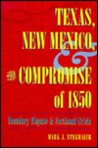
Sidebar 2, for the real world and related to this. Below is my review of a fantastic book entirely about the Compromise of 1850.

Texas, New Mexico, and the Compromise of 1850: Boundary Dispute and Sectional CrisisTexas, New Mexico, and the Compromise of 1850: Boundary Dispute and Sectional Crisis by Mark J. Stegmaier
My rating: 5 of 5 stars

This is a great overview of key aspects of the Compromise of 1850. While Stegmaier keeps an eye on whether California would be admitted as one state or two, and briefly looks at things like the fugitive slave law, his focus is on what started the Mexican War — Texas' border claims — and how they now related not to Mexico on the south/southwest but to New Mexico on the west.

Stegmaier first explained how Zachary Taylor, under the influence of William Seward and others, hoped to end-run around southern fire-eaters by organizing free-state government in New Mexico as quickly as possible, then presenting it as a candidate for statehood as quickly as possible after California's statehood.

Well, Congress would have none of that, even before Taylor's death allowed him not to have a direct confrontation with Congress over military instructions to the commander in New Mexico and other things.

Meanwhile, there was that border. Taylor's idea had been, seemingly, to present New Mexico as a free state, then after admission, have its border with Texas hashed out. The Lone Star folks wanted none of that.

On the other hand, a fair chunk of Texans were ready to let go some of their lands, for fear that too much of a huge West Texas would get occupied by free-soilers and turn the whole state free.

From here, Segmaier details the various different options put on the table at different times for a boundary, along with sub-options such as dividing Texas into two or even three states. He tracks the stances of Sens. Rusk and Houston, the Texas House delegation, and Texas Gov. Wood and others through all of this.

That all, of course, was within the Senate considering, then finally rejecting, an omnibus bill to settle all Mexican War-related issues proposed by Henry Clay, followed by the House adopting bills piecemeal. Excellent parliamentary control by Speaker Howell Cobb, joined by Taylor's death and timely replacement by Millard Fillmore, whom Stegmaier says is quite underrated, round out the picture.


View all my reviews

April 08, 2019

Alternative history: Andrew Johnson convicted in impeachment

Could Radical Republicans have convicted Andrew Johnson in the Senate, versus his actual acquittal at the denouement of his impeachment?

I say yes, and prevent a counterfactual history. Unlike most of my writings on this field, this particular counterfactual history requires multiple elements to be changed, not just one. But, the elements are all of a piece, and they'd all be by the same group — the Radical Republicans in Congress.

So, in outline form, here's what needed to be different.

First, a more comprehensive planning strategy should have been started earlier, even before it looked like impeachment had a shot.

Second, when that shot appeared possible, getting Senate Republicans to hold a new vote and elect somebody besides Ben Wade as president pro tem.

Third, grab the bull by the horns. In light of the Civil Rights Act of 1866 and Johnson's non-actions, rather than try him over the Tenure of Office Act, more bluntly try him over his failure to uphold his oath of office.

Fourth, if this weren't enough to have changed the minds of any of the "sinful seven" (actually 10 Republican senators in all) who early on decided to acquit, given the actual play-out, lean harder on Sen. Edmund Ross, who reportedly told Gov. Crawford that he would resign if the governor wanted him to vote to convict. (How true the veracity of that tale is, I'm not sure.)

Fesseden or Grimes surely could have been swayed. And non-Radicals who stayed stubborn would have been put on notice about possible state legislature opposition when their terms ended.

Spoons/Beast Ben Butler argued that patronage had been spread for Johnson's acquittal. There's good evidence Ross took patronage and some evidence he took a direct bribe. See here. Some of the Sinful Seven claimed that Butler's presentation of the charges as House manager was one-sided. See also Brenda Wineapple's book.

I disagree. It was somewhat inept. But, it was otherwise prosecutorial. That's what House impeachment managers are supposed to be. They're not judges in an impeachment; the Supreme Court serves as that. They're prosecutors.

So, it seems clear that Trumbull, among others, was hell-bent on acquittal.

Had Johnson been convicted, we have two alt-history paths. One is where Wade accepts he's unpopular and the Senate holds a new election for a president pro tem after he steps aside. A moderate but not conservative consensus candidate, like Wade's fellow Ohioan John Sherman or , is elected to replace him.

The other is that Wade is stubborn and despite this handicap, Johnson is still convicted.

A Sherman presidency would have been relatively smooth. All of Johnson's Cabinet likely would have remained.

For Wade, on the other hand, most of the Cabinet outside of Stanton might have quit. Seward might have stayed on for Alaska negotiations, depending on the exact date of Johnson's conviction, then left after that.

January 31, 2019

Alternative history: In the US, Stalin's Popular Front
has CPUSA work with Socialists not Democrats

This possibility popped into my head while grokking a great piece from Popular Resistance by Howie Hawkins about how third parties are more necessary than ever, given the lack of a stong working-class oriented third party in the US for what, 80 years or so and counting?

The "death" really happened in 1934 when FDR worked underhandedly, hand in hand, with the California GOP to kill Upton Sinclair's Democratic candidacy for governor. A year later, in an event that still leaves me, a non-conspiracy theorist, pondering at times — the killing of Huey Long — FDR's other serious possible opposition from the left was out of the way.

Then Stalin tells Communists elsewhere to work with mainstream parties. His advice was primarily directed to Eurocommunists with the rise of Hitler. But it carried to here, too.

As Howie notes, that wasn't the only problem. FPTP for Congress and state legislators combined with a strong-president system and its gubernatorial parallels in states is an added hurdle.

It would have been somewhat less a hurdle if Communists and Socialists had worked together. But perennial presidential candidate Norman Thomas was rightly anti-Soviet Marxist. Stalin would in no way work with him. (See also SPD and KPD in the run-up to 1933 in Germany.) Trotsky had also called out Thomas.

Sadly, though opposing both WWII and later, Vietnam, Thomas — knowingly and willingly, as far as I can tell — accepted CIA money. And, after his death, the old Socialist Party shattered, with one wing becoming Michael Harrington's DSA.

(Note: Why Thomas and Henry Wallace couldn't make common cause in 1948, I don't know.)

January 07, 2019

Alternative history: Nixon picks Rocky or Ronnie, not Jerry

In 1973, after Ted Agnew resigned as Nixon's Veep as part of his plea deal on his income tax evasion charges, Tricky Dick was the first president — and the only to date, of course — to exercise the portion of the 25th Amendment on filling a vice presidential vacancy.

We know he eventually picked Jerry Ford, of course.

But, he had two options besides that.

One was Nelson Rockefeller and the other was Ronald Reagan.

(Note: While my first counterfactual about Reagan running for the presidency was influenced by Bob Spitz's new Reagan bio, linked there, this one popped into mind several weeks ago when recently I read Evan Thomas' Nixon bio of a couple of years back.)

First, the actual history. How likely was Reagan to get it?

Not very.

Nixon still thought of him as an intellectual lightweight, just as he did at Bohemian Grove in 1967, when both were there and Nixon had the first inkling that California's new governor might run in 1968 for the presidency. Nixon retained that feeling into the 1980s, bombarding Reagan with Cabinet nomination and foreign policy suggestions. (Nixon strongly opposed George Schultz at State, which is part of why Reagan chose Al Haig for the spot originally; when Haig left, he smartly ignored Nixon the second time around.)

Ford was Nixon's favorite if nothing else for the reason that Nixon thought Congress would never think Ford capable of being president and thus wouldn't impeach him. WHY Nixon thought the man who had risen to be House Minority Leader would be thought incapable, Nixon never said, to the best of my knowledge.

Of the two who finished in the cold? Nixon personally liked Rocky, and thought better of him temperamentally, than Ronnie. But, he thought Congress would think Rocky could very much be president, and thus he would not be a counterweight, unlike what Nixon thought of Ford.

Anyway, to the counterfactual.

Nixon nominates Reagan. Congress knows he's an even more ardent Nixonite, if anything, than Ford. It knows his reputation as a hands-off governor. But it still hopes at this time that he won't be elevated to the top spot, and it knows he has no real ethics issues. He's confirmed no sweat.

Then, we get to Aug. 9, 1974, with actual history proceeding normally, and Ronald Wilson Reagan becomes the 38th, not the 40th, U.S. president. What happens?

First, at least as soon, if not sooner, than Ford did, he pardons Nixon. And does so with more unseemly language, claiming Nixon was victim of a witch-hunt, etc. This backfires with him even more than Ford's pardon did in reality.

Second, while not totally in the grip of voodoo economics, unlike 1980, he already is willing to listen to nutbar ideas in the dismal semi-science. He thinks a tax cut will help, which it might due to Keynesian reasons. He also thinks the budget needs to be balanced. He also also thinks that Nixon and Kissinger have been coddling the Russkies, that we need to stop SALT II, that we need to ramp up defense spending, and that we need to look at revising, or even jettisoning the ABM.

Reagan has no moderating James Baker as chief of staff. Nancy does get somebody better than Ed Meese to officially be in charge of day-to-day operations, but Meese, as in 1981 and beyond, is the eminence grise. In early 1975, Kissinger resigns, or is pushed.

This opens the floodgates to GOP challengers, who perceive Reagan as unbalanced, as having forfeited any honeymoon, and as politically vulnerable, as well as a possible boat anchor to Republican hopes. Bob Dole, Howard Baker and George H.W. Bush all jump in. So does the more moderate Charles Percy.

Reagan's old comments on making Social Security at least partially voluntary get dredged up in the media. Reagan "obligingly" doubles down on this shortly before the New Hampshire primary, served by a second-rate, and only quasi-official, campaign staff. (John Sears, having been given an advance tip to keep his powder dry and wait for official word, runs Percy's campaign when he announces.)

Reagan, though otherwise popular in New Hampshire, sees support crumble, with semi-next door Dole having already won (by plurality) the Iowa caucuses, followed by Percy, which has prompted other more moderate Republicans, like Charles Mathias, to either look at running or unifying behind Percy, the tacit candidate of the Rockefeller wing. Republican governors Bill Milliken and Jim Rhodes also make noises about favorite son candidacies.

Reagan can't get all the hardcore New Hampshire conservatives behind him. He does nail down Gov. Meldrim Thompson, but Dole, fresh off Iowa, convinces publisher-kingmaker William Loeb to, if not endorsing him, to at least offer no official endorsement.

Reagan wins by plurality in New Hampshire, but fails to break 30 percent. Dole and Percy both run strongly, followed by Baker. Bush, perceived as quasi-moderate at this time, can't break 10 percent, but vows to stay on until Texas.

Percy appears to have the Massachusetts primary wrapped up, and likely Vermont. Others won't contest his Illinois. So, focus goes to Florida, on March 9, and North Carolina, on March 23. Baker convinces Floridians he's the new moderate-conservative southern Republican that's needed, even as a counterweight to the surging Jimmy Carter. He wins there by plurality, with Dole and Percy in an essential draw for second. Reagan's Social Security comments have him finishing even behind Bush.

Reagan, with his Irish up, still hopes to pull out another win in North Carolina. But, despite Jesse Helms' backing, Baker does what he did in Florida. Dole is third and Bush fourth, with Percy focusing on April's Wisconsin race and beyond.

On March 31, 1976, eight years after LBJ did the same, Reagan withdraws.

Percy wins Wisconsin by majority and Pennsylvania by plurality. Bush finishes second to Baker in Texas, narrowly ahead of Dole. Dole pulls an upset in Indiana, edging both Percy and Baker. Baker wins Georgia.

Bush withdraws, and it's essentially a three-person race, outside of possible favorite sons.

With most primaries now leaving the South and going to the Midwest and West, Dole eyes making up ground, and he does.

However, Percy, with Dole and Baker splitting conservatives, takes winner-take-all California by plurality, enough to push him over the top for the nomination.

He names Baker his Veep choice.

Moderate to moderate-conservative Republicanism is rescued. Percy narrowly beats Carter in 1976, but winds up a one-term president. Presumably, the Shah's health, a Carter-like response by Percy, and the taking of hostages play out as they did in actuality.

December 21, 2018

Alternative history: Ronnie runs in 1964, not 1980

Note: This and other counterfactual histories ahead are stimulated by the new bio, "Reagan: An American Journey," reviewed by me here. (Spoiler: I three-starred it.)

Picture Ronald Reagan first giving his famous "A Time for a Decision" speech not in October 1964 as a Barry Goldwater fundraiser but a year earlier, for whatever reason, but it getting just as much attention then as in reality.

Many of the SoCal conservatives who backed Goldwater might never have jumped on that train. They would have seen Reagan right then as both more packageable and more charismatic than Goldy. As to people saying he was a political novice? One answer would be the rhetorical "So was Ike." Another would point at his Screen Actors Guild presidency and related items.

How would Reagan have fared?

In my opinion, he would have bombed even worse than Goldwater.

First, he would have made some of the same gaffes as Goldwater.

Remember, he worried that GE would fire him, years before GE Theater's ratings slid and they mutually separated, over his attacks on the TVA — attacks just like Goldwater made.

Remember, already by this time, Reagan had mentioned voluntary Social Security.

And, parallelling Goldy's "Let's lob one in the men's room of the Kremlin," just move back 20 years Reagan's open mic mic-check of "The bombing begins in 5 minutes."

And, Reagan, just like Goldy, opposed the 1964 Civil Rights Act.

With no presidential debates, Reagan's 1980 "There you go again" to Carter would not have been heard. And, had he tried something like that, LBJ would have clobbered him over that.

Assuming he did something like his mic check or even close, LBJ would have run the Daisy commercial. He also would have run some sort of "affable doofus" commercial.

At some point he would have gotten under Reagan's skin, and a public blow-up by St. Ronald would have finished things off.

He would have lost at least as bad as Goldwater.

What if he then tried to repair things by a 1966 gubernatorial run?

Pat Brown — who should have taken him more seriously in the real world — would have been encouraged by LBJ to go for the kill in hopes of kayoing the entire California GOP. So, Reagan loses again.

That means, in 1968, he's not in competition with Nixon for the GOP nomination. He's a frustrated has-been. And American history changes a lot. He fails more than in reality in trying to get the 1976 Republican nomination. He's not even in the picture for 1980. And U.S. conservativism is forced to adapt, as Republicans and Democrats drift closer into neoliberal nuancings.

November 26, 2018

Counterfactual history — electoral votes switch
and Clay is elected in president 1824

The presidential election of 1824, in the middle of a disintegration and re-alignment of American political parties, was the most vigorously contested in American history and is the second, and so far the last, to be decided by the House of Representatives after no candidate won a majority in the Electoral College.

Andrew Jackson had a plurality, though not a majority, in both it and the popular vote. John Quincy Adams was second in both.

And here is where alternative history is going to come in.

Henry Clay and William Crawford were third and fourth, respectively, but with different orders in the electoral college and popular vote. Clay was third in the popular vote, but fourth in the electoral college, with 37 electors to 41 for Crawford.

The Constitution specifies that, in cases of a runoff, only the top three people receiving electoral votes advance to the House, so Clay was out, by the 12th Amendment, which in addition to requiring president and vice-president to be on separate ballots with separate electors, (a fallout of the crisis-fueled election of 1800 between Thomas Jefferson and Aaron Burr) also cut the "runoff" in the House from the top five candidates to the top three. (Note: This shows that the founders naively didn't anticipate political parties when they should have and that, IMO, they should have ditched their "balance of powers" shibboleth and gone done an optional route considered at Philadelphia — a semi-parliamentary system where the House, but not on a state-by-state vote, would elect the president.)

H.W. Brands, in his new book, talks about Clay's regret for not being able to swing Louisiana's caucus, and thus, eventually, its electors. (Several states still had doubly indirect voting for president at this time — voters didn't even vote directly for electors, let alone for president. South Carolina still had its state legislature select the electors until after the Civil War.)

As it was, Louisiana gave three electoral votes to Jackson and two to Adams. (Six states had split electoral votes in this election, so we cannot talk about faithless electors.) Had he been able to get all five electors, he's one ahead of Crawford and in like Flynn.

People who know the basics of the alleged "corrupt bargain" between Clay and Adams know the importance of this. Clay was Speaker of the House in the previous Congress, and in the previous several before that. That's why his offer to back Adams, rather than Jackson or Crawford, was so important.

As it turned out, one ballot, versus crisis-filled 1800, was all that was needed. The state-by-state vote was Adams 13, Jackson 7, Crawford 4.

What if it had been Clay instead of Adams in there? Let's look at Wikipedia's map of the House vote and go from there.


Let's give Jackson Crawford's Georgia and North Carolina. Let's give Clay Maryland, Delaware, Virginia, Ohio, Kentucky, Illinois, Missouri and Louisiana.

Nobody wins a majority on that first ballot.

Jackson now has nine states. Clay has eight. Adams has seven.

What next? Adams is out, right?

Well, no.

The 12th Amendment, in its own weakness after 1800, doesn't specify any winnowing or cutdown. Neither did the original Constitutional provision which mentioned the House considering the top five candidates if nobody got a majority. This in turn, contra "The Resistance" meatheads who glorify the Constitution because it has checks on Trump or something shows just what's wrong with such shallow thinking by them.

So, we have an 1824 version of 1800's cock-block, but now with a "The Good, The Bad, and The Ugly" style Mexican standoff.

And, besides Jackson partisans in their own corner, other House members consider Clay and Adams both well-qualified for the presidency.

Rather than Clay and Adams dealing, Clay figures he has one more ballot, possibly two, to use his powers before things devolve into a Jackson-Adams showdown between the top two vote-getters.

So, second ballot.

Clay peels Indiana and North Carolina away from Jackson. Clay was second in Indiana's popular vote. Crawford won North Carolina as well as Virginia, but we'll assume Clay has charm to work there.

Through his vice presidential connections, he peels New York away from Adams. (Maybe he'd already do this in a first ballot, but we'll save it.) He does the same with Connecticut.

After two ballots?

Clay has 12 states, one short of a majority. Jackson is at seven and Adams five.

In the third ballot, anti-Jackson representatives from either New Jersey or one of the New England states or another, accept reality and switch from Adams to Clay.

The future of America?

Clay, unlike Quincy Adams, is not a personal iceberg. And, there's no "corrupt bargain" being flung in the background.

He gets about half of his major "American System" ideas passed. The 1826 midterms don't swing as heavily Jacksonian as in reality. He listens enough to Vice President John Calhoun to make his Tariff of 1828 not quite as inflammatory as the Tariff of Abominations, rather writing something like the Tariff of 1832.

But, even without a "corrupt bargain," Jackson still calls for the will of the people.

Jackson wins the popular vote in 1828, but it's much narrower than the real contest. Popular vote is about 51.5-48.5, for states that record it. Clay gets six more electoral votes than Adams from the split New York delegation, wins Pennsylvania and wins Ohio, Indiana and his Kentucky homeland. That's a 69-vote swing, making ...

Henry Clay re-elected, but again as a minority president, with a 152-104 margin.

Clay manages to push through a 20-year renewal of the Bank of the United States' charter in his second term, thus preventing the worst of the Panic of 1837.

==

What happens in the broader political world?

Clay, unlike Andrew Johnson, deigns not to serve in the Senate afterward. He does become a national statesman of sorts, and still makes recommendations from the bench as he deems fit.

Adams retires from politics at this point. He peevishly passes on being nominated for the House in 1826, but eventually accepts re-appointment to the Senate in the future. He defends the Amistad slaves, but being in the Senate, not the House, has no gag order to protest against.

Jackson's third time is the charm. He is elected in 1832 over Calhoun, who tries to pull together some John Tyler-like amalgamation of anti-Jackson Democrats and Whigs-to-be, not jet being as much a states-righter as in reality. Calhoun fails, being seen as too elitist.

Some Jacksonians, enraged at their lion's two losses, talk of abolishing the Electoral College. But southern Jacksonians, knowing that undermines the three-fifths compromise's power, refuse. Eventually, New York Congressional leaders, motivated by how that state chooses electors, proposes the New York Compromise. It states that one elector from each state's number must come from each Congressional district. The two remainders, the "Senatorial electors," can come from anywhere in the state. In a nod to federalism, unlike New York State's law then, and Maine's and Nebraska's today, it does not require the electoral vote to be split based on House districts, but it offers a "sense of the Congress" resolution that in the name of popular democracy, that is a preferred alternative. (In reality, in 1824, New York, like South Carolina, had the state legislature choose electors in a doubly-indirect presidential voting system, but unlike South Carolina, apportioned the results by House district. Five states — Illinois, Kentucky, Maryland, Missouri and Tennessee — used electoral districts for ALL electoral votes, not just the "House electoral votes." Maine did as it does today.)

This Thirteenth Amendment, with the proviso that the idea isn't binding on states, but having the New York and Maine examples, and the quasi-example of five other states, four of them "frontier states" at the forefront of direct democracy, easily passes into law. The five states aforementioned slightly tweak their laws to follow Maine. Other states eventually follow suit.)

Jackson privately makes pledges to serve only one term if his health requires it, but actually serves two, with Martin Van Buren as his vice president.

Van Buren is elected in 1840, but schwaffles on Texas admission. Pro-Jackson Democrats call him a sellout and ram through the nomination of Polk after using the two-thirds rule to deny Van Buren renomination.

From there, counterfactual history looks similar to reality, other than that Jackson is unable to undo the renewal of the Bank of the U.S. Clay changes his mind about the Senate and accepts a special appointment, where he spearheads the Compromise of 1850. The Jackson-era Thirteenth Amendment generally forestalls further presidential election problems. Abraham Lincoln is still elected in 1860, but by a narrower margin than in reality.

July 04, 2015

I'm grateful for the Fourth, even with American exceptionalism

Tidied up, 240 years ago, just like today, war as a "game."
First, American exceptionalism is quite real. Arguably, per the Jacobin, it's at root and branch of the American founding and the American project. Second, and just as arguably, per Michael Lind, it's another American albatross, along with love of military, love of police militarization and more, especially foisted on the country by the South. (Guess the Lost Cause wasn't so lost after all.)

But, we still do live in what is in many ways the best country in the world, even as fighting against American exceptionalism compels me to say that on things like average life expectancy, health care costs and delivery, income inequality and socioeconomic class mobility decline, it's not the best in those said areas.

Per the Jacobin, we need to remember that the American Revolution was a conservative one. In the South, it may have been driven in part by fear of abolition after the Somerset decision, which Lind also notes. And, per Dylan Mathews, yes, abolition might have come faster without the revolution. And, we might have kept parliamentary government, largely, but not entirely, for the better than our current system. So, even if we are overall the greatest nation in the world today, we might have been "even more greater" if we'd kept ties with London 240 years ago.

William Hogeland doesn't, unlike a mag like Counterpunch, take the opportunity of the Jacobin interview to jump into full-on anti-Americanism, but does turn a strong, and accurate, gimlet eye on the situation. Rather than call it a "reactionary" revolution, he cites it as a conservative one, but continuous with the status quo wherever that status quo did not involve Great Britain.

People who were "radical," Hogeland notes, were squeezed out, crushed, even, by 1787. He cites a number of names, not all of them known to me, and none of whom will be in a high school history textbook. Thomas Paine, the one radical of sorts who is known today, was living in London in 1787, but pointedly not elected by Pennsylvania or another state to come serve as a constitutional delegate.

As for the militarization that's been part and parcel of American exceptionalism, especially in the South? Hogeland points to two early, formative events, at roughly the same time: The putdown of the Whiskey Rebellion, which he hints elsewhere Alexander Hamilton may have provoked, and the first of America's Indian Wars, against tribes of the Old Northwest.

On the conservative side, including the militarization, Hogeland is finishing a new book on "Mad" Anthony Wayne, the leader of that first Indian War's battles. Sounds like it could be good.

==

The grateful part?

I could be living in parts of the world where civil liberties are honored less in the abstract, and the reality, alike, than in the U.S. I could be living in an economically mismanaged country.

In such cases, I acknowledge that American Coca-colonialism, along with the old-fashioned type of the Old World, was part of the problem. But, many countries have had indigenous mismanagement of their governments, their economies and more.

Certainly that's true of a China, which had relatively mild burdens of colonialism, and due to its size alone, has shucked off their remnants.

I'm also grateful that I'm educated enough to recognize American exceptionalism, and free to point it out.

So, I can critique, and criticize, American myth — including American exceptionalism — while still being glad I live where I do.

==

The alternative history part, since I've regularly blogged about my own "forks" between real and alternative, or counterfactual, history?

Due to America already then being one-fourth the size of Britain in population, separated by a pre-steamship Atlantic Ocean and of much larger geographic size, it's not conceivable that George III, Lord North, et al, could have put down a rebellion.

As for the causes? Had George, following John Dickenson, only raised taxes and tariffs directly associated with trade, AND done that around 1765, it might have been enough to raise additional revenue for the Crown yet stave off revolution.

But, lack of hubris was never George's long suit, and not just for him, but for those who were the "king's party," or the "city party," or proto-Tories in Parliament. Historians of the time were already wondering if Britain had gotten too greedy for spoils at the end of the Seven Years War.

Beyond this, the Quebec Act would have been gasoline on colonial fires if the tax issue had been handled with less than the utmost dexterity.

Also forget not that Highland Scots, as well as Scots-Irish, had emigrated to America — Highland Scots for whom Culloden was often not just part of memory but part of personal history.

Add in the amounts of Germans (discounting any Hanoverians who might be loyal to George's House of Welf/Hanover), Dutch, and even Swedes and Irish already in America, and George had less than full nationalistic support on this side of the pond.

Short of Britain moving halfway toward today's Commonwealth, or almost all the way toward Canadian Dominion status of 1867, by 1775 if not a decade earlier, it's hard to see how London could have kept hold of the colonies once its initial mismanagement started growing.

July 19, 2014

Counterfactual history: New Mexico is bigger, Texas smaller

The so-called "Trans-Pecos" region of Texas, west of the Pecos River and hence "trans" from the point of view of populated East Texas, really doesn't fully like the capital city folks in East Texas' Austin. Well, the one metropolis in the area, El Paso, at least, doesn't. Most state agencies underserve El Paso compares to East Texas cities, in per capita staffing at state agencies.

Texas own official state history book acknowledges some of this, even:
Most of the region's physical and cultural landscape has little in common with the rest of the state. Although it constitutes about 11 percent of the area of Texas, the Trans-Pecos has received less attention than the more populous east. 
There you go, Texans.

Of course, until Anglo Texians tried to make it so, El Paso never really was part of Texas in the first place. It wasn't part of Spanish Texas, nor was it part of Mexican Texas. We know both of those had the Nueces, not the Rio Grande, as a southern/southwestern boundary. The Llano Estacado, to the west of the headwaters of the Nueces and running north, really was like "unorganized territory," like the land north of Nebraska Territory in the early 1860s before it was officially organized into Dakota Territory.

But El Paso was further west. And on the royal highway between Chihuahua City and Santa Fe. Nobody went east from El Paso 200 years ago, but plenty of people went north and south. In short, El Paso was really either part of today's Mexican province of Chihuahua, part of New Mexico, or part of its own province. El Paso, tis true, didn't have much population, but it was an established city, since 1680, and, as of the Compromise of 1850, more populous than Albuquerque and Santa Fe. (It still is today, but metro Albuquerque is larger than metro El Paso, and the larger Albuquerque-Santa Fe area is larger than El Paso-Las Cruces.)

Today, El Paso is north of the Rio Grande, so it can't be part of Chihuahua. It's about as close to Albuquerque as to Chihuahua City, though, and far closer to it than to Dallas-Fort Worth or Austin. And, given the fact that Texas invaded Mexican New Mexico in 1841, trying to conquer it, shows that early Anglo Texans, despite their claims of the Rio Grande as their border all the way up to its source, really didn't believe that.

So, let's say that as part of the Compromise of 1850, with the feds paying off Texas' massive independence-era debt in exchange for reducing its state boundaries, among other things, those state boundaries, in the Far West, were shoved even further to the east than they actually are.

What would have been some real-world results?

Well, after the Texas oil boom got out to the Permian Basin in the 1920s, New Mexico would be known as even more of an oil state than it is today, because more of the Permian Basin would be in New Mexico. That would have affected the state's broader economy.

Related to that, a New Mexico Territory wouldn't have sold off so many state lands.  So, Big Bend and Guadalupe Mountains national parks would be bigger than they are today, and Davis Mountains would be a national park, too. An enlarged southeastern New Mexico, with all of that plus Carlsbad and White Sands, would rank higher as a nature tourism destination.

Politics? If anything, New Mexico would be more liberal yet than it is today. El Paso is as reliability liberal as Austin, and its liberalism is more New Deal worker liberalism than Austin techie neoliberalism. Oh, sure, the rest of the Trans-Pecos would have far-right ranchers and oilmen, but they'd be far outnumbered by greater El Paso.

And, New Mexico probably would have not just one, but two new Congressmen. El Paso's population alone would provide for one. New Mexico's been on the border between three and four representatives long enough that the rural and small-town parts of the Trans-Pecos might be enough to bump it to a fourth representative, not counting El Paso's addition.

Let's say it has five representatives, or seven electoral votes.

Now, let's look at the 2000 presidential election. Bush beat Gore by 271-267. Give New Mexico two more electoral votes and we're tied and headed to the House to decide, not the Supreme Court. (That said, due to the one-state, one-vote principle, Bush likely would have won the House.)  Beyond that, a New Mexico with two extra electoral votes makes all of the Four Corners states more important politically in general.

So, thanks, Stephen Douglas and other 1850 Compromise folks, for caving in to Texas pouting or whatever.

June 27, 2014

100 years ago today, madness began at #Sarajevo for #WWI

Most world history or western civilization books will date the death of the "ancien regime" to Jan. 21, 1793, the date of the execution of Louis XVI of France.

And, they'd be wrong.

Twenty-one years later, his brother was on the throne as Louis XVIII. All the other crowned heads of Europe, with exception of a few minor princelings in Germany and Italy, were also back, and not only back, but stronger than ever.

Was it 1848, then? Non! Four years later, France had another emperor and nothing had changed elsewhere.

It wasn't the whistle of a guillotine on the Place de la Concorde on a gray day in wintry Paris that spelled finis for old Europe. Rather, it was a whiff of gunpower on a street corner in a backwater of the Balkans, Sarajavo, annexed Bosnian territory, Austria-Hungary.

Franz Ferdinand, not a rock band yet, but just the heir to the throne of the autocratic Dual Monarchy, lay dying in his automobile along with his wife, courtesy of the lucky gunshots of Gavrilo Princip after the Grand Duke's chauffeur missed a turn.

On such bits of fate do the wheels of world history sometimes turn.

To compare 1914 to 1793? France was not permanently a republic until 1871, with allowance for the Vichy years. A crumbling, non-imperial Holy Roman Empire had been replaced by a shiny autocratic German Empire, with that area, even in part, not permanently seeing democratic government until 1949.

The Hapsburgs were forced to split power within their realms between Austrians and Hungarians after the 1867 revolution that followed the Seven Weeks War, hence the Dual Monarchy. However, on the exterior, at least, it was as autocratic as ever. On the inside? The Hapsburg predilection for schlamperei, really, like schadenfreude, not having a single-word English equivalent, but, in Austrian German, meaning something like "insouciant inefficiency," was on the rise.

The Romanovs and Russia, despite a nominal parliament, were as autocratic as in 1793, albeit with emancipated serfs, and more powerful as a country. The Ottoman sultans had lost most of the Balkans and North Africa, but still held autocratic power in their homeland. One of the minor Italian houses, Savoy, had unified Italy into a kingdom.

No, other than with the post-Prussian French republic, and some democratization in Britain, the ancien regime was still in place in 1914.

That said, Gavrilo Princip didn't just help topple the ancien regime.

With the help of one Thomas Woodrow Wilson, the ancien United States crumbled, too.

I've said time and again, and people who read my reviews of WWI related books on Goodreads or Amazon know this to be the case, that we the USofA had no dammed business getting involved in the not-so-Great War.

First, Britain's blockade by extension was just as illegal under international law as German submarine warfare was. But, Wilson never really  protested the former, and Germany, in usual Wilhelmine fumbling, failed to adequately organize neutral powers on the issue. (Don't forget, the Netherlands and Denmark, both bordering Germany, were uninvaded neutrals during WWI.)

With the alternative history of either 1912 Speaker of the House Champ Clark getting the Democratic presidential nomination, or the 1870s federal government listening to an ancillary idea from Horace Greeley of "Go west, young man" fame and moving the national capital to St. Louis, we either would have had a truly neutral president or else the capital removed from the Eastern establishment with Midwestern isolationists regularly protesting Wilson.

But, we didn't. Wilson, myths aside, tilted pro-British from the start. He was enamored of the British parliamentary system, and his book, "Congressional Government," was based on the work of British political scientist Walter Bagehot. Beyond Wilson, Teddy Roosevelt and others of the Eastern Establishment (and yes, there was such a thing back then, already) hankered for war with Germany.

Just as Wilson wasn't truly neutral, the Lusitania wasn't an innocent passenger ship. It was carrying ammunition and other military munitions for the Allies, and it was armed with 4-inch guns, big enough to easily sink a surfaced submarine. (WWI subs had far shorter travel distances underwater than did WWII models. They had to surface frequently to recharge batteries. Also, torpedoes of that era were less accurate, and sub commanders liked to use their own surface guns when possible, instead.)

Was Germany innocent? No ... it did invade neutral Belgium. (Whether Britain would have entered the war without that is an interesting question. The Conservatives very much favored that, but they were on the outside; the ruling Liberals, before Belgium gave them a casus belli, leaned against the idea.)

What would have happened, had the US not entered?

On the Eastern Front, things would have played out just as they did, except that Germany, knowing the US wasn't coming, would have leaned harder on the new Red government in early 1918, as far as peace term severity.

In the West? Let's assume that British, recognizing their blockade by extension hurt Germany more than German subs hurt them, in the face of a truly neutral American president, would have kept up the blockade. A truly neutral president would have allowed loans to both sides, as actually happened, but would have made sure not even the appearance of government backing of the loans happened. British loan rates would have gone higher.

With all that in mind, the 1918 Kaiserschlacht would have faced a worn-down France, and a tiring Britain, even as all three countries neared bankruptcy, too.

Maybe Germany still would have had the Kiel naval mutiny. But, Paris would have been under threat in November 1918 in this scenario, but probably not besieged, rather than the German army under retreat. Maybe German mutiny might have spread to front-line Army troops ... and then to French, maybe even British ones.

A Leninist dream would have seen in the verge of realization ... red Europe.

What next? Would Germany, Britain and France come to their collective senses and negotiated a quick treaty that called for no changes in borders in the west ... a status ante quem, like that of the Seven Years War?

It's hard to say. But, if something like that happened, Hitler wouldn't have. Wilhelm might still have had to abdicate in favor of his son, and the Social Democrats might have insisted on constitutional reform. With massive new territories in the East, Germany would have dominated a Mitteleuropa. Probably, the Dual Monarchy would have shattered anyway. Some Germans might have talked about absorbing Austria, and today's Czech Republic lands, as a state of the German Empire, just like Prussia, Bavaria or Baden. Emperor Karl would be Archduke Karl, if he could hold on to that; if not, the Austrian province would have other government within the Second Reich.

With the price of unsecured loans coming due, the British and French colonial empires would have become iffy even without a second world war. Britain, France and Italy might have formed a Triple Alliance, warning Germany that, as long as it looked east only, and kept a lid on the Soviet Union, it could have peace. Shades of 1814 Paris, the triple allies might even have tried to put a Romanov back in power in Russia.

As for Sarajevo, Bosnia, Serbia, Yugoslavia, etc.? Could the results have been any worse for most of their residents in this counterfactual history than in reality? Probably not.

April 02, 2014

Actual and alternative history meet in book on Hitler's rise

Hitler's Thirty Days To Power: Jan-33Hitler's Thirty Days To Power: Jan-33 by Henry Ashby Turner

My rating: 5 of 5 stars


Easy read, and a lucid and well-thought one, of one of two transitional points in the 20th century; the other being 1917 in Russia, of course.

Turner shows that three people were primarily responsible for Hitler coming to power: current Chancellor Kurt von Schleicher; his predecessor, Franz von Papen; and President Paul von Hindenburg. Lesser roles were played by Hindenburg's son Oskar and his presidential secretary, Otto Meissner, along with Alfred Hugenberg of the German National People's Party.

A key point is that Hitler's rise was not inevitable, and Turner lays out a detailed case for its contingency.

The crux of the matter was the Weimer constitution. The German president had plenty of non-ceremonial powers, including the right to issue emergency decrees. From 1930 on, no Chancellor was able to form a parliamentary majority, so all governed in part by use of these decrees, and their cabinets were known as presidential, rather than parliamentary, cabinets.

Papen tried to rope Hitler into his late-1932 cabinet as vice chancellor, a title he showed as useless himself when he got the same role in Hitler's cabinet. Hitler, with his all-or-nothing strategy, refused.

Hindenburg, also in late 1932, offered Hitler the chance to govern, but only if he could form a parliamentary majority; he declined.

Schleicher, who had put Papen in power as a tool, then grew tired and distrustful of him, so he resigned his Army commission and stood for the Chancellorship himself.

Turner makes clear that all three major players, and the two main secondary ones, consistently underestimated Hitler. None apparently had read Mein Kampf, even though at the state level, the state of Prussia, when under control of the Social Democrats, had civil servants do an analysis, based on the book, on what exactly the Nazis would do if they got power.

Also, Papen and Schleicher both, naively, thought they could control Hitler.

Once the Hindenburgs took a personal dislike to Schleicher, and Papen convinced them that he could control Hitler and (according to Turner) deceived them that Hitler would have a parliamentary cabinet pending the filling in of a few blanks, and Hugenberg decided that this was the best brass ring he could grasp and that he could join Papen in controlling Hitler, the die was cast.

===

Turner concludes with something that will always get my attention: alternative history.

He asks, "What if the Three Stooges, and the Three Lesser Lackeys, hadn't given in to Hitler?"

It's a very good question.

As for Hitler himself, he notes, as all history aficionados of the period know, that the Nazis' vote declined from summer 1932 to the end of fall election, and that the party was nearly broke.

So, Turner says, if only Schleicher had waited him out, Hitler and the Nazis would have continued to slide.

Of course, Hitler could have called out the storm troopers and made a putsch attempt.

But Turner notes that the WWI allies had already agreed to remove the 100,000 man limit on the Germany Army. He thinks a resolute chancellor could have put down such a coup.

As for Hitler's reviving the Germany economy? A large part of that was actions undertaken by a Schleicher cabinet minister.

So, what might have happened? Turner notes that by 1933, a fair chunk of central and eastern Europe had already gone to traditional-type military dictatorships; arguably, Franco a few years later fit this mold. Given German militarism, such a dictatorship, probably with some degree of anti-Semitism but far less than that of Hitler's, could easily have been implemented by coup.

Schleicher himself was in position, but irritated Hindenburg and hit his Peter Principle limit as chancellor.


View all my reviews

February 09, 2014

Counterfactual history: LBJ names RFK his Veep

Long-term regular readers of this blog know that I occasionally like to write these essays into counterfactual history. As a history buff (college minor) I find they fulfill an inner need to ponder some of the "whys" and other things of history, as well as providing an outlet for keeping my analytical and creative thinking skills sharp.

So, here's this one, starting with the necessary historical background.

In the spring of 1964, President Lyndon B. Johnson said he would consider no member of his Cabinet for the nomination to run with him as vice president. Well, without naming names, the general public and especially Democratic Party stalwarts knew just what that meant. Only one member of LBJ's cabinet, the attorney general, Robert F. Kennedy, brother of the late president, had hinted at any such interest, or been talked up by the public.

Bobby, though, had been talked up in spades. And, he had been forceful in trying to get his name on the ticket.

But LBJ, with a cabinet full of Jack Kennedy nominees, and still with fears of coming off as "Rufus Cornpone" to them and others, didn't want a Vice President Kennedy overshadowing him.

But, what if he had thought differently? And acted differently?

Things would have been a lot different, especially late in 1967 and on into 1968.

Bobby Kennedy would have been hard-pressed, even after Gene McCarthy entered the 1968 race as an anti-Vietnam candidate, to speak against the war himself. Party stalwarts would have considered it treason. Plus, LBJ would have been able to get Bob McNamara or somebody else to testify how, when Jack was president, Bobby had been at least as much a hawk on Vietnam as his brother, etc. Plus, with the revelation that Bobby knew about the 1963 CIA assassination attempts on Fidel Castro, if LBJ spun it right, the public would have believed anything about Bobby and Nam.

Related to that, any effort Bobby did make at the presidency before LBJ's March 31, 1968 withdrawal from candidacy speech would have seemed like the rank opportunism that it was. And, afterward.

Then, Martin Luther King Jr. would have been assassinated four days later. The aftermath of that would have overshadowed a Kennedy announcement.

Bobby would have either had to make a very delayed announcement while facing the Johnson machinery and possible antagonism, or waited until 1972.

Without a Vice President Humphrey to run, what would Johnson have done? Supported Bobby? Tabbed Sen. Humphrey as a likeable, pliable, still-hawkish liberal? Possibly. Certainly more likely than supporting Bobby.

Rather, LBJ would have pulled a Taft, 1912. Just as Taft used every bit of party machinery to turn back Teddy Roosevelt, LBJ would have done the same against Bobby Kennedy.

Now, as he did in real history with the Hump as his Veep, would he have forced Humphrey to take some sort of pledge to support administration policy? Likely so.

Question is, with Hubert Horatio not actually being LBJ's Veep, would he have kept at least part of his pecker in his own pocket, and at some point, say a month before the election, started distancing himself from LBJ?

Let's say "yes," with the distancing being small at first. Maybe that would have prodded LBJ to call for his bombing halt a week earlier than he did. Or, if he refused to call for one at all, in spite (many have argued that Johnson wanted Nixon to win more than Humphrey, in large part over Vietnam), HHH might just have finished growing himself a pair, and pledged a bombing halt himself.

Let us say that's enough to push the Hump over the top.

We get continued liberal appointments to the Supreme Court, though Abe Fortas still steps down. Much of the Great Society remains in place, with continued support. Reagan and Rocky square off for the 1972 GOP nomination. Reagan wins, but loses to the Hump and the GOP gets an even earlier start on becoming the party of today, or Rocky wins, then beats Humphrey and the GOP crazies are stuck, or he loses to Hump, narrowly, because the crazies refuse to vote, and moderate GOPers start the exodus.

And if Nixon won?

Bobby runs in 1972, gets nominated, but gets semi-McGoverned. Between this, Chappaquiddick for Teddy and reflections on the narrowness of Jack's 1960 win, the Kennedy dynasty and Camelot myths die a cold, painful death.

November 14, 2013

Alternative history: Kennedy vs Goldwater, 1964

What if Jack Kennedy had never been assassinated on Nov. 22, 1963? Would he have been re-elected?

Contra the Camelot mythers, Jack wasn't universally politically popular. And, pre-Watergate, presidential polling tended to reflect personal popularity of presidents more than it did political popularity at times. Yes, his poll numbers were still high; however, they'd been slowly but surely slipping across most of 1963.

The most recent American Experience, a two-part, four-hour special, details much of this.

So, what about 1964, in an alternative history?

Jack probably would have won, but by nowhere near the margin that LBJ did.

For purposes of this counterfactual thought exercise, I'm assuming Barry Goldwater still gets the 1964 GOP nod.

First, Jack wouldn't have had a martyr's coattails, plus an extended presidential honeymoon, on which to run. With liberals, he wouldn't have had any 1964 Civil Rights Act to run on, either, because he wouldn't have gotten one passed, and frankly, he probably wouldn't even have tried. Therefore, he would have had to run on both the minuses and pluses of the Cuban Missile Crisis, the Berlin Wall, and Vietnam.

Second, and related to that civil rights bill, he would have been facing a less-extreme sounding Goldwater. Sure, Barry still might have said, "let's lob one in the men's room of the Kremlin," but he wouldn't have also looked like a racist for opposing the 1964 Civil Rights Bill because there would have been no such bill to oppose.

Third, do to fears of appearing soft on Communism, Jack might have escalated in Vietnam in 1964 MORE than LBJ did. (That said, he he been re-elected, he likely would have escalated less than LBJ afterward.)

Fourth, from Jack's own words in the second half of 1963, we know he was worried about the election in general and about Goldwater as a specific opponent. (That said, Barry had his moments of naivete at times, if he thought that Jack would have run a lot "cleaner" election than LBJ actually did. Reality is that Jack would have run a more suavely dirty one.)

Now, per good, no time travel alternative history, how do we get to this point?

Quite simple.

In real-world Dallas of Nov. 22, 1963, I believe that Vincent Bugliosi and Gerald Posner are right about Lee Harvey Oswald. The first bullet missed, the second was the so-called "pristine" one (it wasn't), and the third was the head shot.

Let's say Oswald's first shot misses, as in reality. And then, his Mannlicher-Carcano jams! Not for long, but, say 6-7 seconds. He snaps off a second shot, as Jack's limo starts to turn onto the Stemmons Freeway, and misses again. He's quickly found out and arrested.

That said, I'm not sure if Jack would have kept Lyndon on the ticket in 1964 or not. I could see either option. And, I'm not sure how much difference it would have made.

Per Wikipedia's 1964 presidential election article, I see Kennedy, vs. Johnson's actual 1964, I see Kennedy losing all border states except Missouri and West Virginia. That alone would take him down to 388. If he lost those two plus Indiana and Utah, he's down to 353. And, California would take this down to 313. I'm listing these in order from most to least likely. Midwestern farm states might also be more in play, as in 1960. And, the Rust Belt states. Urban blacks might have stayed at home.

And, what would the result have been? Probably little more accomplished in the second term than the first. Kennedy, to protect family Cold Warrior legacy in order to give brother Bobby a shot at the throne, would have escalated in Vietnam, but at a slower pace, again, than LBJ. We would have been at 150K troops, but no more, by the end of the 1966 midterms. After that, it would depend on whether Bobby (who might well have run for Senate in 1964 anyway) had a shot at the crown or not.

We would NOT have had Medicare or Medicaid. Any civil rights acts would have been tepid. We would NOT have had a fair housing act. The gloss would have finished coming off Camelot, and all of Jackie's horses and all of her men and Manchesters couldn't have put it back on again.

And, I'm not alone in saying that. James Patterson at History News Network has a great analysis of what the next 1,000 or 2,000 days would have looked like, and he largely agrees.

January 12, 2013

Counterfactual history - President Aaron Burr

Crazy idea for  the man who "murdered Alexander Hamilton," eh?

But, had he wanted the presidency in 1800 (he did NOT "grasp for it," a great triple biography reviewed just below shows) American history might have been a lot different. First, the review, then I'll pick up the train of thought further about how President Burr might have been different for America than President Jefferson.

=====

Burr, Hamilton, and Jefferson: A Study in CharacterBurr, Hamilton, and Jefferson: A Study in Character by Roger G. Kennedy

My rating: 5 of 5 stars


This is a good re-evaluation for the better of Aaron Burr, basically freeing him from 200 years of accretion of the ... well, the lies that Thomas Jefferson had his minions spread about him. It also fits well in some recent columns and essays about Jefferson who, as Kennedy notes, was the first explicitly lying president, and able to be believed, anyway, by following on Washington, definitely, and also on Adams. And, we get dollops of Hamilton playing off of both.

First, Kennedy established that, when the electorally tied 1800 election went to Congress, Burr did nothing to "angle" for election himself. (It's well known that Hamilton worked against him.)

That said, Kennedy points out that, had Burr wanted the position it could have been his. Burr got electoral votes in 1792 and 96 as well as 1800. In the first two cases, many were in the South. In 1800, Jefferson’s agents specifically fought against this. Related to this,  Burr had Federalist as well as anti-Federalist friends, esp. in New York, and including John Jay. Hamilton, Burr, Jay worked together on abolition in New York as part of that.

A lot of the enmity went back to the Revolution. Burr was mistrusted by Washington due to his assn. with Gates and his clique, before, during and after Saratoga. Hamilton used this when Washington was prez to poison him against Burr. John Marshall was in the army at Valley Forge, as were Hamilton, and Washington. Marshall, as chief justice, presided over Burr's treason trial in 1807. All of the above, remembering Jefferson's "runaway" governorship of Virginia, had reason to disdain him.

A lot of Hamilton’s envy toward Burr may have been “projection,” Kennedy says, and makes a good case for this. He also hints that Hamilton may have seen the duel as a chance for "suicide by opponent" along with one last bit of revenge, having wrecked Burr's chance at the presidency, his chance at New York's governorship earlier in 1804, and before that, John Adams' presidency.

In any case, Burr’s post-duel plans in the Louisiana Territory, as an abolitionist, may have been part of why Jefferson was even further “set” against him. Jefferson himself had designs on  both the Floridas and Mexico himself, after all. But, with a chance to reset the "New World Order" in Louisiana, to meet the idealism of the Declaration and make it slave free, Jefferson took a pass.

But, that's not now. Kennedy informs us that Jeffersons’s Northwest Ordinance anti-slavery petition applied only to **new govts**  in the area. Given that, pre-Constitution, Virginia claimed the entire Old Northwest, as well as the future Kentucky, it was therefore largely vacuous.

There's lot more like this, combined with a "hail, reader" style of writing by Kennedy that I find generally ingratiating.


View all my reviews


=====

OK, first, Burr would have bought Louisiana just like Jefferson. He probably would have created some expedition similar to Lewis and Clark up the Missouri, as well as Zebulon Pike up the Arkansas. He might have been more aggressive than Jefferson on trying to get East Florida, West Florida, or both from Spain.

And, he would have worked for a "reset of the New World Order," with Louisiana being admitted as a free state. He might even have encouraged it, like northern states at the time, to allow free blacks to vote. (They generally only lost or had restricted this right from the 1830s on.) Slavery would have been put on a path to eventual extinction.

That would have forced the South to look at diversifying its economy, including a mechanical cotton picker of some sort, perhaps.

Also, if Jefferson were defeated, we would have no "Virginia dynasty" of presidents. Madison might well have followed Burr, and out from under a Jeffersonian presidential shadow, done better than he did.

And, we wouldn't have had Jefferson's "Embargo," but Burr might have stood up to Britain even more, earlier, than Congressional "War Hawks."