SocraticGadfly: free speech
Showing posts with label free speech. Show all posts

October 22, 2025

Free speech under attack at the University of North Texas

Kenny Boy Paxton is trying to gut free speech for UNT students. On the UNT story, the Denton Wrecked Chronic/KERA have the info the pablum Trib at the first link does not — Mary-Catherine Clark's original video does NOT have any "cheering" students in it, AND she is a member of the local Turning Point chapter. It's also funny to have a wingnut talk about "emotional distress," especially with her last name being "Hallmark." Frankly, given no cheering students in the vid, the way the Chronic/KERA describe it, it sounds like a set-up video. That's added to by UNT's student newspaper, which has "allegedly" on her confronting other students and adds that state Reps. Andy Hopper and Shelly Luther have now inserted themselves, with Hopper also threatening a cut in state funding. Oh, by the way, that would be a bill of attainder, unconstitutional under both Texas and U.S. constitutions.

KERA has Kenny Boy openly engaging in hypocrisy, too:

He said UNT officials have to enforce their policies regarding student misconduct, employee conduct, student absences and free speech.

Per the old "free speech for me but not for thee," I think the likes of Paxton are so blinded by ideology, political scheming or both that they may not even truly grasp that they're attacking free speech. 

There's also a lot of "alleged" statements by Kenny Boy at all links, as he's clearly trying to buffalo UNT. 

All of this is happening even as Strangeabbott names an "ombudsman" (scare quotes) to investigate higher education ethics issues.  

August 16, 2022

Texas Progressives talk nature, water, Paxton, Rushdie

SocraticGadfly saw the obits news last week, and immediately remembered Michael Badnarik as "Mr. Driving Without a License," and gave the 2004 Libertarian presidential nominee a "proper salute" for that and more. 

Off the Kuff takes a look at some more in depth polling data about attitudes towards abortion in Texas. 

Stace gives us his Thoughts on Viernes about the FBI raid, Abbott's Human Trafficking bus, and Beto's MF'in comments.

The Southern Baptist Convention is under federal investigation for its history of sexual abuse and cover-up.

So, were Texas Dems not ConservaDems by all voting for Biden's so-called Inflation Reduction Act? Actually, since it benefits fossil fuels in a number of ways (which the Trib doesn't even note) ...

Rich Richman, the head of Child Protective Investigations within the Department of Family and Protective Services, the guy investigating families of trans (gender?/sexual?) kids at the behest of AG Ken Paxton, has resigned. He also oversaw the flubbed Bastrop investigation.

Speaking of, Kenny Boy is suing the feds again, this time over tweaks to the federal school lunch program's discrimination statutes, and which cover ONLY those statutes within the school lunch program. Contra mouth-breathing types, including a speaker I heard at a school board meeting, it doesn't go beyond that.

The Farmer's Almanac claims Texas could have another year of winter storms. That said, re its claim of being right 85 percent of the time? When you try to look precise yet carefully remain as vague as a horoscope, that's not hard to do.

Texas Parks and Wildlife officially hates mountain lions

Mean Green Cougar Red warns us about the threat to monarch butterflies.

I wonder how THAT barbecue tasted? Maybe we should ask Ronny Jackson?

Yes, I know about the 1850s Sacramento floods, and I know that Anglo alteration of the Central Valley, as well as the wildfires and climate change mentioned in the story, would make a similar flood worse today. But, basically insinuating the whole Central Valley could be obliterated by a megaflood today is laughable.

G. Elliott Morris reassesses the landscape for Democrats following the Kansas abortion vote.  

Juanita finds some more ridiculousness stemming from the Alex Jones lawsuit.

Your Local Epidemiologist has a plan for the upcoming school year.

The Texas Living Waters Project says that the bipartisan infrastructure bill will provide a bounty of funding to help us deal with our growing water problems.

The Houston Press finishes off its Houston Bucket List with some honorable mentions.

Did British intelligentsia abandon Salman Rushdie (after a fair chunk of both left and right took their chance decades ago to get in a few swift kicks)? Had Rushdie himself moved on or become tired of being the focus of free-speech issues? Unherd has thoughts.

June 01, 2020

Trump: Partially right on social media for wrong reasons

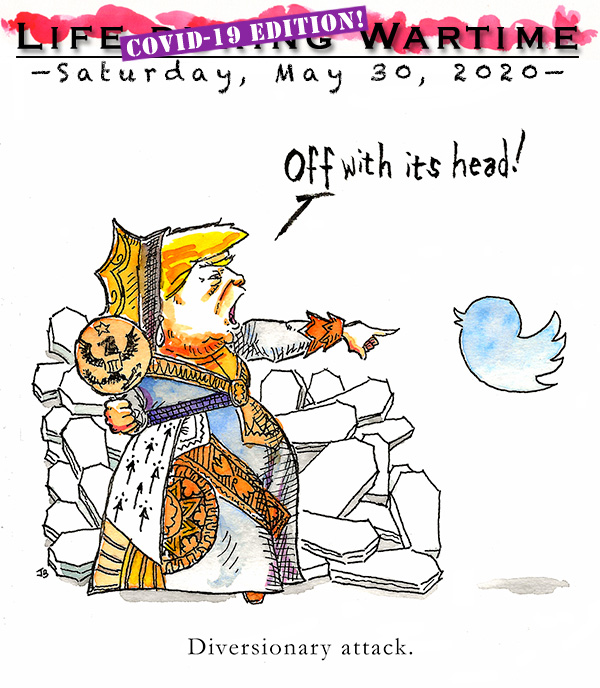
President Trump's now-announced executive order saying that social media platforms should be treated like publishers under terms of the 1996 Communications Decency Act was reportedly in the works for months, waiting for an excuse. That Daily Bees story is also worth reading for the holier-than-thou hypocrisy of Hucksterman and his minions. If tRump had a Facebook account, Zuckster the Huckster would treat him with the same kid gloves as Jack.

The Bees, though, failed to note what Tech Dirt DID: Not only can tRump not rewrite law, not only can he not replace the federal court system and its jurisprudence, even in the areas where an executive order might carry weight, this one is nugatory and meaningless.

The reality, as an Australian state-level supreme court ruled recently with Google, is that these folks ARE publishers. But publishers have biases all the time. Let's stop pretending otherwise. But, if Jack Dorkey's going to be a hypocrite, you and I can jump off, whether permanently or selectly. (My current plan is to stay off Twitter for a couple of weeks, and then get on just enough to reactivate my primary account, then likely deactivate again and lather, rinse, repeat.)

As for federal law? MUCH of the 1996 Communications Decency Act is flawed and needs overhauling, not just Section 230. Some of it's bad in civil libertarian terms. Some of it's bad in neoliberal capitalism terms, like Section 230.

Specifically, subsection (c)(1) needs to be overhauled. But (c)(2), which is the target of Trump's ire, is OK in my book. Non-Internet publishers do this all the time, and not just with profanity. If wingnuts don't like Twitter, they can go to Gab. Unfortunately, left-liberals and beyond have failed to start any alternatives that I know of, and general social media alternatives? MeWe is OK and easy to use, but more tumbleweeded than Google+. Mastodon struck me as being as clunky as a mastodon. Ello became a British MySpace.

Since Al Franken et al struck out on Air America, a specifically left-liberal and beyond (or even "pergressuve") major effort in Gnu Media just hasn't happened.

Now, what would it mean legally to reject (1) but not (2)?

Per that Aussie case, first of all, it would mean hiring more humans, and paying them better, to clean their Augean stables.

Second, it would force more governments to establish a formal complaint process for notification of these companies, with civil liability if they fail to haul down material without establishing good cause otherwise. As of now, the Good Samaritan clause leaves them non-liable in the US even after such a notification. And that's the crux of the issue — inadvertent initial acceptance of uploaded material on social media sites, or inadvertent search returns on news aggregators, versus willful retention of such material after notification. In essence, because companies hire people to look for offensive material, they are using publication standards.

Third, while it wouldn't put the "old mugshots, old records" people out of business, they'd be living a more marginal live than robodial phone callers.

Fourth, in the case of Google and some search engines, it would likely increase civil liability in some narrow ways on paid search results, to a similar degree of conventional media and advertisers, per the last part of my "second" paragraph.

Fifth, it might lead Google and other search engines to proactively block more search results. That would increase the so-called "dark web," but again, print versions of that, and some pirate radio versions, existed before the Internet. I mean, the average American couldn't find snuff films (to the degree any actually existed and the whole idea wasn't just urban legend) 30 years ago.

In other words, the situation re Section 230 as a whole is more nuanced than the likes of EFF claim. The reality is that Congress could nuance both it and other areas of the CDA that need it without running afoul of either the original or later First Amendment worries.

Counter-commenters might cite, oh, the Seth Rich conspiracy theory. Yeah, but that appeared in traditional media, and Seth's relatives sued Fox and Washington Times. A district court tossed the case, but an appeals court — rightly, IMO — reinstated it.

==

Update, June 11: Ars Technica has a long discussion of Section 230 and possible options. Ben Wittes' "reasonableness exceptions" at the bottom of the piece is exactly what I would support.

June 17, 2019

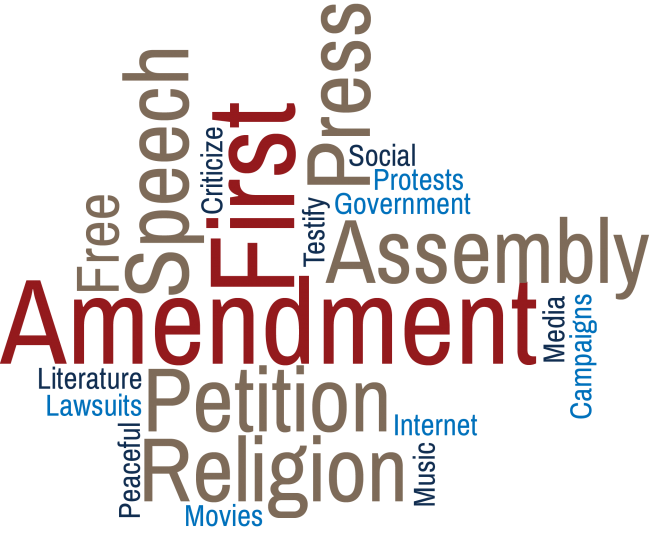
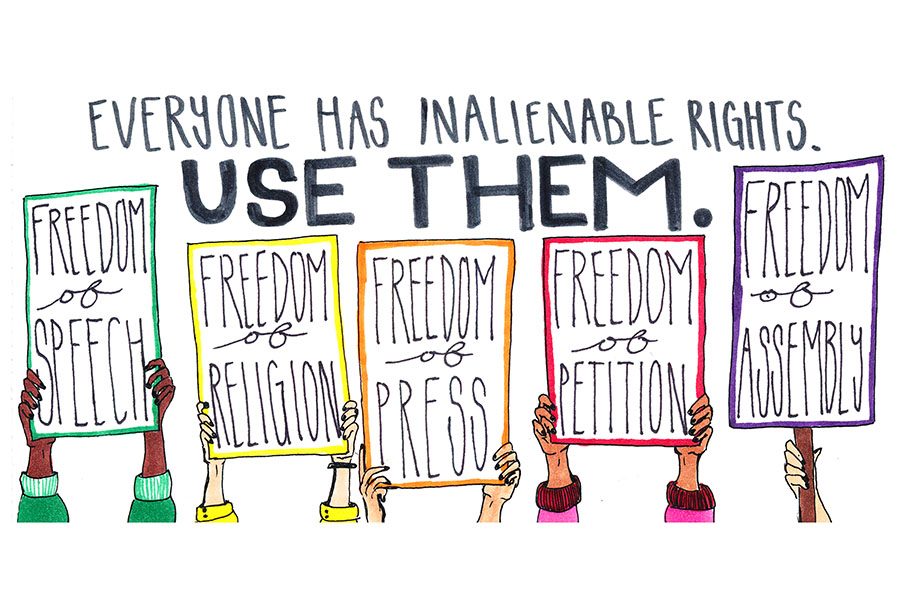
There are five clauses to the First Amendment

And, unfortunately, all five of them face more headwinds in today's America.

Here's some of the details on the problems.

As the arrest of Julian Assange has shown:
  • The media thinks there's only one clause;
  • It thinks that clause is a blank check;
  • It's totally indifferent about two of the other four.
The general public?
  • The winger portion thinks that one clause is a blank check;
  • Much of the left and right, conservative and liberal, winger and not, doesn't actually care for the central clause;
Much of the public cares even less for two other clauses.

So, first, a link to the actual amendment.

The five clauses are, to inform the unfamiliar:
  • Freedom of religion;
  • Freedom of speech;
  • Freedom of the press;
  • Freedom of assembly;
  • Freedom of petition.
Per the first and second bullet lists?

The press does often think that "freedom of the press" is a blank check in many times, not so much to libel, but to print information that is secluded — whether public sector or private sector — without impunity.

Often, such information needs to be published. At other times, it does not. The process of working through this is called "editing," something Julian Assange couldn't bother himself to do.

The press is indifferent about the last two clauses, especially the freedom of assembly. When presidents used "national security" after 9/11 as an excuse to put protestors at their events in protest pens blocks away from their appearances, and allowed political parties to do the same, national and big regional press said nary a word.

Since then, while the media has called out anti-BDS bills as a violation of freedom of speech, it has ignored that they're also an infringement of freedom of assembly, since that's exactly what boycotts are about.

Ditto, since the election of Trump, when wingnut Congresscritters have blocked alligators from commenting on their social media accounts, big media has ignored this infringement on freedom of petition.

The general public?

Wingers of course continue to deny Jefferson's "wall of separation" on church and state, including the descendants of the Baptists who applauded Jefferson. They also continue to lie with claims we're a Christian nation.

The general public has, in repeated polls over decades, indicated that it's willing to have freedom of speech restricted on national security grounds, which is bad enough, but on lesser, even much lesser grounds.

In reality, the First Amendment cares not for decorum or style, nor about upholding actual or alleged traditional mores.

Also, the general public often has little more concern for freedom of assembly than the press has shown. Many have not worried about elected officials engaging in social media blocking; in fact, wingers have often applauded it.

Finally, as I noted recently, specifically about Stephen Breyer, "librul" Supreme Court justices don't care a lot about the freedom of assembly or freedom of speech portions of the amendment.

June 18, 2015

#SCOTUS says #Confederate flag not free speech; #hypocrisy alert?

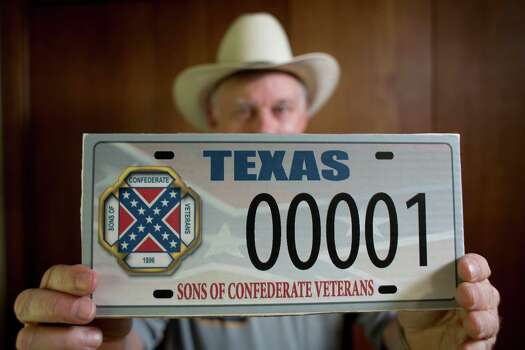
More specifically, the Supreme Court has said the state of Texas can ban the Sons of Confederate Veterans from being part of the state's vanity license plate program because of its use of the Confederate flag.

This is a tough issue, but I generally disagree with Gov. Greg Abbott, who led the push for the ban. The Sons of Confederate Veterans has had local chapters that have been squirrely, but, how else do you put the SCV on vanity plates without the Confederate flag?

Here's the backstory:

In 2010, the Texas Department of Motor Vehicles Board denied a request from the Sons of Confederate Veterans' Texas Division that the state issue a license plate featuring the group's name and a picture of the Confederate flag. The board said it denied the application in part because "a significant portion of the public associate the confederate flag with organizations advocating expressions of hate directed toward people or groups that is demeaning to those people or groups."
This, of course, gets into issues of hate speech vs. actual hate crimes, and many other things. 

The easy answer is to get rid of vanity plate programs in general. Here in Tex-ass, that would have the advantage of killing off another privatization contract, for starters. (Here's the details of the current contract.)

And, if a pattern of hateful speech eventually becomes part of criminal activity, as with Charleston shooter Dylann (sic) Roof reportedly  displaying a Confederate flag license plate, you then prosecute for a hate crime.

Otherwise, this is just like Adopt-a-Spot programs that have highway road signs. States, when someone like a Ku Klux Klan local has become an Adopt-a-Spot volunteer, have simply killed the public signage for the program.

It's interesting that Clarence Thomas was part of the majority. Given that he's been more philosophically consistent on the Court than Nino Scalia, and has opposed many affirmative action programs, it's interesting indeed. The Atlantic has more on his flip-flop, which does stem from his Southern background. Now I'm back to questioning his intelligence, if he can see no link between Southern white intimidation of blacks and the need for some type of affirmative action. There's good in-depth analysis here of Thomas in particular and the majority in general.

And, isn't that, my "get rid of vanity plate programs in general," reminiscent about what John Roberts has said about affirmative action?

"There is no honor among Supreme Court justices."

And, the ACLU and Americans United for Separation of Church and State, among others, agree this is censorship.

January 16, 2015

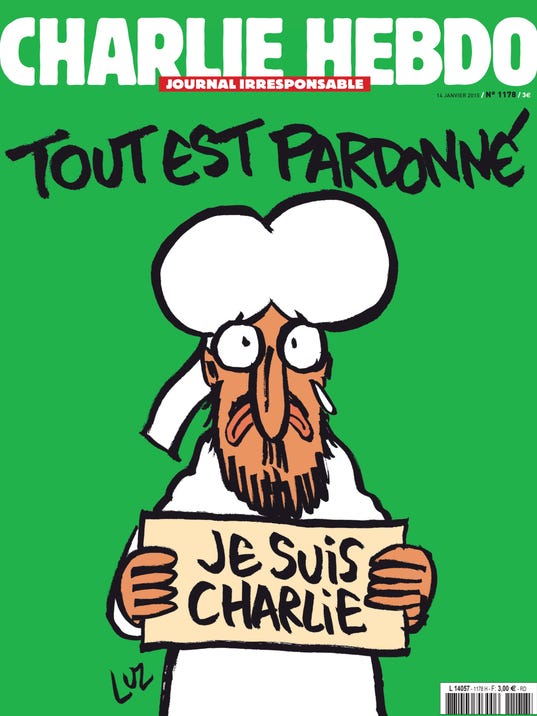
Professional thoughts on #CharlieHebdo, #1stAmendment

You may have already read my earlier blog post, with my thoughts about all that's wrong in how so-called social justice warriors attempted to hijack the aftermath of the recent killings of staff at French satirical newspaper Charlie Hebdo.

Now, below, is a an edited version of my own most recent newspaper column, which covered the attacks and issues of free speech — not in France but here in the US.

It would be nice if all were forgiven. Or, if USA Today
would have run other Charlie Hebdo cover art.
The recent attack on the French satirical tabloid newspaper Charlie Hebdo are a reminder that freedom of speech, including satirical speech, is a commodity with an insecure purchase in our world.

It’s also a reminder that journalists, the professional practitioners of freedom of speech, don’t always have the safest jobs in the world. Per the advocacy group Reporters without Borders, in 2014, 66 journalists were killed, 11 assistants were killed, and 19 citizen journalists were, too. Numbers were about the same in 2013.

Charlie Hebdo’s work may not seem “fun” to fundamentalist Muslims, but free speech is free speech, and recognized as such in most of the “developed” world, including but not limited to the United States. (It should be noted that the French magazine doesn’t only skewer Muslims; one cover had the Pope and a Jewish rabbi, as well as a Muslim imam, all demanding the magazine be veiled.)

That said, while the Western world may not totally like Christian and Jewish beliefs and stances getting skewered, it doesn’t generally try to prevent such satire from being published by the media — or from being talked about by the general public.

That’s not quite so true for Muslim-majority nations. Four years ago, the United Nations’ Human Rights Council finally swatted down an attempt to get member nations to criminalize blasphemy. Previous such motions regularly passed the predecessor body to the Human Rights Council, but the United States, followed by the European Union, eventually recognized the free-speech issues that were at stake and voted no.

Various forms of freedom of communication are surely as protected in the U.S. as in modern Europe, are they not? After all, of the 10 original amendments to our Constitution, our Bill of Rights, the First Amendment safeguards exactly these issues.

On paper, yes.

In reality, maybe not so much.

In a country where we have had presidents and congressional leaders of both parties want to control the flow of news, usually on some vague  “national security” grounds, we shouldn’t assume that the First Amendment, and what it’s supposed to protect, is on 100 percent terra firma inside America. If anything, we should operate on a deliberate assumption that the First Amendment is not on such firm ground.

And, it’s not just political leaders; many of the people that make up “We the People” say the same thing. In the past two years, the annual “First Amendment Survey” conducted by the Newseum Institute shows that a full one-third of Americans think the First Amendment’s protections go “too far.”

This is probably a good time to pull up the famous statement by the French literary giant Voltaire:
“I do not agree with what you have to say, but I’ll defend to the death your right to say it.”
It’s also a good point to remind people that the First Amendment has five freedoms. We’re talking about freedom of the press. Many people know about freedom of religion, which most often results in court cases, and, especially over questions about what Thomas Jefferson’s “wall of separation” meant. This, outside of ideas that the press “abuse” their freedom, is usually the area where people think the First Amendment goes too far.

Also worth noting is that African-Americans and Hispanics are actually more likely than Caucasians in thinking that First Amendment freedoms go too far. So too, per the 2013 survey, the younger people are, the more likely they are to think that the First Amendment goes too far. (Whether this is related to their having grown up in an "always on" world, and if so, whether that's a cause of, or a result of, them being more willing to surrender First Amendment rights and related civil liberties, I don't know. But, it is a good issue, and as ever more people enter adulthood from an "always on" world, one to keep an eye on.)

But, those are just two of five freedoms of the First Amendment.

Beyond that, the amendment also guarantees freedom of speech in general. If I as an individual, not just as a newspaper editor, want to say something like what Charlie Hebdo does, or utter obscenities, or whatever, I can do that. And so can you.

There’s also freedom of petition. We can write our presidents, members of Congress, governors and legislators, and ask them to undertake specific political actions.

And, there’s freedom of assembly. That includes unionizing, voter registration drives and other public organizing work. More controversially to some, it also covers protest marches by anybody from the Ku Klux Klan to the New Black Panther Party and more.

(I chose precisely this because Marlin, Texas is about 50 percent African-American and about 35 percent Caucasian — many of that number being older, and not fully "reconstructed" whites — and thus knowing that one or the other of the two groups would be offensive to about everybody here.)

I presume that Voltaire would also defend to the death our right to assemble, to petition, and to engage in protests.

If Voltaire is not good enough, then we — and those who think the First Amendment goes “too far” — should remember Nazi-era German Lutheran minister Martin Niemöller and his famous poem:
“First they came for the Socialists, and I did not speak out—
Because I was not a Socialist.
“Then they came for the Trade Unionists, and I did not speak out—
Because I was not a Trade Unionist.
“Then they came for the Jews, and I did not speak out—
Because I was not a Jew.
“Then they came for me — and there was no one left to speak for me.”
If we remove free speech, assembly, religion or petition rights from others, or we think the press goes too far in using its freedoms and try to restrict it, there may eventually be nobody to speak for us.
It’s the same story George Orwell tackled in “Animal Farm” — free speech belongs to all of us and should be defended by all of us, for all of us.

Even unpleasant or antagonistic speech.

That's why I don't like public or private university hate speech codes here in the U.S. Even though I think Steve Salaita is not all that, I still don't like him being tripped up over such codes. Humorous issues of schadenfreude that such codes produce at times, including for tripping up so-called "social justice warriors," when we get to serious brass tacks, I don't like them. And, they're not needed on college campuses anyway. Students who are intimidated by a professor have grievance channels. (And, since as much as 75 percent of teaching staff at the average modern higher education outlet today is part-time adjunct instructors, students are quite likely to win such grievances.)

Unfortunately, the American media has surrendered much of its own playing field on this issue in the last decade or so.

Look at the semi-cowardice with which it has self-censored American battlefield deaths in Iraq and Afghanistan. Or, now, self-censored in refusing to print any Charlie Hebdo covers, even ones like the one at left that skewer all three monotheisms at once, not just Islam. Or, in one case we know of, where an American newspaper pixelated a picture of somebody in New York reading Charlie Hedbo, pixelating the issue's cover, and only the cover.

Back to my introduction to this column and the issue of unwarranted assumptions.

"We the People" should not assume that the mainstream media will remain a reliable guardian of the First Amendment. We shouldn't assume that it always is one today. Certainly not of the spirit of the First Amendment.

We also, as courts continue to look at the issue of bloggers and such as journalists, shouldn't limit our scope as to who is a member of the media, in part due to the paragraph just above.

#JeSuisCharlie.

#IAmMedia.

August 23, 2014

#StevenSalaita is NOT a cause celebre in my book — #schadenfreude!

I had started out planning on just doing a long Facebook/G+ comment, but realized that, like Corey Robin, I was getting into blog-post length.

So, here goes.

Steven Salaita had been offered a tenure-trace position at the University of Illinois at Urbana-Champaign. Indeed, even though the new school year had not started yet, and the board of trustees had not officially confirmed his hiring, he was mentioned in university PR as faculty.

Until the latest Israel-Hamas violence, and a series of Tweets by him related to that, corralled with commentary (not all of which I accept in any way) here, which led the university to rescind his appointment.

And now, per my header, modern academia, as detailed by this piece at Puff Hoes, is making him into a cause celebre indeed.

First, anybody who regularly reads me knows I'm not pro-Zionist or even close to it.

But I, although I am in less than no way a Zionist, and I fully support a Palestinian state, do NOT see Steven Salaita as a cause celebre. Nor, unlike a number of academics, do I see this as a constitutional issue or anything like it. Unlike the likes of Corey Robin, I don't necessarily see this as the Israel lobby doing intellectual judo with the phrase "anti-Semitism," either.

I'll be honest that I'm kind of torn on this. His initial Tweets were fine in my world, but, when he went to wishing that West Bank Israeli settlers would "go missing," he was arguably then in hate speech territory; even if not an incitement to violence, it was directed at a particular class of people, and therefore is arguably hate speech.
You may be too refined to say it, but I’m not: I wish all the fucking West Bank settlers would go missing. — Steven Salaita (@stevesalaita) June 20, 2014
And, I would argue that his "go missing" Tweet, though not specifying how the settlers should go missing, wants them to die, if nothing else. And, it doesn't make any objections to how they might die, if that's part of them going missing. 

Per the last link before the quoted Tweet, I disagree with the defender of Salaita that at worst he was talking about kidnapping; I think at worst, he could be seen as talking about killing.

Why didn't he just say that then?
But if “‘go missing’ refers to kidnapping,” why didn’t Salaita just write “kidnap”? After all, he prefaced his statement with the warning that it was “unrefined” and described the settlers with the expletive “fucking.” Why then, after all the build-up, would he resort to a euphemism?
Erm, because he is smart enough and young enough to know that somebody might be looking at his Twitter account and he was trying to play it both ways? 

Anyway, let us consider that to be hate speech, even if not an outright incitement to violence. We know how academia, including the modern Social Justice Warrior type Left, likes its codes like that, just as much as it likes its free speech absolutism for tenure-track faculty.

Well, first, he had not been officially hired yet. Even if he had, you're not "tenured" until you cross the tenure-track finish line. So, what we have is two SJW codes colliding in a big, steaming pile of schadenfreude. And regular readers of my blog know I loves me some schadenfreude. And, I love the sound of petards hoisting in the morning!

And, that's where Puff Hoes jumps the track into the big steaming pile:
That now brings us to Friday's shocking statements. Chancellor Wise declared that "we cannot... tolerate... personal and disrespectful words or actions that demean and abuse either viewpoints themselves or those who express them." Yet as a matter of well-settled American constitutional law, the University of Illinois must tolerate "words... that demean and abuse either viewpoints themselves or those who express them." 
"Must"? Really? So, should black students then put up with every antic of differently-priced cookie sales and worse done by Young Republican groups? Should women put up with men's rights advocates telling women students that they're "dressing for rape"? I'm sure many people, even if not Brian Leiter, author of the Puff Hoes piece, would disagree.

This all said, I don't give a flying fart if Leiter is a law professor.

Now, one can argue that, as a public institution, a state university has a different standard on speech than, say, a Notre Dame. I'm not a lawyer, but I think that would be a tough sell in the court system still, especially if the state of Illinois also has hate crimes legislation, which could, at a stretch, be brought to bear on matters civil as well as criminal.

That said, per this NPR interview with labor and labor law reporter Steven Greenhouse, even in the public sector, employees' First Amendment rights aren't absolute:
However, if, you know, a government employee does something that really, you know, betrays trust or is direct insubordination or helps an enemy or endangers a nuclear power plant, then the government might say, you know, we have ample cause to fire that person for what he or she said despite, you know, the First Amendment protections of free speech.

I can do that one better.

In my day job as a newspaper editor, the community here fired a police officer for making a socioeconomically biased rant on Facebook. It violated the department's social media policy, which was part of the hiring process. The social media policy was designed to make sure police officers did not appear biased to certain classes of people — very similar to what the university can argue against Salaita.

Even then, though, such protections would apply only after official hiring. Since Salaita had never been hired, he's SOL to put it bluntly. (Related to that, he wasn't fired, because he never was hired.) As part of that, as an educated layperson, I disagree with this post; I think the Illinois case at hand is far different. Especially given that U of I had NOT supported a boycott of Israeli goods and services, I think that the idea, as alleged by some, that board approval would be a rubber stamp is questionable and that, as this layperson understands the term, promissory estoppel may not come into play. The fact that, even though Kubota lost the case at hand, it claimed that promissory estoppel is normally only a cause for defense, not for suit, means that, even with Illinois allowing it here, it's probably got a pretty high bar.

Beyond that, Saltaita's own Tweets would also offer the university additional ammunition against a promissory estoppel claim, beyond their content. The juvenility, beyond just the vulgarity, they should, if otherwise and previously unknown to the university, could be used to argue that it did not know the "full package" it was buying. And, as a non-lawyer, I think the burden of proof would be on Salaita to show that the "full package" was publicly visible and known before this. In other words, in non-legal everyday English, if this comes to a lawsuit, Salaita might need to prove that he was a doofus before midsummer 2014, and that he was a publicly known doofus.

At a minimum, it's not a slam dunk, such a case. Also speaking of slam dunks? College boards of regents don't like being assumed to be rubber stamps, either; that I know. So, legal defenders of Salaita? I think you're overassuming.


I can now also say that the University of Chicago has a current professor of law who understands constitutional law no better than Dear Leader, our constitutional law scholar president.

Whether Salaita should have been non-hired, of course, is a different question as to whether or not the U of I was in its rights to do so.  So, too, is the question of "the Israel lobby" having any influence on this decision or not.

Had he not made the "go missing" Tweet, I would be more supportive of him ethically, even if not legally. But, I think he did go a Tweet too far with that.

Follow-up thoughts

But, let's get back to the schadenfreude at the start of this. The academic Left is going to have to decide whether protected speech is more important than protected classes of people, or not, when the two collide.

Let's go further on the issue of tenure. A lot has been rightfully made about universities, both public and private, using ever more part-time adjunct faculty. However, tenure-track professordom has its own problems. Beyond a Saraita, or a Ward Churchill, whether in appearance or in reality, every large university has tenure-track professors who are lazy, who are bad teachers no matter how much or well they public, who commit sexual harassment and worse. This, like many issues in life, per Idries Shah, has more than two sides.

A third side is full-time professors, without them necessarily being tenured. Now, part of that is removing the stigma from being non-tenured. Related to that, part of the solution may be extending the number of years it takes to get tenured.

Another issue is that of "privilege" (forgive me for sounding like an SJW!) and the First Amendment. Academics (setting aside the public vs private schools issue) and journalists (I'm one, so I can speak) often seem to assume they have a special level of First Amendment protection that nobody else does. And, it seems that the higher one goes up  the academic or journalistic ladder, the more common such views are.

Well, other than the government being differentiated from the private sector, last I checked, no class of persons, including no class of employees, had a special privilege to the First Amendment. And I may blog in more depth on this later. Actually, I'm pretty damned sure I will. I think this is part of why certain strands of upper-tier academics and journalists irritate not just man-on-the-street wingnuts, but right-wing talking heads. And, the irritation isn't 100 percent wrong.

Also, it's clear that this issue is about as politicized as the reproductive choice movement, with both "ends" having little room for centrists of some sort. I guess that, in one sense, that's good; despite some academic liberals claiming that U of I's change of mind shows the power of Zionism, it's more complex than that.

It's also an issue of how many younger people, even ones paper-smart enough to be offered tenure-track jobs in academia, aren't necessarily real-world-smart, at least not when it comes to the issue of electronic "devices," the social media world, etc. And I have blogged about that before.

January 19, 2014

Free speech for me but not thee can always backfire

I'm not quite as much a First Amendment absolutist as Glenn Greenwald is, but, that said, I'd have to say, along the lines of this piece about them, that Massachusetts' selective free speech zones outside of abortion clinics are at least "problematic."

The biggest point is that they can be turned around on others. Having been restricted to just certain areas for protest and speaking at antiwar rallies in Dallas, especially ones around area in which either George W.  Bush or Dick Cheney were expected, I know personally that the old "safety concerns" issue can be expanded to cover a lot of things that pummel the First Amendment into oblivion.

Also being an environmentalist of some sort who has protested more than once outside eXXXon's annual shareholder meeting, and knowing that both the federal government and various states, and their respective law enforcement and investigative agencies have been all too eager in the past to sling around the word "ecoterrorist," gives me further reason to pause at this law. 

The story makes just these points:
If the Supreme Court were to uphold the Massachusetts law, it’s not hard to imagine businesses lobbying to create zones where union members are not allowed to speak, but workers for the business are. Businesses could use the same logic used in McCullen:  the picketers are disrupting business and upsetting customers. So, government, please silence them—even though they are standing on a public sidewalk.

Potter described how liberal activists have made this mistake before.  He said, “Back in the late 1990s…Planned Parenthood was using RICO statutes against anti-abortion protestors.  A lot of civil rights people were saying this is going to come back around to us and sure enough RICO has been used against animal-rights protestors.  The [lawsuits] have failed, but it costs mountains of cash to defend against.”

In an interview, the First Amendment lawyer Floyd Abrams—who is a supporter of abortion rights—described the Massachusetts law as being “as bad as first amendment cases have gotten in a while.”  He said of the liberal groups supporting the law, “They undervalue the First Amendment…and substitute political liberalism” as their guiding principle instead.
But, but, but ... you say. The ACLU supports this!

First, the ACLU's never been perfect on the First Amendment. And, since the days of the Skokie march, and especially in the last decade or so, since Anthony Romero has become executive director, it's slid further downhill. Former board members, harassed off by Romero in combination with then board president Nadine Strossen, and outside critics as well, attest to the fact that the ACLU has become more a liberal special interest group and less a civil liberties organization in general.

Greenwald knows those critiques and basically doesn't discuss them. Nor does he discuss the fact that the ACLU isn't the only civil liberties game in town. One will note that the Center for Constitutional Rights is not listed as supporting the Massachusetts law, at least in this story. (That's not to say CCR is necessarily perfect on such issues.)

Second, Floyd Abrams makes the same point that I made earlier. And frankly, I doubt it changes until Romero moves on. Sadly, I think that's not going to happen before the end of this decade, if that. I think he likes the little fiefdom he's built up.

Plus, as Perkins notes, Massachusetts has anti-harassment law that already covers the intent of this legislation.

I'm sure Pennsylvania also has similar rules. That's why, although a Pennsylvania man is to be congratulated for his work at clinics, he's simply wrong in supporting the Massachusetts law, as well as the reasons he gives for justifying his stance.

March 07, 2011

If Stanley Fish is for it, I'm agin it

The (self-proclaimed?) dean of American pomo philosophers says the Supreme Court got Westboro wrong. For a philosopher of language in America to hold that shows just how shallow he can be.

On language in general, perhaps Fish should read an Errol Morris column.

August 30, 2009

Free speech vs. free democracy

The two issues clash head on at the Supreme Court, in a reargument of the political status of an anti-Hillary Clinton movie.

While this is not an easy case to look at, first of all, it’s CERTAINLY not one that fits within the “originalist” understanding of the Constitution promoted by Justice Scalia and some other members of SCOTUS. And, given both that and the fact the Court seems itching to make a broad ruling, …

I simply have to disagree with both the ACLU and Reporters Committee for Freedom of the Press, with their briefs supporting Citizens United. I feel even more so that way with our current Democratic president having helped wreck remaining shreds of public campaign financing by opting out of the system.

And, we now see the results in his fiscal policy, and the advisors thereof.

And, contra RCFP, this isn’t a ruling on “news,” it’s a ruling on advertising, which has NEVER had the same level of speech protections.

On the originalist side, the Founding Fathers simply did not envision:
1. A nation of more than 300 million people
2. Corporations being declared “persons” before the law by a previous Supreme Court
3. The exploitation of that ruling
4. Or many other related things.

Yes, a broad ruling the other direction pushes us in the direction of government censorship. I hope for a narrow but good ruling.
-END-

November 11, 2008

Fake Egyptians want real religious freedom

Will SCOTUS grant it?

The religion which calls itself Summum is a bit “interesting,” indeed. Between the story and the picture, I think you can understand how “fake Egyptian” is a good description.

Nonetheless, as King Ed said about some South Sea Islands king either being a real king or else just a dark-skinned brute, Summum, in terms of the First Amendment, is either a real religion or fakery.

And, it’s now in the lap of the Supreme Court to decide that issue nearly so much as it is to decide the connected issue of whether it then deserves First Amendment protections.

In 2003, the president of Summum church wrote to the mayor of Pleasant Grove City, Utah, asking to erect a monument inscribed with his religion’s Seven Aphorisms in the city park, “similar in size and nature” to the one devoted to the Ten Commandments.

The city said no, and the legal battle was on.

Both the relevant federal district court and the 10th Circuit Court of Appeals have ruled in Summum’s favor. SCOTUS has said cities can’t discriminate on pamphleteering in public places, but has yet to give an explicit ruling on donated religious objects.

Mayor Michael W. Daniels is spinning this as a history issue:
Only donations concerning the city’s history are eligible for display in the park as a matter of longstanding policy, he said, and only when donated by groups with a long association with the city. The Fraternal Order of Eagles, a national civic organization, donated the Ten Commandments monument in 1971.

But it’s really not that.

As for whether it’s a religion or not, beyond the Supremes, I guess the IRS is the final arbiter.

And, SCOTUS won’t be tackling it on that legal angle anyway, even though that’s the undercurrent.

The case instead is proceeding as a free-speech issue, hence the possible parallels with religious pamphleteering.

And, that said, I don’t know whether that angle will make it easier, or harder, for “civil religionists” like Nino Scalia to overturn the appellate court.

November 09, 2008

Judge doesn’t understand either free speech or taxpayer rights

A federal district judge in Denver has upheld BushCo booting three protestors from a taxpayer-funded appearance and speech by Bush.

District Court Chief Judge Wiley Daniel ruled the protestors had no right to be at an invitation-only event, despite it being taxpayer-funded and despite them getting tix from a GOP congressman. He said that previous courts had allowed a restriction of speech at presidential events.

At the same time, Wiley conflated speech rights and free assembly rights with this gem:
"President Bush had the right, at his own speech, to ensure that only his message was conveyed," Daniel wrote. "When the president speaks, he may choose his own words.”

Uhh, judge? A bumper sticker did nothing to interfere with Bush’s speech.

To quote Ronald Reagan, “Mr. Bush, We the People paid for that microphone.”

May 09, 2008

Friday scatblogging — pornworld edition

Let’s just jump right to the facts:


Next month, Ira Isaacs, a 57-year-old Los Angeles–based video director, will sit center stage at what may be the most extreme obscenity trial in U.S. history.

There's no question the titles are extreme: Laurie’s Toilet Show, Mako’s First Time Scat, Gang Bang Horse (Pony Sex Game), and Hollywood Scat Amateurs No. 7 — the last of which Isaacs directed himself — feature coprophagy and bestiality.

So, is this “art,” or even if we aren’t that charitable…

Meanwhile, that’s not just a head, that’s art that Radar has to lead off the story. (If you don’t believe it’s art, read the artist’s name that’s part of the photo URL.)


(If you don’t believe it’s art, read the artist’s name that’s part of the photo URL.)

But, the bottom line is …

Is it free speech? (Isaac’s videos, that is.)

Hell, yes.

The government dropped two counts that Isaacs didn’t properly document the age of people in the films. So, it’s just over what is “obscene.”

Frankly, the whole “(no) redeeming social value” criterion is obsolete from where I sit.

First, what social group or subgroup are we talking about? Can Isaacs claim that a jury of his peers should consist of likeminded hardcore porn producers?

Without agreeing that what Isaacs produces is “art,” I don’t doubt that what he produces makes money, enough money to show there’s a fair-sized social group getting some sort of “redeeming” value from it:
There was a guy who shit in a can and sold it for the price of gold. [In 1961, Italian conceptual artist Piero Manzoni canned his feces in 90 tins and sold them for the price of their weight in gold.]

About when he got busted:
There’s FBI all over the place. But I’ll tell you, they were very, very pleasant people. They were really nice. Those guys would rather be fighting terrorism than being the sex police. The FBI guy was as curious as you are. He asked me, “Off the record,” he asked me, “How do you convince girls to do this kind of stuff?” I said, “I do it very well.”

I am laughing my head off at some Mormon FBI agent from BYU or University of Utah (the FBI explicitly recruits both campuses) taking notes, and a “Hmmm” moment hitting the back of the frontal lobes of this straitlaced Mormon brain.

Meanwhile, federal prosecutors know they don’t have much of a case, I guess:
They offer me a plea deal. I met with them at the beginning of March [2007]. They say, “Take a year and half.” I said no. Then they call me up, and they say four months in prison and four months house arrest. And I turned that down.

Shit, they’re begging, just to get a conviction for some BushCo U.S. Attorney to mail back to D.C. and Alberto Gonzales (at that time).

And, Isaacs has irony:
The only thing I regret is not putting Bach in the background.

I agree that the feds will have a hell of a time trying to convict him in LA.