He's got leverage in this huge drought, which has led the federal government to declare one-third of the nation's counties disaster areas and therefore eligible for relief of some sort.
We've already gotten statistical research indicating global warming made last year's Texas drought more likely, and we're learning more and more about details of climatic tipping points.
Add in that much of the area affected by drought is at least "reddish" in American political terms, and President Barack Obama has his opportunity.
No big federal disaster relief for all these counties until red-state Congressmen and Senators get real about global warming.
Of course, even if this weren't an election year, Dear Leader wouldn't do that. But, he should.
Because, as Bill McKibben has noted in his hard-hitting new piece in Rolling Stone, the clock is REALLY ticking. The 2-degree Celsius change that climate scientists were hoping to avoid? Sorry, that's already cooked in the bag. Even 3C probably is. The worry now is that we might have a 5-6 degree change, or 10 degrees Fahrenheit, by the end of the century.
That said, McKibben notes that, especially since the midterm elections, Dear Leader has been more of the problem than the solution.
This would be a golden opportunity for a truly liberal president to have some cojones, and do the political equivalent of a Thomas Kuhn scientific paradigm change. There's so much to fight — fossil fuels, A/C electric use feedback from the heat, and more.
And, it's not being fought.
Meanwhile, can "nudges" work to change people's thinking, and inertia? Possibly, argues one columnist, though we should note this only applies to people with some inertia on the issue, not denialists.
David Leonhardt, meanwhile, says we should be optimistic about not just the U.S., but the world, adequately addressing these issues. I often agree with his columns, but, to be honest, I think he's smoking something this time.
The amount of electric power to get us using more full electric vehicles, or at least plug-in hybrids, is going to be massive. Even more so for China and India as more people want cars. And, while that cuts down on oil drilling, it increases mining for materials for the batteries.
More thoughts of mine on red-state farmers, drought and global warming here.
July 20, 2012


#GnuAtheist fail — civics
 |
| Ron Lindsay |
Along with that, I critiqued him for seeming to hold the idea that we could narrowly address the issue of campaign finance money and the rich, and not address income inequality and larger social issues. So far, after my last comment on his blog post, he has yet to address it, and he's indicated he doesn't plan to speak further in general on the issue.
Well, Lindsay as a lawyer knows that when you present a case for something you marshal evidence for it. He knows as a philosopher thta when you make quasi-propositional extended statements, that could be construed as an argument in the philosophical sense, you offer warrants for it/them.
So, what is "irrational" about many Americans' attitude toward not just the wealthy in general, but more specifically, growing income inequality? (Lindsay, by the way, also never tackles the issue of income inequality.) Anyway, can you present specific examples of such "irrational" beliefs? I can surely present rational counterexamples. And, we can offer them to the "jury" of the broad skeptical community.
Also, how can you appear to believe that money's influence on political campaigns can be disaggregated from larger social issues? And now we're going to get to the "civics" behind this post's title.
If one looks at the Gini coefficient, a common measure for income inequality (the U.S. is as bad as Mexico, by the way), and compares it to a list of countries based on how free they are (the Wikipedia one, based on Freedom House, is good but not great), the two track fairly closely. Now, there's no way to prove causal correlation, there's enough tracking closeness, with enough "subjects," of individual countries, involved to make a reasonable, a rational, Mr. Lindsay, assumption that there is causal correlation.
And, it's probably both ways. Less free governments tend to enrich their own members and close cronies (the old USSR a prime example). Richer countries tend to have the wealthy work to bend economic, tax and other policies to their ends. The power they gain can intimidate the press into not risking losing ads, or now, trying to control Net content, or work with the government to send it private information, and much more.
For Lindsay not to take into account any of that is an eyebrow raiser. Because, if wealth isn't an issue for humanism, if even the unmentioned issue of income inequality isn't an issue for his brand of humanism, isn't broader issues of freedom and equality before the de jure law as well as the de facto one?
And, in a note to libertarians in general, whether Gnu Atheists or not, that's another reason for progressive taxation and worrying about the influence of concentrated wealth.
Update, July 20: This blog post of mine, about Bastille Day, reminds me of something else related to Lindsay's stance. I say there that the U.S. has often tended to emphasize liberty to the point of downplaying equality and fraternity. And, greater income inequality certainly undercuts ideas of fraternity, and makes claims of equality before the law ring hollow. I think also of FDR's Four Freedoms.
July 17, 2012
Why the media and pundit silence on Geithner?
Mitt Romney's alleged misstatement to the Securities and Exchange Commission about when he left Bain Capital (1999 or 2002? or maybe later?) is getting plenty of airplay, including his own fun attempts to explain it away.
But Treasury Secretary Tim Geithner's alleged blind eye to Barclays' manipulation of interest rates from 2005-2009 while he was president of the New York Federal Reserve, which I blogged about last week? Almost crickets, relatively.
And, I have a theory about that.
Republicans, and conservative pundits, haven't attacked Geithner for a specific reason. They know he helped their rich, bankster-type allies, very, very much over those years. They know that he was in their corner.
And, they know that to bring attention to any of this would bring that dirty, messy corner back to light.
Now, that means Obama, other top Democrats and Geithner himself are getting a bit of a pass from conservative flaks right now. (For example, Rush Limbaugh could attack Geithner, but all he can do is say Obama hates America and similar nonsense.)
Now, what about the liberal punditry side? Naked Capitalism has talked about the Barclays-Libor issue somewhat, but with a broader focus than just Geithner.
To name a name, who is knowledgeable about economic issues and a heavyweight among mainstream liberals, what will Paul Krugman write and when?
July 15, 2012
Your Romney-Obama criminality photo of the day
I saw another version of this photo on Facebook, and I fixed the second caption so it's correct.

Just a friendly reminder, in this blog post, of just what that second caption, on Geithner, is all about.
Just a friendly reminder, in this blog post, of just what that second caption, on Geithner, is all about.
Coming up: Worst presidential election since 1924
At least concerning the two major candidates, the GOP's Mitt "Bain of the working class" Romney and Barack "Dear Leader" Obama, this is quite arguably the worst presidential election since that of 1924.
And, I'm not joking. Obama-Romney is worse than W. Bush-Kerry, or Poppy Bush-Dukakis. I really have to look back decades for a race this bad, in my opinion, between the two "major" candidates. Both are tools of the rich to some degree. Romney may have perjured himself on an SEC filing statement about Bain Capital. Obama's Treasury Secretary, Tim Geithner, arguably was an accessory to fraud for four years as president of the New York Federal Reserve.
The 1924 campaign was the last time we had a clearly Wall Street-loving Republican running against a me-too (conservative in 1924, neoliberal today) Democrat. The only difference was that Republican Calvin Coolidge was the incumbent while me-too Democrat John W. Davis was the challenger.
As the Wikipedia article notes, this was one time when a third party was not just viable enough, but had enough of an "opening" for its candidate to win electoral as well as popular votes. Progressive Robert La Follette won more than 16 percent of the popular vote and the state of Wisconsin.
Ahh, if Green Party candidate Jill Stein could only hit that level, and force the Commission on Presidential Debates, the group so secretive it has NO contact information on its website, to let her into debates.
And, it's not just me that thinks this is a turkey.
A recent Gallup poll said youth turnout, by the age range of 18-29, could be down 10 percentage points from 2008. Yep, that Obamiac young people's enthusiasm of four years ago is dead as a doorknob.
Gay rights? Reluctant change. But, the banksters, regulation, civil liberties, the economy and other things, not so much. The book is out still on many aspects of business-friendly neoliberal Obamacare.
July 14, 2012
Bastille Day: What we could learn from France
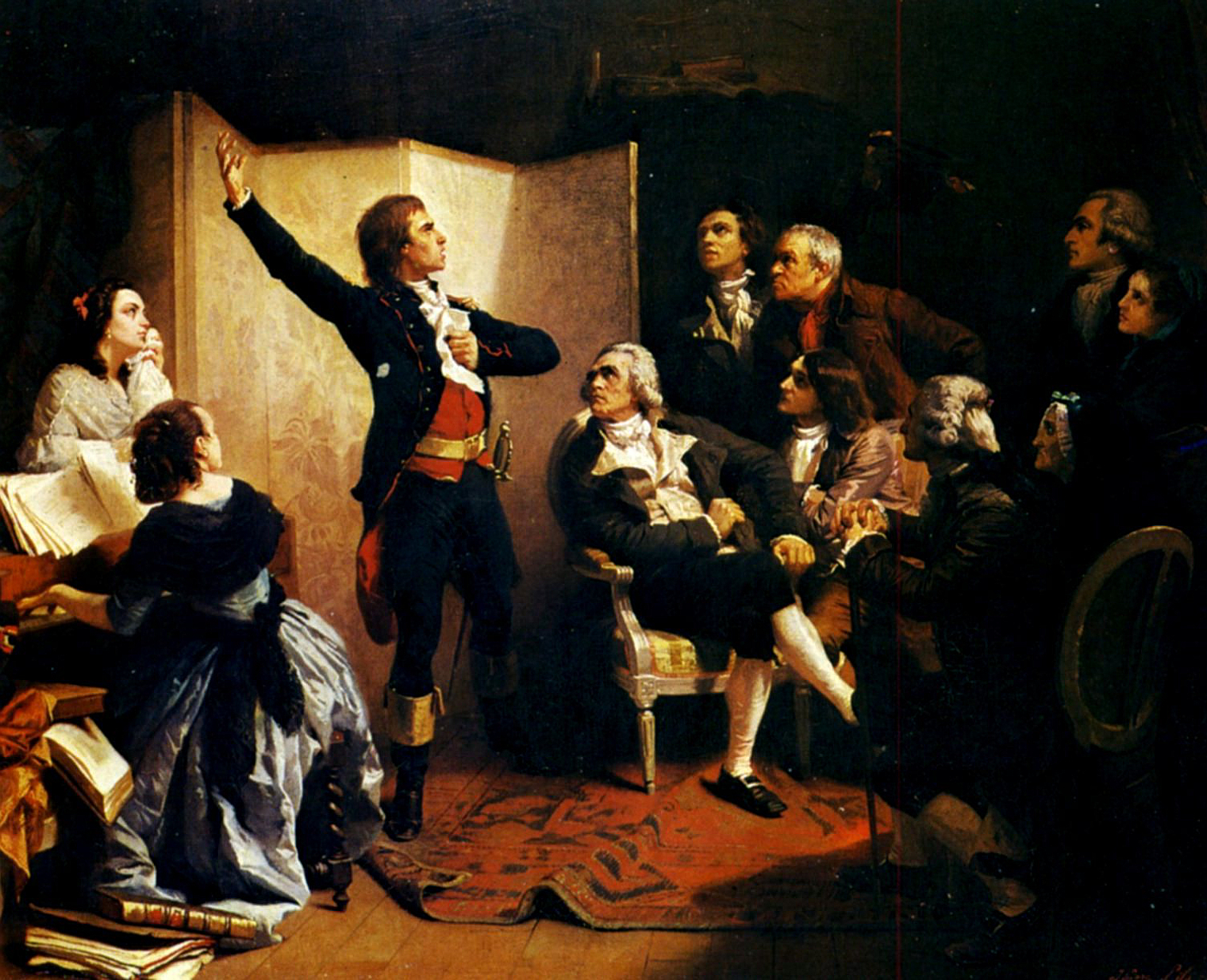 |
| Rouget de Lisle, composer of La Marseillaise, sings it for the first time./Wiki |
Has there ever been a modern national anthem quite like it? Yes, The Star Spangled Banner can sound more martial, God Save the Queen/King more stately and O Canada more ... "spiritual"?
But, none of them is as stirring as La Marseillaise. And none tells the story of creating a modern republican nation.
The call to "citizens." The resistance to invasion and monarchs/tyrants.
And, the French Revolution's background of "liberty, equality, fraternity."
The U.S. Founding Fathers, certainly those of the Constitution, focused on only the first of those three words. Even Jefferson, with his Jeffersonian yeoman farmers, wasn't exactly interested in too much fraternity, and certainly not in equality for non-white folks.
Indeed, for those whites, even (and just males at that, of course), the first real de facto nod toward equality and fraternity had to wait until the time of Andrew Jackson.
And, the legal nods toward that, and for blacks, at least (Indians still not in the mix) had to wait until Lincoln and then the three great post-Civil War amendments.
However, equality and fraternity still have a sometimes precarious purchase in the American social psyche.
Many Americans deny the existence of socioeconomic classes in our country, even as study after study shows less social and income mobility exists here than in old Europe. Fraternity? An Ivy League degree sets you apart, no matter your political leanings. (That's not to say that France and Britain, at least, don't still have some issues with this today, too.) We're well behind Scandanavia, Holland, and some other European countries on these two issues.
And yet, the myth gets peddled, in part as part of the larger myth of American exceptionalism, that we're doing just fine on these two words, to the degree we think about them at all.
We're not.
Subscribe to:
Posts (Atom)