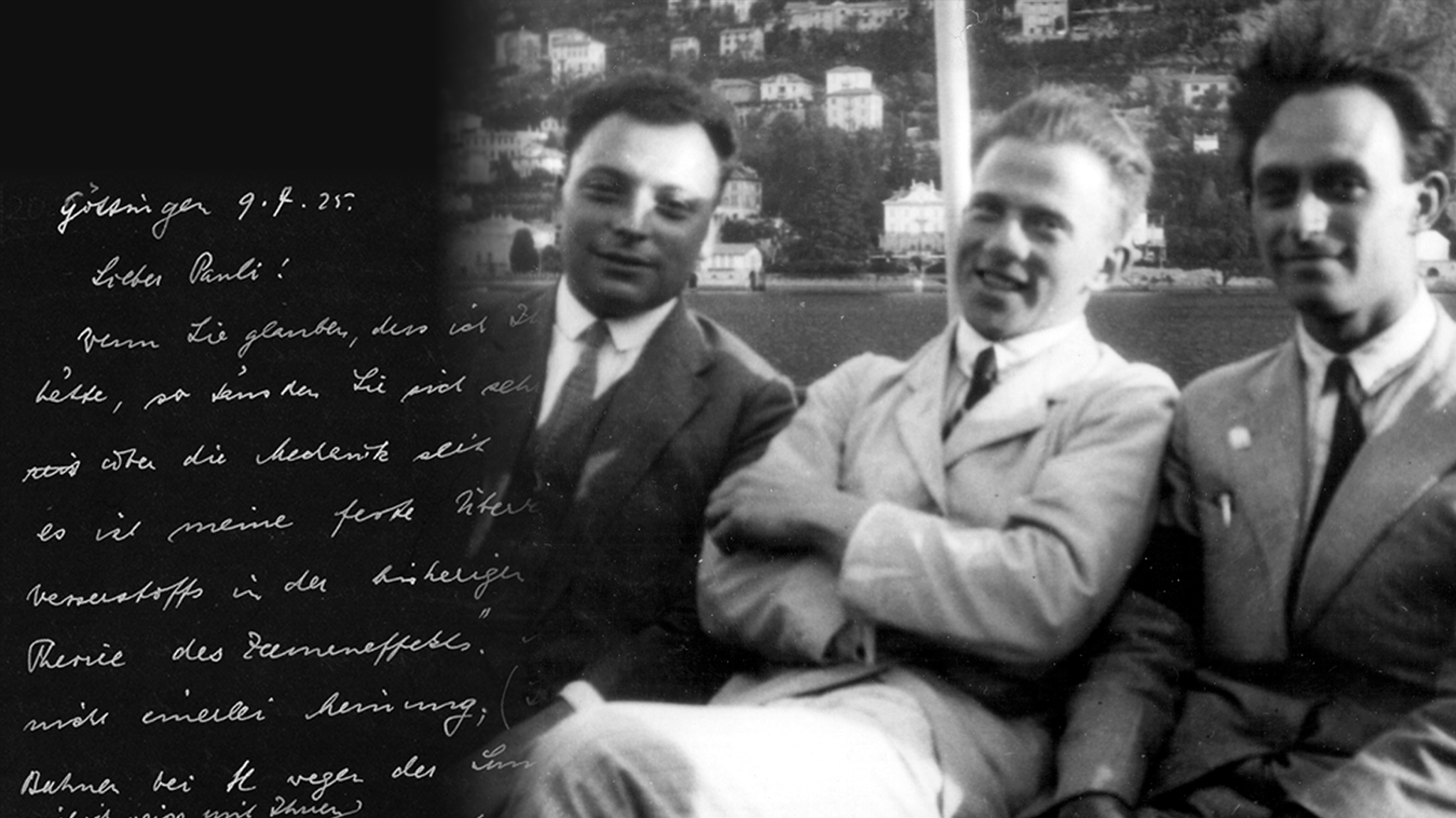
Left: The first lines of the letter sent by Werner Heisenberg to Wolfgang Pauli on 9 July 1925, explaining his efforts to interpret quantum physics differently. (Copyright: Heisenberg Society) Right: Wolfgang Pauli, Werner Heisenberg and Enrico Fermi take a break by Lake Como during the 1927 International Congress of Physicists, where the new quantum mechanics was discussed in depth. (Image: Wolfgang Pauli Archive, CERN)
I'm a day late, but, via Joe Costello, redeeming himself, July 9, 1925, per CERN, is when Werner Heisenberg officially told Wolfgang Pauli that he was going to get rid of this whole nonsense of "orbits" (that unfortunately is still taught in many places in Merikkka at the elementary level and even beyond).
Note I said quantum mechanics, not quantum theory. That, of course, without him fully realizing what he was doing at the time, and instead postulating to evidence, was 125 years ago, when Max Planck simply couldn't solve black-body problems in terms of classical physics and so proposed the "quantum" as an indivisible, granular unit of energy.
From that, among many other things, arose Niels Bohr's "planetary" model of atoms, with electrons rotating atomic nuclei (neutrons still unknown) in orbits. Despite Bohr being his mentor, Heisenberg vowed to kill this.
CERN quotes from his letter to Pauli:
“All of my pitiful efforts are directed at completely killing off the concept of orbits – which, after all, cannot be observed—and replacing it with something more suitable.”

Eventually, his matrix mechanics were shown to be inferior in SOME WAYS to Erwin Schrödinger's wave mechanics.
But, Heisbenberg was still king of the hill, as he showed two years later when, in response to Einstein himself at the famous 1927 Solway conference, he articulated the Uncertainty Principle, which remains the "one ring to bind them all," not just of quantum mechanics, but also of gravity and Einstein's special theory of relativity.
Einstein's reaction was itself wrong on the reaction, but right on the insight of what Heisenberg meant.
"God does not play dice with the universe."
There is no god, not even in the sense of him and Spinoza, since physical "laws" are empirically based and Einstein's own rejection of a cosmological constant turned out to be a bad move — based on empirical data.
And, to the degree this phrase is seen as confirming Einstein as a physical and also a philosophical determinist, he was wrong there — as wrong as little Bobby Sapolsky, whom I just murdered recently. (Figuratively!)
Contra both these? I quote Julius Caesar:
"Alea jacta."
That's the bottom line.
Einstein was right to see how the principle, as articulated by Heisenberg, meant the universe had a fundamental "graininess," which translated into a fundamental indeterminency. That, in turn was not something in either Special or General Relativity.
And, speaking of wrong? Schrödinger was wrong about his infamous cat.
And, Kurt Gödel refuted Einstein even more, along with Alfred Tarski


No comments:
Post a Comment