I previously blogged how I did not lie the idea of St. Louis Cardinals manager Mike Matheny starting Lance Lynn in game two of the divisional playoffs against the Pittsburgh Pirates.
And now, we've seen how that resulted. Lynn gets hammered. Three doubles and one HR. Can't even get out of the fifth inning.
Even though it would have meant three rookies in a row in the rotation after Adam Wainwright, I preferred, as I told a friend last week, the rotation of Waino, Shelby Miller, Joe Kelly and Michael Wacha (or flip 3 and 4). Yes, I know Miller's innings count is getting up there. So, you pull him after six; it's the playoffs and you're just running a four-man rotation, so you've got a deeper bullpen.
That said, what if there's more?
Per said friend, what if Miller's on an innings count limit, like Stephen Strasburg was last year with the Nationals? I've not seen anything that's pretty "hard" in the rumor department on this, but it could well be true.
If so, then the Cardinals' brass, in a different way, have handled a semi-shutdown of Miller about as badly as the Nats handled a full shutdown of Strasburg last year.
Here's why? If this is a semi-shutdown, even, then WTF is Miller doing coming out of the pen in the eighth inning when you're already down 6-1? Even if it's NOT a semi-shutdown, what are you doing having him pitch a "waste" inning in a blowout?
This is just totally stupid.
And, if he is on a semi-shutdown, make it a full shutdown. Keep him off the roster next round of the postseason, if we have another round and don't have to second-guess you. I mean, you're not fooling other teams. We know that Miller won't start this round. Assuming the Cards advance, Mike, unless you immediately announce that he's part of the rotation, opposing managers will assume he's not.
And, if there is no semi-shutdown, then don't pitch Lynn any more this postseason. As ESPN's game story notes, this is the third straight postseason start where he's spit the bit. Mike, his "strong finish" this season was generally against weak teams.
Back to Miller, and the specifics of how Matheny used him, though.
But, even if there is a semi-shutdown, and you think he can do something out of the bullpen, this was still a "waste." Have Kevin Siegrist pitch another inning, instead.
Beyond that, I don't believe in "semi-shutdowns," anyway. If you believe in strict inning or pitch limits for a season for rookie pitchers, then stand by your belief and shut him down. A straddle like this is only worse, if you are concerned about his arm. And, again, it's not fooling anybody in future postseason rounds, either.
That said, if you are a Cards fan, and you've read through my rant, take a minute to vote on my postseason odds poll, too!
Anyway, with one more win, we'll find out just how Matheny feels about Miller, and whether there's any truth to this speculation. Given the way Lynn sucked canal water, I definitely don't want him on the mound in the NLCS.
October 05, 2013


Why the federal shutdown won't end soon

"We're not going to be disrespected," Rep. Marlin Stutzman (R-Ind.) told The Washington Examiner. "We have to get something out of this. And I don't know what that even is."Nuff said. (If you're unfamiliar, this Examiner is not part of the national chain of exploitive, "be your own publisher" blogs, but rather is one of the outposts of Philip Anschutz's money-losing wingnut papers. In DC, the Examiner arguably makes the Moonie-run Washington Times look sane on occasion. Anschutz also owns the Weekly Standard. Nuff said there, too.)
More posturing, by Rep. Tim Griffin, during the DC woman's strange behavior.
Griffin had tweeted, “Stop the violent rhetoric President Obama, Chuck Schumer and Nancy Pelosi. #Disgusting” from his personal Twitter account, a few minutes into an active shooter situation on Capitol Hill that put the Capitol complex on lockdown.Maybe we didn't have nuff said earlier, Timmeh?
Reason 2: The branding war has broken out. Faux News says it's a "slimdown" not a shutdown.
Yeah, right. But, let's follow up on Faux:
It's a slimdown. It's a slowdown. It's a dietary shake for the 47 percent who are getting fat of Obamacare!Sincerely, Mittens A. Romney.
Reason 3: Related to No. 1, the GOP can't agree on what the fight is about.
Reason 4: In standing up to tea party hardcore folks, Speaker of the House John Boehner at times has less gonads than President Barack Obama. That said, that's true of all the House GOP leadership. That's why Majority Leader Eric Cantor refused to challenge Boehner after last year's elections.
Reason 5: Ted Cruz, who can't even apologize right, even when it involves World War II vets who are theoretically tea party constituency types in many cases.
Reason 6: Other Tea Partiers are blaming everyday government employees trying to do shutdown-related work for the problems this causes.
Reason 7: There's plenty of hypocrisy in politics in general, but Democrats proposing a bill to stop paying Congress' salaries during the shutdown is a great "callout" of the GOP. Let the branding war step up. Because, per that No. 2, and previous GOP messenging, from "death panels" to "death taxes" (add in gun violence and we could ask, "What is it with today's GOP and death?")
Reason 8: Based on 2 and 6, contra some media folks who still play the "equivalence" game, other Democrats, or so it seems, are not going to lay down in the road for Ted Cruz, Marlin Stutzman and other radicals. And, speaking of that, this is not "equal fault."
These folks, as I said in a comment elsewhere, are whiny titty babies who are apparently convinced they can't win the Senate to go along with the House in 2014, let alone win the presidency after that. They're holding their breath until they hope they can get the nation's collective face to turn red.
And, over what? Obama is not socialism, unless you want to talk about corporate socialism in a bill largely crafted by America's Health Insurance Plans, the industry's lobbying agency. But, then let's talk about ethanol subsidies, oil depletion allowances and much more.
Reason No 9, IF it pans out: Boehner is now claiming that, at least, he won't let the government default. Well, let's see how many "attachments" he puts on a debt ceiling bill and if he can get enough "moderates" in the GOP to go along.
However, "Tailgunner Ted" Cruz has already made his opposition to this clear.
And, besides that, it turns out that Boehner was apparently lying about not letting the government default.
Reason No. 10: The back pay deal being approved. So, now that the GOP can say, "Hey, look, we'll take care of government employees," it has one less reason to compromise. That said, as Senate Majority Leader Harry Reid puts it at that link, you're agreeing to pay them, why not pay them now and bring them back to work?
Anyway, my over/under, currently, on when the shutdown will end? Oct. 23. And, that may be wildly optimistic. If there's no end to this inanity by then, Thanksgiving becomes my next over/under.
October 04, 2013
Bad moves by #Cardinals manager Mike Matheny? (Updated with Lynn loss)
At first glance, I do NOT like this idea, namely, the idea of Mike Matheny starting Lance Lynn in game two of the divisional playoffs against the Pittsburgh Pirates.
Even though it would mean three rookies in a row in the rotation after Adam Wainwright, I preferred, as I told a friend last week, the rotation of Waino, Shelby Miller, Joe Kelly and Michael Wacha (or flip 3 and 4). Yes, I know Miller's innings count is getting up there. So, you pull him after six; it's the playoffs and you're just running a four-man rotation, so you've got a deeper bullpen.
If this were Lynn's first year to have struggled so much in the second half of the season, it would be one thing, but he's done it two years in a row now. And, for the year as a whole, he actually regressed a bit from last year.
Yes, ESPN notes he had a strong close, but the Cards as a team had an easy closing schedule. And, the period before those last four starts of his left me unsettled.
And, interestingly, Matheny apparently hasn't set his rotation beyond Game 2, per the ESPN story. Wacha and Miller have heard nothing, they said. Also interesting is that Kelly is not mentioned as having heard nothing. So, is he the one headed to the pen? Or even being left off the first-round roster?
Matheny also hinted that closer-so-far Edward Mujica could be left off the roster. Well, that explains why Trevor Rosenthal got those end-of-year save opportunities. (And, looking ahead, it also indicates what sort of salary offer the free-agent-to-be Mujica should expect from the Cards in the offseason.)
I agree with making Rosenthal the closer; don't think I'd leave Mujica off the roster, though. I want a bit of insurance.
===
Update, Oct. 4: Hey, I'm a genius, right? Sadly so. Lynn gets hammered. Three doubles and one HR. And ... WTF is Miller doing coming out of the pen in the eighth inning when you're already down 6-1?
Best guess I have is that he's on an innings count for the year, but the Cards haven't announced that. Wunderbar. Assuming that's the case, and assuming they beat the Pirates, we'll know for sure when Matheny announces his NLCS rotation. Let's hope that we have the opportunity to wonder if we need to second-guess him again.
That said, if you are a Cards fan, and you've read through my rant, take a minute to vote on my postseason odds poll, too!
Newspapers are like automakers - SUVs and hardcopy editions (updated)
NOTE: I am expanding this into a running post about problems with newspapers, both old and new.
And now, back to the headers.
Mathew Ingram has used this analogy before.
Although I think it's a good one overall, I don't think it's 100 percent right. Even more, to the degree that I do think it's right, it's frustrating that Ingram doesn't extend the analogy.
And I shall now do so.
Where the idea is right is that print newspapers are like full-sized SUVs.
Let's unpack that more.
American automakers got stagnant in the 1960s, other than running away from the big fins of the late 50s. Japanese cars were laughed at. So was the VW Bug. "Snooty" upscale European imports were accepted as a fact of life.
US automakers then had the two Arab/Iranian oil embargos of the 1970s to face. American automakers didn't lear from the first and still had little in the way of small cars, let alone quality ones, ready to compete with Japan, or with expanded offings from VW.
But, along came the 1980s. Then the 1990s. Oil prices not only stabilized, but after a short spike for the Gulf War, went downward, way downward. Down to around $10/bbl.
So, U.S. automakers, also buoyed by the EPA's CAFE standards stagnating, and knowing that the corporate fines for average fleet CAFE falling short of standards, and ignoring ideas of peak oil and the rise of car-driving classes in the developing world, said "What, me worry?" The Chevy Suburban had been around for decades, yes. But, none of the other SUVs had, by and large. So, with a variety of marketing angles, they pitched Americans on a bunch of low-mileage, high profit margin vehicles. (Japan followed suit, yes, but hedged its bets by not making anything as big as the Suburban and by keeping most of its SUVs on car chassis so as to help mileage by 1 or 2 mpg. But I digress.)
Meanwhile, there's newspapers, with the timetable a decade or two later, but with parallels.
In the 1970s and 80s, TV has achieved near-total saturation of the US. Cable TV has helped make that happen, as well as allow for the rise of the early superstations like WGN and TBS. But, the industry has "held its own," at least in terms of keeping readership constant, although it hasn't quite kept readership percentage.
Then, along comes the Internet. Newspapers start to worry. They invest a lot of money in early websites, early digital baseplates for SLR cameras, and other things, in the early 1990s. However, the Net doesn't take off as fast as expected, so by the late 1990s, they figure why worry? Major media trade groups don't see the storm clouds ahead, like readily available broadband, etc.
Instead, they see the housing bubble inflate their real estate pages (even as Craigslist cuts into classifieds, though that hurts alt-weeklies more), and also their auto pages, as low post-9/11 interest rates combined with home refinancing lead to a spate of new auto purchases. (We even have a tie-in.)
So, the hardcopy newspaper with all the new ads became like the SUV. High-margin, as high of margin as newspapers had been for some time, as more and more big cities lost their second daily newspapers.
But, both sides ignored storm clouds.
For the automakers, it was Peak Oil. (And, for any deniers, King Hubbert wrote about Peak Oil *after* the first fracking for oil had been done. That's part of what figured in to his calculations of difficult-to-get oil. You can sit down again.) They also failed to address climate change concerns, and that that issue, along with newly skyrocketing oil prices, might lead a more liberal presidential administration to to address CAFE standards anew.
For newspapers, it was ignoring that Net 2.0 was on its way, leading to an explosion in company direct marketing, plus many more outlets for web ads. Both would drive online ad rates down even as more people went to the Internet. Ad-blocking technology and other issues would add further headaches.
Some of the two industries' problems overlapped. Despite warning signs, neither newspapers in general (though I'm focusing on US ones, and larger dailies, to be precise) nor automakers braced themselves for the possibility of a housing bubble bursting.
As a result, the Great Recession hit both hard, "demanding" that both turn on a dime, though the bulky SUV can't, and the US automakers' mindset behind it wouldn't easily. Ditto for newspapers. The only answer was to cut, cut, cut jobs in both places. The automakers at least had more reason; people were buying few cars in general, and fewer American cars and SUVs in particular. And, they didn't have fat profit margins tapering down; they had slim profit margins going negative.
In the newspaper world, people were still reading. They were just doing more of it online because it was free there in most cases. In a disaster as big as Detroit ignoring Japan in the 1960s, National Newspaper Association leaders, along with most board members of the Associated Press, etc., assumed a "TV model" would work for online newspapers, and made no backup plans to quickly move away from that if they were proven wrong. As part of this, the AP underpriced its product to news aggregators like Yahoo, followed by Google.
The future?
Both industries are likely to make future mistakes, as I see it.
Even though a 20-cent/gallon fluctuation is no more than 2 cents a gallon just before the first oil embargo, Americans, between expecting cheap gasoline as a God-given American exceptionalism birthright and seeing gas price signage every day (or being alerted by places such as Gas Buddy), are extremely sensitive to gas prices in the short term. And, since President Obama allowed loopholes for E-85 vehicles and other things (even though nobody will run them on E-85 and we can't afford to make that much ethanol anyway), and didn't seriously raise the penalties for failure to meet corporate CAFE, Detroit will follow suit on such sensitivities, while Japan and Europe will carefully hedge their bets. (Speaking of those two areas, why, why, why, won't somebody combine the best of both and bring a diesel-hybrid to market? Ford actually built a nice concept version, but won't sell it.)
For newspapers, it will be the belief that the bottoming out of online ad rates, like Herbert Hoover's expected economic recovery, is just around the corner. That will combine with a belief that ad dollars from mobile devices are part of the salvation, even though, as I have blogged before, digital dimes are likely to face an undercut replacement in mobile nickles. Smartphones aren't big enough to do a lot for either ad display or news story reading. And, the idea of creating two different versions of mobile-land, one for smartphones and one for tablets, surely makes newspapers, ad designers, web designers and others all cringe.
So, are we headed to Bezos' point of hardcopy newspapers being dead in 20 years? With rare exceptions of truly national papers like the New York Times, Wall Street Journal and maybe USA Today, I say yes. (USA Today, despite whatever hopes Gannett has for it, is a different kettle of fish. It's not a newspaper of news or financial record and most of its content is wire copy. That said, for older readers who see their local daily go online-only in another decade or two, and want to hold a hardcopy paper in their hands, it will still have an audience of sorts.)
On the flip side, there is some truth to how going online only, and totally, not a hybrid like Advance Publications is doing with its major papers, frees up a lot of overhead. (And I'm talking about online-only as Net-HTML style only; no "e-editions" of PDFs of hardcopy newspaper pages.)
Obviously, pagination copy editors are gone. A small portion of them will be kept around for line-type copy editing, though I don't think it will be many; even larger newspapers will be cheap here. (And, with Adobe going to the cloud, on a subscription basis, including forced buys for updates, you escape having to have so many copies of InDesign, unless, of course, you dodge that by going back to Quark.)
As for a website? Teach the managing editor, sports editor and other guys who now paginate how to use Wordpress (the website version, not the blogging one). That way, you also dump TownNews or whoever else is providing your web services and likely overcharging you.
Printing press? If you're a daily of any size, you own your own. Well, now you don't have to pay pressmen, or press maintenance, or buy upgrades.
Those savings are known by all pundits. But, don't forget others.
You no longer need your contract carriers and paying all of them. Related to that, your circulation department gets whacked; assuming you have a paywall, you train a small bit of your old circ folks in the IT basics to manage online subscriptions. And, if you're a non-daily, and you go by mail? Going online avoids the overhead of the Postal Service, along with its increasing deterioration in and cutbacks of service. (That said, the old, largely white small town folks are the ones still most wedded to hardcopy newspapers, and with lesser rates of Internet access, let alone use, then the nation as a whole, so it may well be more than 20 years before the community non-daily paper in hardcopy is dead. But, given the rapidity of change, it may not be.)
And, per an end-of-October mass email by the National Newspaper Association, here's another reason for non-daily as well as daily newspapers to be thinking about an online-only future at some date:
So, get ready to go online only. And, if this drives the cost of other second-class mail higher yet, and threatens the solvency of the Postal Service? Well, this is just like the situation with the AP. Newspapers as a business don't exist to keep the Postal Service in business.
And, per this post, re Adobe's future plans for cloud-based software, going digital-only lets one cut other overhead, too.
As for places like New Orleans, who saw the loss of a daily print newspaper as a blow to status? Well, if Advance didn't have such crappy websites, this could be spun into entering a brave new world and offering the best in all-digital daily coverage.
That then gets me back to Jeff Bezos.
The Newhouse kiddos at Advance, I think, simply want their "cut" from their family's legacy with the chain. (Having worked at a paper in the Freedom chain when it went into bankruptcy and then came out, I've seen the dynamic at play.)
Bezos has no such attachments, nor does he have such a chain of newspapers to work with. It's just the Washington Post and some Beltway outliers.
Now that a basic paywall is in place, I don't think he plans any major changes for, say, 3-5 years. Rather, he's going to do a LOT of brain work, and when he's ready, he'll make changes so wholesale, all at once, that Advance will look like pikers in contrast.
How well other papers will then emulate him remains to be seen.
To wrap up, here's why I say that the analogy isn't perfect.
Newspapers, at least theoretically, have more of this issue under their control on their side of the street. Detroit can't do anything about Peak Oil. It can appreciate the car market in developing countries, but it has to accept that a thin sliver of that, except in a country both totalitarian and inegalitarian like China, is for SUVs. Barring massive lobbying, it can't undo Obama's CAFE standards tightening, or block higher gas taxes in Europe, etc.
Newspapers? They can accept that Bezos' 20-year deadline is real, especially if they see him treat it as real at the Post. They can ignore people like Ingram and other Gnu Media gurus when they oppose paywalls. If the print paper doesn't quite totally die within 20 years, they can price it like an SUV.
And, Advance, while doing it the wrong way, is still better in some ways than other stopgap measures. From what I've read, pagination hubs in general are a nightmare. (The only way they might work is if more newspaper chains had developed better local or close-area regional hubs in general.) CNHI, now near the end of its fifth full year of a mandatory week of furlough every quarter, continues to blacken its own name and foul its own sheets.
===
Meanwhile, I'm looking at "house" ads for National Newspaper Week from the Newspaper Association of America.
Two of them specifically talk about the sports section, which is arguably one of the more problematic spots in hardcopy in daily papers, especially larger ones. There's that massive amount of space demanded for agate for box scores. Then, most papers continue to have a page 2 box that lists sports on TV and radio, something that's not done for science programs, either classical or modern music programs or anything else. And, the biggest dailies, like the Dallas Morning News, have dumped almost all of their high school stuff on paywalled websites now, for that reason, on issue No. 1.
It's also funny in another way, and sad in yet another.
Funny? All the ads that show a newspaper still show the old hardcopy; not a one has a person at a computer, tablet, etc.
Sad? All the ones that have people in them? All white folks.
But, wait. Besides this misplaced nostalgia in ink, there are multiple op-ed columns. Some of them talk about online newspapers, even while ignoring most of the financial issues involved, or else engaging in major spinning. That's OK. National Newspaper Week is about what newspapers do right — local news, sports, features, holding governments to account ....
And, speaking of ...
The columns and op-eds?
Lamar Alexander? Puhleese. ANY U.S. elected official who has not robustly opposed the Patriot Act, NSA spying, etc., has no fucking business writing a column for this.
I am officially disgusted, and appalled that the National Newspaper Association gave him this platform. And, I counted at least halfway to 10, then emailed relevant officials. (And have yet to hear back.)
===
Editor and Publisher now has a piece about newspapers and newspaper related companies with new effort to add value to their products.
It's kind of laughable.
One of the five listed companies is AdBlock, which is adding value by floating the idea of an individual user creating a whitelist of certain companies' ads to allow, as long as they'll agree to certain standards. AdBlock's whitelist could ding online advertising even more than the use of it already does. (Speaking of, if you're a user of AdBlock Plus, it now has an extension specifically for Facebook blocking needs.)
Two others are Gatehouse Media and Digital First Media. They both seem to be touting their own versions of something like product-placement-based advertorial content that I can find for free elsewhere. Given that Gatehouse just filed Chapter 11 and portions of Digital First have done so in the past, why does this not surprise me? Also given that a lot of DFM's products are cheap, and that CEO John Paton is a paywall-hater, his advertorial content is likely to be cheap, anyway.
===
And, see this new post of mine for how expecting video, "2.0" ideas, or going down the Buzzfeed route, let alone the Daily Mail route, isn't likely to bring serious new money in the traditional newspaper coffers.
And now, back to the headers.
Mathew Ingram has used this analogy before.
Although I think it's a good one overall, I don't think it's 100 percent right. Even more, to the degree that I do think it's right, it's frustrating that Ingram doesn't extend the analogy.
And I shall now do so.
Where the idea is right is that print newspapers are like full-sized SUVs.
Let's unpack that more.
American automakers got stagnant in the 1960s, other than running away from the big fins of the late 50s. Japanese cars were laughed at. So was the VW Bug. "Snooty" upscale European imports were accepted as a fact of life.
US automakers then had the two Arab/Iranian oil embargos of the 1970s to face. American automakers didn't lear from the first and still had little in the way of small cars, let alone quality ones, ready to compete with Japan, or with expanded offings from VW.
But, along came the 1980s. Then the 1990s. Oil prices not only stabilized, but after a short spike for the Gulf War, went downward, way downward. Down to around $10/bbl.
So, U.S. automakers, also buoyed by the EPA's CAFE standards stagnating, and knowing that the corporate fines for average fleet CAFE falling short of standards, and ignoring ideas of peak oil and the rise of car-driving classes in the developing world, said "What, me worry?" The Chevy Suburban had been around for decades, yes. But, none of the other SUVs had, by and large. So, with a variety of marketing angles, they pitched Americans on a bunch of low-mileage, high profit margin vehicles. (Japan followed suit, yes, but hedged its bets by not making anything as big as the Suburban and by keeping most of its SUVs on car chassis so as to help mileage by 1 or 2 mpg. But I digress.)
Meanwhile, there's newspapers, with the timetable a decade or two later, but with parallels.
In the 1970s and 80s, TV has achieved near-total saturation of the US. Cable TV has helped make that happen, as well as allow for the rise of the early superstations like WGN and TBS. But, the industry has "held its own," at least in terms of keeping readership constant, although it hasn't quite kept readership percentage.
Then, along comes the Internet. Newspapers start to worry. They invest a lot of money in early websites, early digital baseplates for SLR cameras, and other things, in the early 1990s. However, the Net doesn't take off as fast as expected, so by the late 1990s, they figure why worry? Major media trade groups don't see the storm clouds ahead, like readily available broadband, etc.
Instead, they see the housing bubble inflate their real estate pages (even as Craigslist cuts into classifieds, though that hurts alt-weeklies more), and also their auto pages, as low post-9/11 interest rates combined with home refinancing lead to a spate of new auto purchases. (We even have a tie-in.)
So, the hardcopy newspaper with all the new ads became like the SUV. High-margin, as high of margin as newspapers had been for some time, as more and more big cities lost their second daily newspapers.
But, both sides ignored storm clouds.
For the automakers, it was Peak Oil. (And, for any deniers, King Hubbert wrote about Peak Oil *after* the first fracking for oil had been done. That's part of what figured in to his calculations of difficult-to-get oil. You can sit down again.) They also failed to address climate change concerns, and that that issue, along with newly skyrocketing oil prices, might lead a more liberal presidential administration to to address CAFE standards anew.
For newspapers, it was ignoring that Net 2.0 was on its way, leading to an explosion in company direct marketing, plus many more outlets for web ads. Both would drive online ad rates down even as more people went to the Internet. Ad-blocking technology and other issues would add further headaches.
Some of the two industries' problems overlapped. Despite warning signs, neither newspapers in general (though I'm focusing on US ones, and larger dailies, to be precise) nor automakers braced themselves for the possibility of a housing bubble bursting.
As a result, the Great Recession hit both hard, "demanding" that both turn on a dime, though the bulky SUV can't, and the US automakers' mindset behind it wouldn't easily. Ditto for newspapers. The only answer was to cut, cut, cut jobs in both places. The automakers at least had more reason; people were buying few cars in general, and fewer American cars and SUVs in particular. And, they didn't have fat profit margins tapering down; they had slim profit margins going negative.
In the newspaper world, people were still reading. They were just doing more of it online because it was free there in most cases. In a disaster as big as Detroit ignoring Japan in the 1960s, National Newspaper Association leaders, along with most board members of the Associated Press, etc., assumed a "TV model" would work for online newspapers, and made no backup plans to quickly move away from that if they were proven wrong. As part of this, the AP underpriced its product to news aggregators like Yahoo, followed by Google.
The future?
Both industries are likely to make future mistakes, as I see it.
Even though a 20-cent/gallon fluctuation is no more than 2 cents a gallon just before the first oil embargo, Americans, between expecting cheap gasoline as a God-given American exceptionalism birthright and seeing gas price signage every day (or being alerted by places such as Gas Buddy), are extremely sensitive to gas prices in the short term. And, since President Obama allowed loopholes for E-85 vehicles and other things (even though nobody will run them on E-85 and we can't afford to make that much ethanol anyway), and didn't seriously raise the penalties for failure to meet corporate CAFE, Detroit will follow suit on such sensitivities, while Japan and Europe will carefully hedge their bets. (Speaking of those two areas, why, why, why, won't somebody combine the best of both and bring a diesel-hybrid to market? Ford actually built a nice concept version, but won't sell it.)
For newspapers, it will be the belief that the bottoming out of online ad rates, like Herbert Hoover's expected economic recovery, is just around the corner. That will combine with a belief that ad dollars from mobile devices are part of the salvation, even though, as I have blogged before, digital dimes are likely to face an undercut replacement in mobile nickles. Smartphones aren't big enough to do a lot for either ad display or news story reading. And, the idea of creating two different versions of mobile-land, one for smartphones and one for tablets, surely makes newspapers, ad designers, web designers and others all cringe.
So, are we headed to Bezos' point of hardcopy newspapers being dead in 20 years? With rare exceptions of truly national papers like the New York Times, Wall Street Journal and maybe USA Today, I say yes. (USA Today, despite whatever hopes Gannett has for it, is a different kettle of fish. It's not a newspaper of news or financial record and most of its content is wire copy. That said, for older readers who see their local daily go online-only in another decade or two, and want to hold a hardcopy paper in their hands, it will still have an audience of sorts.)
On the flip side, there is some truth to how going online only, and totally, not a hybrid like Advance Publications is doing with its major papers, frees up a lot of overhead. (And I'm talking about online-only as Net-HTML style only; no "e-editions" of PDFs of hardcopy newspaper pages.)
Obviously, pagination copy editors are gone. A small portion of them will be kept around for line-type copy editing, though I don't think it will be many; even larger newspapers will be cheap here. (And, with Adobe going to the cloud, on a subscription basis, including forced buys for updates, you escape having to have so many copies of InDesign, unless, of course, you dodge that by going back to Quark.)
As for a website? Teach the managing editor, sports editor and other guys who now paginate how to use Wordpress (the website version, not the blogging one). That way, you also dump TownNews or whoever else is providing your web services and likely overcharging you.
Printing press? If you're a daily of any size, you own your own. Well, now you don't have to pay pressmen, or press maintenance, or buy upgrades.
Those savings are known by all pundits. But, don't forget others.
You no longer need your contract carriers and paying all of them. Related to that, your circulation department gets whacked; assuming you have a paywall, you train a small bit of your old circ folks in the IT basics to manage online subscriptions. And, if you're a non-daily, and you go by mail? Going online avoids the overhead of the Postal Service, along with its increasing deterioration in and cutbacks of service. (That said, the old, largely white small town folks are the ones still most wedded to hardcopy newspapers, and with lesser rates of Internet access, let alone use, then the nation as a whole, so it may well be more than 20 years before the community non-daily paper in hardcopy is dead. But, given the rapidity of change, it may not be.)
And, per an end-of-October mass email by the National Newspaper Association, here's another reason for non-daily as well as daily newspapers to be thinking about an online-only future at some date:
On Capitol Hill, NNA opposes proposals by Sen. Tom Coburn, R-OK, to hand over authority to USPS—to set rates and to change service levels without—pre-review by the Postal Regulatory Commission. Coburn’s proposals are included in a the Postal Reform Act of 2013, jointly proposed by Coburn and Sen. Thomas Carper, D-DE, chairman of the Senate Committee on Homeland Security and Governmental Affairs. NNA believes handing unfettered authority over the government monopoly’s services and rates to the USPS Board of Governors would result in higher rates for Periodicals and more attempts at promoting selected direct mail products over newspaper advertising.Oh, I'm sure this is a possible outcome.
So, get ready to go online only. And, if this drives the cost of other second-class mail higher yet, and threatens the solvency of the Postal Service? Well, this is just like the situation with the AP. Newspapers as a business don't exist to keep the Postal Service in business.
And, per this post, re Adobe's future plans for cloud-based software, going digital-only lets one cut other overhead, too.
As for places like New Orleans, who saw the loss of a daily print newspaper as a blow to status? Well, if Advance didn't have such crappy websites, this could be spun into entering a brave new world and offering the best in all-digital daily coverage.
That then gets me back to Jeff Bezos.
The Newhouse kiddos at Advance, I think, simply want their "cut" from their family's legacy with the chain. (Having worked at a paper in the Freedom chain when it went into bankruptcy and then came out, I've seen the dynamic at play.)
Bezos has no such attachments, nor does he have such a chain of newspapers to work with. It's just the Washington Post and some Beltway outliers.
Now that a basic paywall is in place, I don't think he plans any major changes for, say, 3-5 years. Rather, he's going to do a LOT of brain work, and when he's ready, he'll make changes so wholesale, all at once, that Advance will look like pikers in contrast.
How well other papers will then emulate him remains to be seen.
To wrap up, here's why I say that the analogy isn't perfect.
Newspapers, at least theoretically, have more of this issue under their control on their side of the street. Detroit can't do anything about Peak Oil. It can appreciate the car market in developing countries, but it has to accept that a thin sliver of that, except in a country both totalitarian and inegalitarian like China, is for SUVs. Barring massive lobbying, it can't undo Obama's CAFE standards tightening, or block higher gas taxes in Europe, etc.
Newspapers? They can accept that Bezos' 20-year deadline is real, especially if they see him treat it as real at the Post. They can ignore people like Ingram and other Gnu Media gurus when they oppose paywalls. If the print paper doesn't quite totally die within 20 years, they can price it like an SUV.
And, Advance, while doing it the wrong way, is still better in some ways than other stopgap measures. From what I've read, pagination hubs in general are a nightmare. (The only way they might work is if more newspaper chains had developed better local or close-area regional hubs in general.) CNHI, now near the end of its fifth full year of a mandatory week of furlough every quarter, continues to blacken its own name and foul its own sheets.
===
Meanwhile, I'm looking at "house" ads for National Newspaper Week from the Newspaper Association of America.
Two of them specifically talk about the sports section, which is arguably one of the more problematic spots in hardcopy in daily papers, especially larger ones. There's that massive amount of space demanded for agate for box scores. Then, most papers continue to have a page 2 box that lists sports on TV and radio, something that's not done for science programs, either classical or modern music programs or anything else. And, the biggest dailies, like the Dallas Morning News, have dumped almost all of their high school stuff on paywalled websites now, for that reason, on issue No. 1.
It's also funny in another way, and sad in yet another.
Funny? All the ads that show a newspaper still show the old hardcopy; not a one has a person at a computer, tablet, etc.
Sad? All the ones that have people in them? All white folks.
But, wait. Besides this misplaced nostalgia in ink, there are multiple op-ed columns. Some of them talk about online newspapers, even while ignoring most of the financial issues involved, or else engaging in major spinning. That's OK. National Newspaper Week is about what newspapers do right — local news, sports, features, holding governments to account ....
And, speaking of ...
The columns and op-eds?
Lamar Alexander? Puhleese. ANY U.S. elected official who has not robustly opposed the Patriot Act, NSA spying, etc., has no fucking business writing a column for this.
I am officially disgusted, and appalled that the National Newspaper Association gave him this platform. And, I counted at least halfway to 10, then emailed relevant officials. (And have yet to hear back.)
===
Editor and Publisher now has a piece about newspapers and newspaper related companies with new effort to add value to their products.
It's kind of laughable.
One of the five listed companies is AdBlock, which is adding value by floating the idea of an individual user creating a whitelist of certain companies' ads to allow, as long as they'll agree to certain standards. AdBlock's whitelist could ding online advertising even more than the use of it already does. (Speaking of, if you're a user of AdBlock Plus, it now has an extension specifically for Facebook blocking needs.)
Two others are Gatehouse Media and Digital First Media. They both seem to be touting their own versions of something like product-placement-based advertorial content that I can find for free elsewhere. Given that Gatehouse just filed Chapter 11 and portions of Digital First have done so in the past, why does this not surprise me? Also given that a lot of DFM's products are cheap, and that CEO John Paton is a paywall-hater, his advertorial content is likely to be cheap, anyway.
===
And, see this new post of mine for how expecting video, "2.0" ideas, or going down the Buzzfeed route, let alone the Daily Mail route, isn't likely to bring serious new money in the traditional newspaper coffers.
October 03, 2013
#Occupy decides to join #banksters instead of beating them - #OWS exploitation
 |
| Sadly, my hopes are officially mistaken My Photoshopping, in part |
Damn, Baffler really kicks ass and takes names on this:
Occupy, being loosely defined in its goals and its membership—a movement, not an organization—has long been a theme waiting for its marketing opportunities, despite the apparent withering of the brand. Not much is being occupied by Occupy, anymore, but it still looks good on a T-shirt. Or splashed across a debit card, with a low $1.95 fee for cash withdrawals, because fight the power.Yep, it's all about the branding and marketing. "Thanks," Adbusters.
But, wait, that's not all. It gets better!
I couldn't have said it better myself.As the seminal 1967 book infamously stated, the poor pay more, and a transition from a big corporation’s prepaid debit card to a social movement’s corporate-supported prepaid debit card won’t turn off the darker realities of the socioeconomic bottom. Maybe it’s time for Occupy payday loans, Occupy check-cashing storefronts, and Occupy pawn shops.
But, I've said similar on the branding and other things from the start.
Adbusters? Strikes me as a bunch of graphic artists pissed off that they couldn't get jobs at top U.S. or Canadian graphics or advertising shops.
OWS? Strikes me as a bunch of rich white kids who got either MBAs or JDs precisely because they wanted to work on Wall Street, then the Great Recession hammered them.
No, really: Their own internal demographics prove the richer, whiter and better educated, as I've blogged before. I just took a guess that the "better educated" is probably those two degrees, and why. Most the Occupy folks probably had parents with three times the income mine had.
Meanwhile, proof that they've joined the banksters? Felix Salmon had that earlier this week, discussing this debit card in detail, while noting it had no Visa logo (at that time). He covers the details of the apparent exploitation angle, noting it's no better than any other debit card:
Occupy Money says in its FAQ that its card is “more than just a prepaid card since it features additional services. It’s our aim to make the card and its associated charges less expensive than other cards on the market.” But it doesn’t feature an explicit price comparison. And if you look down the list of fees ($0.99 per month, $4.95 to load cash onto the card, $3.74 to deposit a check onto the card at a store, 4% for instant check deposit via your smartphone, $1.95 to withdraw cash from an ATM, $2 to speak to an agent, $0.99 for a balance inquiry, etc) then it’s hard to come away convinced that the cost of this card is really going to end up being lower than the cost of its competitors. As for the “additional services”, there’s no indication of what those might be. I find it hard to believe that they include anything you can’t get from Simple or GoBank.Bray says he'll stick with his credit union. If you want to go more private than that, there's other options. The whole Islamic private banking system has been around for centuries.
Meanwhile, per what I first blogged about this yesterday, this is also just another case of Occupy hypocrisy. The lack of transparency involving Rolling Jubilee on debt reduction is nothing new. Thomas Frank agreed with me and many others in nailing them for this "horizontal leadership" nonsense, though Frank failed to note that that too is a myth, or rather, a lie, as I blogged here. The creation of the debit card only underscores this. Because, now that you've got a money-making tool in hand, your leaders will become more visible. It may not be by choice, but they will become more visible.
Hey, Occupy douchebags, why don't you go beyond the Visa partnership and pretend to like actual poor people? You could partner with McDonald's on their debit payroll cards.
Basically, I'm at the point that NOTHING some tentacle or another of the Occupy octupus does will surprise me. It may still disgust me, of course, but even that's going to fade.
Or another way, per another bete noire? The Occupy kiddies, the ones who were Ivy League gravy trainers? They strike me like the Atheist Plus movement, the offshoot of Gnu Atheism. And, yeah, in both cases, there's "leaders." The Occupy folks who were actually serious? I feel sorry for you. Of course, you were warned by better and more famous people than me, about the need for organization, visible leadership, planning and more. And, this is why America could use some of old Europe's hard-hitting, occasionally jaundiced, social skepticism.
As for you of the young who weren't the richer, whiter and better educated? Most of us are naive at times when we're young. I hope you learned some lessons. And, don't deep too deeply into Euro-style social skepticism, but just a bit. That includes being skeptical about the Adbusters and Anonymous types who pushed for this movement, fueled it, exploited it and everything else.
To wrap this up: To any of my real progressive friends? If you talk favorably about the Wall Street original of the "Occupy" movement any longer, I'll kick you in the gonads.
#WendyDavis says yes — officially (updated)
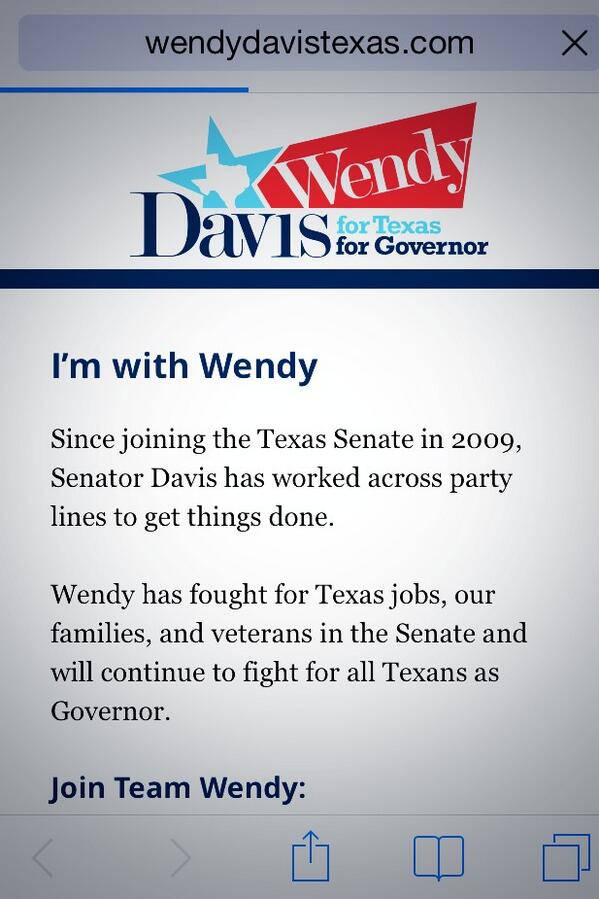 |
| Screen grab of Davis website, pulled back down again after too-early unveiling. Alana Rocha pic via Burnt Orange Report |
It's now official, and the Davis campaign can formally unveil the website that it launched too early, earlier today (left).
Per the Austin American-Statesman, she stressed jobs and education in her announcement.
That said, there are several questions to be answered.
Is Davis "the answer" for the gubernatorial election in particular, and for related issues?
Well, per my blogging on that issue, it depends on what question you're asking about for her to be the answer. As for campaign chess, she needs to tie Greg Abbott to Rick Perry on low-wage jobs, then tell what she'd do better. On education, she needs to pin Abbott to Perry and the GOP Lege for the revamped, I mean gutted, state franchise tax that has taken us down the road of underfunded schools.
That one won't be easy. Those same Lege folks and Perry have raised and raised and raised all sorts of fees across the state, year after year, while continuing to pretend they weren't raising taxes.
She will indeed draw enthusiasm. How could she not, after Bill White in 2010 and Chris Davis in 2006? Heck, Tony Sanchez in 2002 wasn't that dynamic, and Gary Mauro in 1998 wasn't, surely. Not since Miss Ann, the late Ann Richards, squared off for re-election against Shrub Bush in 1994 have Dems had a dynamic candidate at the top of the ballot.
Speaking of Ms Ann, the Texas Observer says her takedown of Claytie Williams offers some lessons for Davis.
That leads to other issues.
First, per one name mentioned above, does Davis have a "Tony Sanchez" problem? In other words, as I have blogged, and to riff on a GOP acronym, is she a DINO?
Well, again, depends on how you define "Democrat," "good Democrat," etc. in today's world. Per that link just above, if a person who's at least somewhat, if not more than somewhat, a state-level version of a neoliberal, punching the socially liberal hot buttons on abortion (per her filibuster), gay rights, women's rights and minority rights, but iffy on other things, like sucking up to big business in general, the oil bidness in particular, and having some possible conflicts-of-interest ethical problems, then she's fine.
(Update, Oct. 5: And, not good here, Davis' take on Tea Party inanity in DC. A "tiptoe" answer around around who's to blame for the federal government shutdown doesn't help her in my eyes.
Already pandering for independent voters, or what is up with this? I also don't really, as someone not native to this state, like the "we do that better in Texas" angle.)
Now, back to whether or not she's the "answer."
I still don't see her winning. I still think Battleground Texas, with its demographic assumptions and other things that I said are unwarranted, won't be able to do enough heavy lifting in 13 months to get her over the top. But, I wouldn't be surprised to see her break 45 percent. And, that itself would be an accomplishment. Richards just barely broke that herself in 1994.
And, while it's "just" a moral victory, it could offer some help in close downballot races, too. I don't doubt that, in addition to raising enough money to run a competitive campaign, she will do a lot of appearances in key areas — the cities and select suburbs of the Texas triangle.
And, if we are playing chess, my preliminary predictions are 52.5 for Abbott, 46 for Davis and 1.5 for others. Certainly, if you offered those percentages six months ago, the Texas Democratic Party would have gratefully accepted.
And, that's not unrealistic. Per a Politico piece, she's got the gap down to single digits right now. True, it's early in the season and landscape, with 50 percent reporting undecided. But, it's good news for her campaign, not just for the run itself, but that idea of "possibility" will probably help loosen some wallets and purses.
At the same time, some would say she can't go too liberal. It's clear, as San Antonio's alt-weekly spells out in detail, that she needs to get white women to vote for her. But it does more than that.
It notes that Texans have low voter turnout. Part of that is surely due to the crappy candidates Democrats have had at the top of the ticket in recent years.
"Brand loyalty" is also an issue; witness the number of Democrats who voted for Kinky in 2006, and many others who gave it serious thought, despite large parts of his agenda, when he did act halfway serious, being quite non-liberal.
Subscribe to:
Posts (Atom)