Editor and Publisher has a great synopsis of why they're not good for journalism. Three main points.
1. Their news coverage is restricted by wealthy donor interests and pressures. (E&P has specifics in the TT's case, re John Sharp/Texas A&M.) So, no "probing" journalism, if told not to. (That said, I've experienced that at for-profit papers, too.)
2. "Freeloading" by for-profit papers, with the possible result of further salary depression, etc.
3. Back-scratching for friends. Evan Smith's $315K salary as the Trib's executive editor has been mentioned by me before. I consider it out of line in general, especially since one of the Trib's "sponsors," Texas A&M, gets taxpayer money.
The first point is something I've seen coming down the point for some time. Rich funders of nonprofit papers, whether individuals or foundations, can steer these papers into boutique journalism, spike or lighten negative stories and more.
Here's another T-Trib story, a good one that could have been better, about drought and farmers depleting the Ogallala Aquifer. But, no questions were asked, facts stipulated, or anything else, about global warming and climate change. Why not?
Anyway, next time you see the Trib do an in-depth piece, ask further questions of the story.


June 25, 2012
Rick Perry lies about Texas jobs
Got a long email from Perry's office boasting about Texas jobs.
(Apologies for the partial post earlier.) Here's what's at the core of
the email:
Reality? Perry refused to do more for education, whether taxes or Rainy Day Fund, and therefore has costs thousands, if not tens of thousands, of local jobs.
Reality? As I blogged last year, the "Texas Miracle" is a largely an illusion; and the illusion of it is largely based on immigration, including illegal immigration.
Reality? Many of the jobs that have been created are low-income jobs, usually without healthcare benefits.
Reality? That reflects larger "quality of living" issues in Texas.
Reality? The "no new taxes" has been an excuse to mask rising "fees" in a variety of areas, including things such as car registrations and titles that impact people regularly.
Worst of all? Tricky Ricky sent this out as a solicitation email.
Speaking of "no debt," it sounds like he's got plenty from his ill-fated presidential campaign.
If he were president, we'd see the income gap get even wider, more colonias, increases in all sorts of federal user fees (and the money not dedicated to specific budgets), slashed public health care programs and worse.
Here in Texas, we are fiscally sound and conservative. Texas has no state-income tax. And to help create jobs, we recently exempted thousands of small and start-up businesses from paying taxes.
I know what Washington can’t seem to grasp balanced budgets and a relatively low tax burden encourage private sector job creation.
Texas led the nation in job growth over the past 10 years. Between March 2002 and March 2012, the Lone Star State added 1.318 million new nonfarm jobs.
We added 225,800 jobs over the past year along, with Forbes magazine recently ranking Texas cities 1st, 2nd, 4th and 6th of top 25 best job climates in America.
A strong job climate is no accident. It takes an entrepreneurial spirit, which we have in our people. It takes common-sense tax and regulatory policies. And it takes disciplined lawmakers, who can say no to special interest excess.
The Texas Legislature have been conservative and fiscally responsibly in recent years, but there is no guarantee that will continue.
That’s why I recently introduced the Texas Budget Compact - Principles for a Stronger Texas.
We all have a vested interest in the future of Texas, we need to do everything we can to help our state become a stronger, more prosperous state, better prepared to deal with the unexpected and better positioned to care for our own. That's what the Budget Compact is all about, a unique opportunity to do right by Texans.
"The Texas Budget Compact," comprised of five simple yet effective principles that will lead to a stronger Texas:
To be honest, these are pretty simple prescriptions for budget health in Texas.
- Practice truth in budgeting.
- Support a Constitutional limit of spending to the growth of population and inflation.
- Oppose any new taxes or tax increases, and make the small business tax exemption permanent.
- Preserve a strong Rainy Day Fund.
- Cut unnecessary and duplicative government programs and agencies.
Reality? Perry refused to do more for education, whether taxes or Rainy Day Fund, and therefore has costs thousands, if not tens of thousands, of local jobs.
Reality? As I blogged last year, the "Texas Miracle" is a largely an illusion; and the illusion of it is largely based on immigration, including illegal immigration.
Reality? Many of the jobs that have been created are low-income jobs, usually without healthcare benefits.
Reality? That reflects larger "quality of living" issues in Texas.
Reality? The "no new taxes" has been an excuse to mask rising "fees" in a variety of areas, including things such as car registrations and titles that impact people regularly.
Worst of all? Tricky Ricky sent this out as a solicitation email.
Speaking of "no debt," it sounds like he's got plenty from his ill-fated presidential campaign.
If he were president, we'd see the income gap get even wider, more colonias, increases in all sorts of federal user fees (and the money not dedicated to specific budgets), slashed public health care programs and worse.
June 24, 2012
Failure is OK, and need not be an orphan
Some poetic thoughts of mine, following reading a VERY interesting column that was referenced in my previous post
Failure IS an option
I am not a failure,
And I am not the sum of my failures
But I am a person who has failed, and will fail,
Many, many times.
I am also anxious, fretful, and pessimistic –
A toxic brew.
Accepting that failures are not moral faults
Is not always easy to do;
Even harder to accept
Is that because of luck and the actions of others
Failure says little about my skills in many cases.
But self-flagellation
Is a means of trying to assert control
Rather than feeling powerless from its lack.
But that’s not reality.
The truth?
Many of my actions
Have countless outside tangential influences.
But even that is not all of reality.
Even my most important actions, most consciously decided
Have many subconscious influences
From chaotically driven, chaotically competing subselves.
Kennedy and others were all wrong here.
Failure has just as many fathers as victory,
Even if they scurry for dark corners
After the lights of the mind are turned on.
Failure IS an option
I am not a failure,
And I am not the sum of my failures
But I am a person who has failed, and will fail,
Many, many times.
I am also anxious, fretful, and pessimistic –
A toxic brew.
Accepting that failures are not moral faults
Is not always easy to do;
Even harder to accept
Is that because of luck and the actions of others
Failure says little about my skills in many cases.
But self-flagellation
Is a means of trying to assert control
Rather than feeling powerless from its lack.
But that’s not reality.
The truth?
Many of my actions
Have countless outside tangential influences.
But even that is not all of reality.
Even my most important actions, most consciously decided
Have many subconscious influences
From chaotically driven, chaotically competing subselves.
Kennedy and others were all wrong here.
Failure has just as many fathers as victory,
Even if they scurry for dark corners
After the lights of the mind are turned on.
June 23, 2012
Accept failure! Accept half-empty glasses!
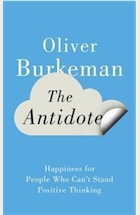
With a column title like "Happiness is a Glass Half Empty," followed by references to Stoicism, among other things, we've got real meat.
And, the book title, by the column's author, goes even further than Ehrenreich, in noting such potentially harmful thinking must be fought. Indeed, we need an "antidote" for such ideas.
The column delivers a good foretaste of this, including noting how it's OK to fail, and better than OK to accept the idea of failure.
 |
| The Museum of Failed Products |
But, Burkeman notes, products fail even more often than small-business start-ups. So, why can't we accept these and other failures?
He says that it's in part because we've forgotten some good wisdom from the past.
He doesn't specifically say this is connected to the relative ease of modern life, but maybe it is. Anyway, here's his dive into Stoic ideas:
Behind all of the most popular modern approaches to happiness and success is the simple philosophy of focusing on things going right. But ever since the first philosophers of ancient Greece and Rome, a dissenting perspective has proposed the opposite: that it's our relentless effort to feel happy, or to achieve certain goals, that is precisely what makes us miserable and sabotages our plans. And that it is our constant quest to eliminate or to ignore the negative – insecurity, uncertainty, failure, sadness – that causes us to feel so insecure, anxious, uncertain or unhappy in the first place.If you know philosophy, you know his idea, though he doesn't use the actual word: "ataxaria." It's more, less and different than detachment or dissociation. The idea of "acceptance" might get closer.
And lest one draws the wrong ideas from Marcus Aurelius or Epictetus, he steps in:
Yet this conclusion does not have to be depressing. Instead, it points to an alternative approach: a "negative path" to happiness that entails taking a radically different stance towards those things most of us spend our lives trying hard to avoid. This involves learning to enjoy uncertainty, embracing insecurity and becoming familiar with failure. In order to be truly happy, it turns out, we might actually need to be willing to experience more negative emotions – or, at the very least, to stop running quite so hard from them.Indeed. And, with some variations, beyond his hangups with sex and repression (while ignoring sexual abuse's connection to hysteria!) Freud talked about this to some degree. So, too, in yet another vein, Miguel de Unanumo arguably did this in "The Tragic Sense of Life." (To me, every Gnu Atheist who wants to bash religion in general should have Unanumo on his/her required reading list.)
Anyway, what about recent claims that blind optimism can improve one's actions in life? Not so fast, Burkeman says. Research shows that things like visualizing positive outcomes can actually backfire, by practitioners often refusing to do the work to get to those outcomes. Ahh, magical thinking, new variety.
And, there's other twists from the glass half empty. Here's one:
Psychologists have long agreed that one of the greatest enemies of human happiness is "hedonic adaptation" – the predictable and frustrating way in which any new source of pleasure we obtain, whether it's as minor as a new electronic gadget or as major as a marriage, swiftly gets relegated to the backdrop of our lives: we grow accustomed to it, and it ceases to deliver so much joy. It follows, then, that regularly reminding yourself that you might lose any of the things you currently enjoy can reverse the adaptation effect. Thinking about the possibility of losing something you value shifts it from the backdrop of your life back to centre stage, where it can deliver pleasure once more.
Burkeman then morphs back to the failed products. He says the flip side of not being realistic about failure is being unrealistic about the causes of success, including believing we have a lot of control over causing success when that's often not that true.
Or, if you want more reason to try to change your viewpoint, here's one:
Perfectionism is one of those traits that many people seem secretly, or not-so-secretly, proud to possess, since it hardly seems like a character flaw. Yet, at bottom, it is a fear-driven striving to avoid the experience of failure at all costs. At the extremes, it is an exhausting and permanently stressful way to live: there is a greater correlation between perfectionism and suicide, researchers have found, than between feelings of hopelessness and suicide.
That ... the last part ... I did not know. Being somewhat pessimistic and a "negative" thinker, yet a bit of a perfectionist at times, that's words to take to heart ... accept failure! Failing at something doesn't make me a failure, does it?
There's plenty more ideas like this salted through this long column. Here's a good short one for conclusion:
Happiness reached via positive thinking is fleeting and brittle; negative visualisation generates a vastly more dependable calm.
Go read the whole thing and, like me, keep an eye out for this book.
#Rio20 a big fat flop - blame #US and #BRIC - and #China
Rio-20 is a big fat flop, the spin aside. Arguably, while the fault likes primarily with the developed world, the BRIC nations need to bear more scrutiny.
We need a three-tier, not a two-tier, ranking of nations. China would definitely be in that, as would Brazil. India might.
My solution would be a carbon tax here in the US, which, under WTO rules, if I am correct, allows carbon tariffs on imports. China, and Brazil/India, would have to get cleaner.
And, this would, beyod the eglobal warming angle, satisfy so many domestic US constituencies.
Non-wingnut US businessmen who manufacture here would knoiw we're not selling out domestic industry. That includes US utilities.
Labor/New Deal liberals know that part of the money from this could fund job (re)training, as well as be a price incentive to bring at least a few jobs back to America.
Environmentalists know that beyond global warming itself, this could help the environment more broadly. (That said, some fellow environmentalists need to get on the breeder reactor bus, IMO.)
So, let's do it!
Or, we can have business as usual.
That said - a bit of schadenfreude; red states will get hit worse by much of the change. That includes Texas and Oklahoma, definitely, Arizona and Utah most definitely. And, somewhat, Florida. Of course, purplish Colorado and split Nevada and New Mexico will also get swept up. In California, the more "red" southern Cal will hurt worse.
I'd love to be president and veto any and all agriculture disaster bills due to drought-related crop loss on the Plains until red-state senators knuckled under.
We need a three-tier, not a two-tier, ranking of nations. China would definitely be in that, as would Brazil. India might.
My solution would be a carbon tax here in the US, which, under WTO rules, if I am correct, allows carbon tariffs on imports. China, and Brazil/India, would have to get cleaner.
And, this would, beyod the eglobal warming angle, satisfy so many domestic US constituencies.
Non-wingnut US businessmen who manufacture here would knoiw we're not selling out domestic industry. That includes US utilities.
Labor/New Deal liberals know that part of the money from this could fund job (re)training, as well as be a price incentive to bring at least a few jobs back to America.
Environmentalists know that beyond global warming itself, this could help the environment more broadly. (That said, some fellow environmentalists need to get on the breeder reactor bus, IMO.)
So, let's do it!
Or, we can have business as usual.
That said - a bit of schadenfreude; red states will get hit worse by much of the change. That includes Texas and Oklahoma, definitely, Arizona and Utah most definitely. And, somewhat, Florida. Of course, purplish Colorado and split Nevada and New Mexico will also get swept up. In California, the more "red" southern Cal will hurt worse.
I'd love to be president and veto any and all agriculture disaster bills due to drought-related crop loss on the Plains until red-state senators knuckled under.
June 22, 2012
A #RonPaul-tard hits the op-eds of the NYT
Brian Doherty is a senior editor at Reason magazine, and has an obvious bromance with Ron Paul, as this New York Times guest piece shows. If not that, this "sue the GOP?" piece at Reason clearly shows taht.
Dear Mr. Doherty:
I am not a libertarian, BUT, I can set you straighter than you are now.
1. Gary Johnson is more of a libertarian than Ron Paul ever has been.
2. In case you missed it, Paul, like Ayn Rand, is hypocritical enough to now get Social Security. (And, in the past, and I believe today, Social Security had conscientious "opt-out" grounds, so don't give me the "he paid into it" bull.)
3. A certain percentage of libertarians are OK with national health care, even a single-payer system, viewing it as "legitimate" within libertarian mores. Why don't you ever discuss that?
4. Speaking of lawsuits, isn't it hypocritical for libertarian types to lead the big-biz push against lawsuit abuse under the guise of "tort reform" even as you appear to support the Paul suit, and lawsuits would be the only way of keeping biz in check in your libertarian dream world?
Dear Mr. Doherty:
I am not a libertarian, BUT, I can set you straighter than you are now.
1. Gary Johnson is more of a libertarian than Ron Paul ever has been.
2. In case you missed it, Paul, like Ayn Rand, is hypocritical enough to now get Social Security. (And, in the past, and I believe today, Social Security had conscientious "opt-out" grounds, so don't give me the "he paid into it" bull.)
3. A certain percentage of libertarians are OK with national health care, even a single-payer system, viewing it as "legitimate" within libertarian mores. Why don't you ever discuss that?
4. Speaking of lawsuits, isn't it hypocritical for libertarian types to lead the big-biz push against lawsuit abuse under the guise of "tort reform" even as you appear to support the Paul suit, and lawsuits would be the only way of keeping biz in check in your libertarian dream world?
Subscribe to:
Posts (Atom)