SocraticGadfly

October 23, 2012

How to address voting machine company ownership and presidential elections

With skepticism about the accuracy and security of voting machines going beyond knowing how they can misperform, going beyond even big campaign donations to GOP candidates by voting machine companies  like Diebold, we now read liberal conspiracy theory about Mitt Romney’s son, Tagg, investing in such companies. As Think Progress points out, this is about 95 percent untrue/overblown.

However, the first parts are true … and an investment issue like this could pop up among a future GOP — or Democratic — candidate.

So, what can be done?

Legislation can be done, if Democrats will step to the plate — both federal and state legislation.

Here’s a suggestion:

No candidate for federal (state) office shall own stock in any publicly traded company that manufactures, sells, markets or services voting machines, nor shall said candidate have an ownership share in any privately held company that manufactures, sells, markets or services voting machines, nor shall said candidate own stock in any publicly traded company or have an ownership share in any privately held company that owns, invests in, or has any stock or ownership share itself in any publicly traded or privately owned company that manufactures, sells, markets or services voting machines.

Said restrictions shall also apply to all relatives within the third degree of consanguinity of said candidate, as well as spouses or other persons who have a legally recognized personal relationship with said candidate or candidate’s relatives within the third degree of consanguinity.

And, after Democrats got the cojones to pass this at the federal level, use the stick of threatened withdrawal of federal voting assistance funds to muscle states to pass similar laws.

And, speaking of that ….

While we’re at it, let’s get a law passed, at the federal level, which stipulates something like this:

Given that the election for President of the United States is an interstate election and therefore a form of interstate commerce, voting standards for elections for President of the United States shall solely be determined by the government of the United States.

For presidential elections at least, it kicks everything from fake vote fraud campaigns to butterfly ballots and Bush v. Gore in the seat of the pants.

October 22, 2012

Monday debate preview — stand by for WAR!


Stand by for WAR!
Wikipedia photo
Remember the 2004 “foreign policy” presidential debate, where John Kerry tried his hardest to prove that, if elected, he would kill more Iraqi “terrorists” than George W. Bush? How about the 2008 “foreign policy” presidential debate, where Barack Obama rhetorically moved heaven and earth to say he would kill more Afghan “terrorists” than John McCain?

Well, to riff on Paul Harvey’s old signature phrase, stand by for WAR! Or warmongering, at least.

Monday, we’ll get to see this year’s “foreign policy” warmongering debate. And, yes it will be just that.

First, Mitt Romney has shown that foreign policy is his weak suit, and would be even if he were standing in Israel with Sheldon Adelson whispering in his ear.

Second, speaking of that, he’s shown that he’s more tea party-wingnut on social policy than on domestic issues. Since Mormons don’t believe in the rapture, and more conservative rich Jews would give him money even if he were only a semi-wingnut, I honestly don’t know where this one comes from. But, it’s there.

The “first” showed up horribly for Romney in the town hall debate, on Libya, even though the mainstream media and Obamiacs both have overplayed it somewhat, in my opinion. That said, Romney does like to look macho, so look for him to talk about killing al-Qaeda in Africa, Hamas (and even the Palestinian Authority, perhaps) in Israel and the nation of Palestine, for him to kill any Taliban in sight in either Afghanistan or Pakistan (showing his willingness to flirt with World War III), to kill any Iranian he can, and to kill any Syrian he can.

He’d offer to kill Chinese, too, but they’re too valuable as serf labor for factories in Bain Capital takeover companies.

Anyway, the last two debate cycles have shown that it’s the candidate who is either a challenger (2004) or perceived as inexperienced (2008) who feels the need to sound like a Strangelovean Gen. JackD. Ripper protecting American vital bodily fluids.

To the degree I remember 2000, I think Bush used some of the same tough-guy angle on foreign policy.

But, let’s not forget that Obama hasn’t been all talk since his election.

Remember Anwar al-Awlaki? An American citizen killed without trial by an Obama drone.

And, if that’s not enough to convince you that Dear Leader will fight fire with fire, there’s something else. It seems like we’re now backtracking on pulling out all of our troops from Afghanistan.

The fact that Team Obama wants to keep25,000 there is also yet another reason to move past bipartisan warmongering and vote Green.

And, let’s not forget that civil liberties get shot at in the “War on Terror,” too.

How many “sting operations” like the one that resulted in an arrest earlier of an alleged terrorist have also bent and folded civil liberties?

Meanwhile, per what Martha Raddatz got wrong at the Veep debate, let’s not forget that this “foreign policy” debate (speaking of Sheldon Adelson) will definitely, on Romney’s part, be an attempt to dog-whistle and fuse Israeli foreign policy and US foreign policy at the hip.

Question is … how weakly will Obama respond? Especially if Romney blatantly goes into warp drive on his pandering and publicly calls for Jerusalem to be the capital of Israel? (No, it wouldn’t surprise me.)

Meanwhile, free trade vs. fair trade as a foreign policy issue will get ignored.

So too, per that link about Raddatz, will be:
• Chinese cyberwar
• The possibility of Pakistan becoming a failed state
• The possibility of Mexico becoming a failed state
• Canada, tar sands and Keystone XL won’t get ignored, per se, just the facts about it vs. “energy independence” myths.

October 21, 2012

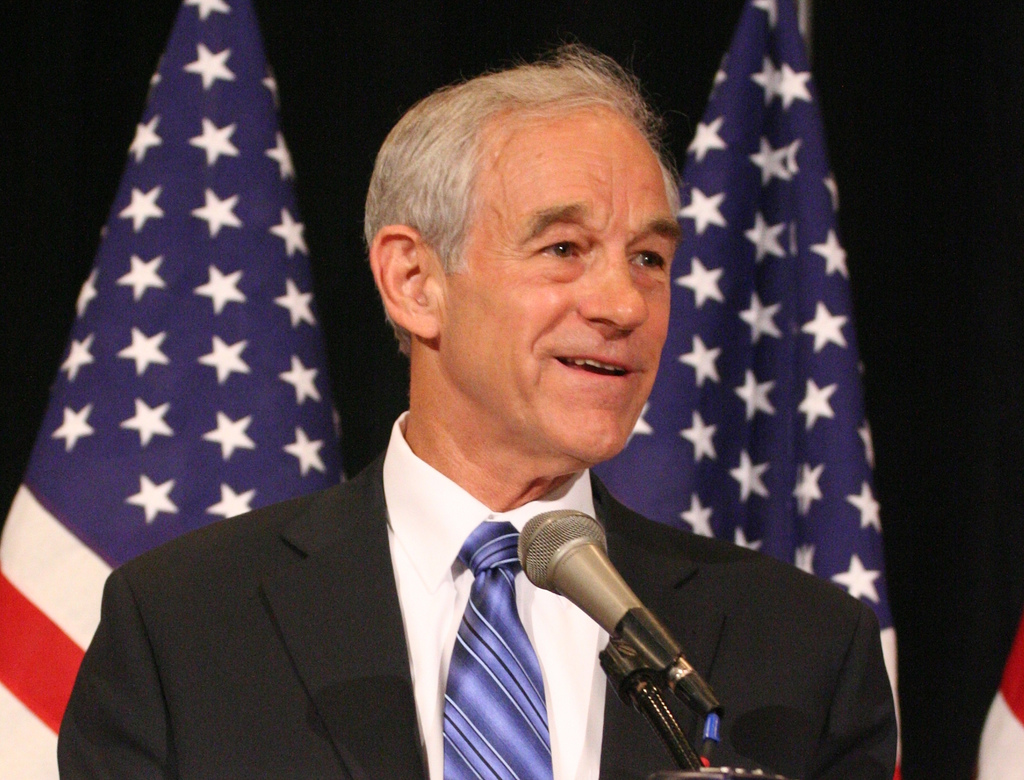
Dear #RonPaul and #Paultard #goldbugs — what is #fiatmoney?


Ron Paul, looking about as clueless as his
self-deluded followers./Photo via Wikipedia.
The answer, the real answer and not your made-up answer, as to what currently constitutes fiat money in the United States, is what I’m going to give you right now as part of calling you out on both your hypocrisy but also your shallow thinking.

In today’s United States, fiat money is not just the Federal Reserve Notes you profess to hate. It’s also bank checks, credit cards and debit cards. And that’s not just because they’re dependent on fiat money or a fractional banking system.

Even if they were based on the gold standard, or gold and silver, because those three — bank checks, credit cards and debit cards — are not immediately payable in specie, they’re also fiat money.

Period. End of story.

Therefore, Rep. Paul and Paultard groupies, you should, if you’re logical not only want to destroy the Federal Reserve System, you should also want to destroy the entire banking system of the United States, the entirety of Internet commerce, and a significant fraction of “meatspace” commerce. I know you don’t, because, Rep. Paul, you’ve gotten online “money bombs” for years.

That said, let’s go to point No. 2, where you’re guilty more of shallow thinking rather than hypocrisy.

And, that is in the issue of non-fiat money.

Gold has very little intrinsic value. It’s only given a largely speculative value on things like commodities exchanges because of human greed. Its fellow precious metal, silver, has much more intrinsic value.

That said, other substances, some of them compounds, some of them elements, have far, far more intrinsic value than gold

So, Rep. Paul and Paultards, if you really want to end fiat money, instead of being goldbugs based on non-rational greed, here’s what you should propose as currency/monetary standards instead:

1. Petroleum. The American economy of the last 120 years would be dead and unrecognizable without it. Beyond the automobile and the airplane, don’t forget plastics, fertilizers and much more. Of course, if you think “fiat money” has wrecked the United States, that would be nothing compared to a monetary system under the control of OPEC.
2. Uranium. Without it, and even more the transmutation of U-238 into Pt-239, we couldn’t have been warmongers par excellence for the last 55-60 years. The US has a fair amount of uranium. Of course, unless you want a radioactive Fort Knox, where do you store it?
3. Lead. See “uranium” and extend further back in time US warmongering and imperialism.
4. Silicon. Without it, there’s no computer revolution, no Internet revolution, etc.
5. Lithium. Without it, we’re not going to have a green revolution in terms of rechargeable batteries, etc.

I could cite several more examples, but, if you want a monetary standard for non-fiat money to be relevant to the economy, these and other substances are far more relevant than gold.

Oh, and try reading some history, too. China was using paper money 1,000 years ago, when Europe was in the Dark Ages.

Or combine history with philosophy. You might, just might, realize that money itself is a “fiat” replacement for barter.

October 20, 2012

The NYT inadequately criticizes American exceptionalism


It's nice that the Old Gray Lady ran an op-ed mentioning it, even mentioning how, although it's more prevalent among the right/GOP than the "left"/Democrats, it is indeed bipartisan. It's also nice that they mentioned the statistics, often cited by Democrats as well as those further left, undercutting the idea that America is exceptional in many ways.

It's even nice that Scott Shane explained a bit about its background and how problematic it is:
“People in this country want the president to be a cheerleader, an optimist, the herald of better times ahead,” says Robert Dallek, the presidential historian. “It’s almost built into our DNA.”
This national characteristic, often labeled American exceptionalism, may inspire some people and politicians to perform heroically, rising to the level of our self-image. But during a presidential campaign, it can be deeply dysfunctional, ensuring that many major issues are barely discussed. Problems that cannot be candidly described and vigorously debated are unlikely to be addressed seriously. In a country where citizens think of themselves as practical problem-solvers and realists, this aversion to bad news is a surprising feature of the democratic process.
However, I think Shane still doesn’t go quite far enough.

First, he doesn’t viscerally depict the fetid stench of what is honestly a species not of bullshit, but of the fouler-smelling human excrement.

Second, he could note that American exceptionalism arose from the American Revolution plus the Constitutional Convention, not just John Winthrop’s “city on a hill” Puritanism but that white America’s treatment of Native Americans plus Britain’s freeing of slaves had already put paid to American exceptionalism by the 1830s. (And that the treatment of Native Americans had Northern as well as Southern roots.

Shane then says this, near the end:
Of course, the reason talking directly about serious American problems is risky is that most voters don’t like it.
Which was preceded by this:
In a country where citizens think of themselves as practical problem-solvers and realists, this aversion to bad news is a surprising feature of the democratic process.
But again, no further examination of either one.

So actually, to someone not so “embedded” from the mainstream media into the bipartisan establishment, this isn’t surprising at all. Rather, it’s quite expected. Again, from both Tweedledee and Tweedledum voters. I’d be more surprised, actually, if Americans wanted to be honest about where we stood in the world.


Beyond that, there’s further reality that has escaped Scott Shane.


Reality? The Dunning-Kruger effect, the social scientific term for Garrison Keillor’s comment that everyone in Lake Wobegon is above average, is at play.

All Americans think they know better, even when they don’t. Again, this runs deepest among conservatives, but many Democrats/liberals exhibit it, too, at least among the “laity.” If I picked an average, white-collar, college-grad self-identified liberal off the streets, he or she probably wouldn’t know bupkis about the Trail of Tears or the Long Walk, would overestimate foreign aid spending (though by less than conservatives) and probably think America is generally better, by international measuring sticks, than it actually is, though less so than conservatives would, and less reflexively.

But, try to re-educate that person, especially if they’re entrenched in American majoritarian social structures, and you wouldn’t do a whole hell of a lot better than with a tea partier from Kansas.


What was it the old cartoon character Pogo once said? Ahh, yes: “We have met the enemy and he is us.” American exceptionalism has developed as an incestuous relationship between a public that is largely a mix of self-righteous and self-delusional and a ruling class invested in keeping the public self-delusional, while milking the self-righteousness.


And, it’s fair to point the finger at the American populace beyond this, too. And at people who are smarter and more internationalized than the average American, too.

I think above all of American businessmen, many of whom assume that the American way of doing business, grounded in the twin cults of worship of the CEO and worship of extroversion, is the only way to really do business right. And, of course, that’s not true, including and starting with the humongous income gap that this American style is used to justify.

Or American think-tankers assuming that America’s version of capitalism is better than the more social-democratic variety of much of continental Europe, and not asking “developing nations” for their opinion. Or, how many Americans of the political establishment look down their noses at parliamentary government systems. Of course, that may be because they’re afraid it will someday finally be desired here.

Shane also falls short in failing to look at the role of luck in American exceptionalism. That includes the luck of Euro-Americans stumbling upon arguably the most fertile of the continents, overall, and one blessed with much more natural resources than Europe. Add in the ability to kill off 90 percent of the natives via transmission of European diseases, more natural resources than Central or South America and better climate than Canada, and it was a piece of baklava, to riff on Max Klinger in a MASH episode.

Of course, to do a more serious riffing, taking off on Ann Richards’ comment about George H.W. Bush: “(White) America was born with a silver spoon in its mouth,” or to riff on Barry Switzer, not Ann Richards, that “(America) was born on third base and thinks it hit a triple.”


This second column partially dovetails with it, but is too kind to Obama, who really, when push comes to shove, believes in a kinder, gentler American exceptionalism in foreign policy. (Actually, on foreign policy, I suspect many a Green-type does, too, to be honest.)

Specifically, even as it’s been announced that the US is in talks to keep 25,000 troops in Afghanistan, David E. Sanger claims that Obama is “out of the occupation business.”

Yeah, right.

And, of course, THERE is where the real problem with modern American exceptionalism lies — the mainstream media’s attachment to the bipartisan foreign policy establishment that supports it abroad.

Of course, the human excrement will get spread deeply Monday night by both Tweedledee/Goody Two-Shoes/Mitt Romney and Tweedledum/Dear Leader/Barack Obama.

What the Founding Fathers got wrong


As we enter the start of another Supreme Court term and Justices Scalia and Alito worship the written word of the US Constitution even more than some Muslims who almost make the Quran a second god (and Quranolotry IS more a concern in Islam than Bibliolatry among even fundamentalist Christians), and as both Goody Two-Shoes/Tweedledee Romney and Dear Leader/Tweedledum Obama fall all over themselves to venerate that piece of paper, let’s look at what the Constitutional Founding Fathers got wrong.

First, for the “sake” of nation-building, “all men” of the Declaration of Independence became all white men. Black slaves in the south became 3/5 of a census abstract “person” for electoral votes; Indians not taxed got excluded while Indians who wanted to live like white folks, even with taxation, got chased to Oklahoma.

Second, ignoring the possibility of political parties, even though the British Parliament already had different factions, that were formed in part on political differences, and not just being “in” or “out” at court.

Third, the electoral college, in multiple ways. They didn’t consider winner-take-all possibilities. They didn’t allow for one state having 65 times the population of another, as part of that (California vs Wyoming) rather than 12.7 ties larger as in 1790 (Virginia vs Delaware, including slave numbers). Juliet Lapidos at the NYT also notes this.

They didn’t foresee mechanical reapers changing agriculture. Nor railroads, then cars and airplanes, overturning transportation and connectedness. They had no idea of the Internet and what it would do. Nor of atomic energy.

They failed to see that an ambitious and ardent man could make the presidency a strong executive indeed, despite the fears that most of them not named Alexander Hamilton had of that.

They failed to even entertain the idea of a parliamentary government with a low-power head of state president, rather than a king, blindly leaning too much on Montesquieu.

But, just as Christian fundamentalists don’t want to hear that their bible was written by humans who weren’t only fallible in a general sense, but short-sighted like other humans, unimaginative, and sometimes downright wrong, so the Scalitos of the world will book no opposition about the weakness, even wrongness, of the constitution.

Ditto for the Robert Byrds, who think “civics” is another word for “worship the Constitution.”

Well, it’s not.

If you really want to know more of what’s wrong with it, read “The Frozen Republic.”

October 19, 2012

Gratitude without god

When I first heard of this idea, a decade or more ago, I was in a psychological place where I was learning more and more about the idea of gratitude.

But, at the same time, I was pretty well down the road to my secularist, contra-metaphysical philosophical naturalist stance of today. I had tried “working with” ideas of “spirituality” but found what I was seeing promoted under that guise was New Agey-type metaphysics that, even if technically not religious, was indeed metaphysical and impossible to square with my re-emerging philosophical naturalism.

But, I was still trying to wrestle with this issue.

Having heard the phrase “an attitude of gratitude” in both New Age-type settings and from traditional ministers, and it being, for various reasons, an idea that I agreed with, I was trying to figure out how to be grateful if there wasn’t anyone to whom to be grateful.

Finally, I realized that I was mentally enshackled by the New Agey “present situations” that I had recently been in, plus my childhood religious preacher’s kid background.

Instead, why couldn’t I simply have an “attitude of gratitude” without a personal object for my gratitude?

And, so I do today. Little mental tools such as reminding myself of three good things that have happened for/to me today, especially if I had an active part in any of them, help this process.

The new job I have is reason to be grateful. I don’t have to listen to a boss asking me to resign (and himself not being grateful for me not doing so, since another person did leave a week after I would have completed my 30 days notice), threaten to “forget” my paycheck, or other things. I have work that’s fairly easy, still OK on pay, and fairly non-stressful while leaving open a growth curve.

I have the possibility of thinking about new work-creative outlets with the “timing” of the economy continuing to improve, as seems likely, albeit still slowly.

I have a life free from debt, the ability to live frugally without living stingily. That includes being a smart grocery shopper and knowing how to cook healthily while on a budget.

I’m grateful for modern medicine, including psychological counseling and medications as needed. Being a methodological and philosophical naturalist, I’m grateful for the scientific mindset behind it.

I’m grateful for the Internet. I’m grateful for the skeptical, critical thinking ability to recognize the dark side of the Internet itself, as well as seeing through most all of the spam, urban legends and such to which the Internet has given impetus.

Anyway, I don’t need to show you all my “gratitude list,” though I do believe journaling like this is a helpful psychological tool.

Let’s get back to my main point. Just as one can be moral without god, religion or metaphysically-oriented spirituality (karma is just as evil a “stick” as hell), one can be grateful as a state of being without needing a good to whom to tell that.