SocraticGadfly

January 01, 2014

Gasol-Bynum swap? Why would the Lakers wait? Dump, tank, Wiggins!

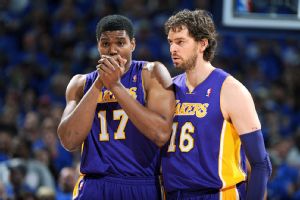
Andrew Bynum and Pau Gasol in Laker teammate days.
Getty Images via ESPN
ESPN says that a possible trade is in the air between the Los Angeles Lakers and the Cleveland Cavaliers.

Potentially on the move? Currently disgruntled Lakers center Pau Gasol and currently disgrunted and temporarily suspended Cavaliers (and former Lakers) center Andrew Bynum.

But, under this idea, the Lakers don't want Bynum to play him, but rather to dump him.

Come again?

Yep, and here's why:
By trading Gasol in a package for Bynum and then waiving Bynum, the injury-ravaged Lakers could save more than $20 million in salary and luxury taxes, which could help them maintain financial flexibility heading into the next few summers. A Gasol-Bynum trade would have to include at least one other player to make the deal work under league rules, and perhaps other assets from Cleveland.

Plus, there's another advantage.

Per previous blogging I've done ever since news of Kobe Bryant's downtime with a broken leg, this gives the Lakers the perfect, justifiable reason to start tanking and get in the Riggin' for Wiggins sweepstakes to nail down a shot at Kansas freshman star Andrew Wiggins.

Given that Steve Nash is likely out for the years and the Lakers have no true point guards, and that no Gasol eliminates a playmaker of sorts as well as a scorer and rebounder, it would be easy to accumulate plenty of lottery Ping-Pong balls this way.

Why the Lakers and GM Mitch Kupchak would want to wait, I don't know. By the time Kobe is back, they'll be deep in the Western Conference dust with no chance of coming back, anyway. Even without this trade and dump.

And, there's another good reason:
The Lakers have been luxury-tax payers for six straight seasons. While the luxury-tax savings this season -- and the ability to avoid the repeater tax penalty, which kicks in when a team is a taxpayer in four of five years, starting with the 2011-12 season -- would undoubtedly help the Lakers' long-term flexibility, the franchise's history and organizational culture make that a difficult prospect to consider.
So, the Lakers are the New York Yankees of the NBA, in essence. But, with a chance to get smarter than the second generation of Steinbrenners.

Beyond that, Laker fans need to face reality even more than the front office. It's time to rebuild. This offers at least a puncher's chance of doing that relatively quickly and painlessly.

===

Unfortunately, as of Jan. 2, talks have cooled off. Why? The Lakers are greedy for an additional "asset." What? Getting under the lux tax, tanking, freeing up free agent money, and possibly doing a quick rebuild aren't enough?

Take the minimum additional  player Cleveland has to add to make the deal work; stop being greedy enough to ask for a first-round draft choice or whatever.

Eating toads and other nonsense, New Age and otherwise

I hear New Age / positivity thinking / success gospel / bright-sider / secrets of selling aphorisms and slogans all the time, whether on  public radio, in books I scan but pass up at the library, mouthed by people in 12-Step groups, vouchsafed by people in personal growth programs and more.

At their best, they're arguably not totally harmless, though with some of them, the kernel of motivational truth they bespeak may outweigh their downsides.

At their worst, when told to people in cancer recovery, soul-killing stretches of life, or other problems, they're a mentalist form of social Darwinism and thus, quite harmful indeed.

So, let's dig in and look at a few of these.

That "eating toads" phrase, though commonly attributed to Mark Twain, comes from the French aphorist Nicolas Chamfort, according to writer and novelist Paul Theroux. He wrote: "Swallow a toad in the morning and you will encounter nothing more disgusting the rest of the day."

So, let's start right there.

1. Here's my take on that phrase, "Swallow a toad in the morning and you will encounter nothing more disgusting the rest of the day."

Why shouldn't I instead figure out a way to better my life so that I don't face the perceived necessity of toad-swallowing in the morning? Better yet, why shouldn't we as a society work for that as a societal goal? And, why shouldn't we also as a societal mindset, move at least partially beyond the "no pain, no gain" behind this?

Related to that ...

2. One of the most common of these pseudo-insightful aphorisms is "Whatever doesn't kill you makes you stronger."

So laughable on several grounds.

My standard response is: "How do you know in advance if it will kill you or not?" Plus, as a good secularist, I know there's no "you" left after you are dead.

Bill Murray, in a Tweet a few weeks ago, had a more sarcastic take: "Whatever doesn't kill you makes you smaller." And, that actually, if it's "sometimes" rather than "always," is true, sarcasm aside. A bout with cancer may not kill me. However, it will certainly weaken me, and perhaps for the rest of my life, not just temporarily. And, not just physically. The "fog of chemo" is a well-known mental issue for cancer survivors. And, even after chemo's done, I may be permanently affected enough physically by the cancer for the effects to include my mind, my self, my personality.

Add in that this was first uttered by Nietzsche, and that's probably good reason to dump the phrase right there.

3. I mentioned earlier, that these phrases are downright harmful if told to, say, a person trying to get over cancer. Or a person in a 12-Step program still struggling, and struggling in part because the slogans sound like nonsense.

One of them is "All you have to do is believe," or something similar.

Excuse me, but believe in WHAT? This sounds like Eisenhower's take on civic religion, namely, that everybody needs some sort of religion or deity.

Wrong.

Second, the harm? The cancer survivor who is told this, when encouraged to try an "alternate" treatment, then gets told her lack of faith is the problem when she doesn't get better. Ditto for the would-be sober person for whom an "anonymous" group simply doesn't work. Both of them get depressed, with various further, potentially deadly, consequences.

So, you want a New Year's resolution? Work on decluttering your mind from stuff like this.

December 31, 2013

Why not a 4-point line in the NBA?

Over at ESPN's Grantland site, Zach Lowe has a good, in-depth piece about how NBA teams (for the most part) are moving ever more toward 3-ball offense. And, it makes sense. The simple math says that a 3-ball at a 36-percent shooting accuracy is like shooting a 2 with 54 percent accuracy, and you have to be inside 17 feet, maybe a bit closer, to do that with a 2. So, shoot away is sound coaching, if you've got a team that can shoot the 3 that well.

But, not everybody likes this.

Lowe also notes some folks, like Stan Van Gundy and Billy King, are worried about this trend (as if Billy King actually has much idea of success in the NBA or how to get there), and how they and others are suggesting possible remedies.

One of them is to make the current field goal worth 3 and the current 3-ball worth 4, but Lowe notes that would diminish free throws and lead to Hack-a-Shaq late in games, at least if non-shooting fouls under such scenarios only got two free throws. (Or slow the game dreadfully if they drew three free throws, and make the whole process worse.

My alternative?

Don't make 3-pointers worth 4. Go one better.

Add a 4-pointer on top of the 3, and make Antoine Walker's dreams come true. Walker famously said "there are no fours" when asked why he jacked up so many 3-balls, a sentiment backed by actions that got him on Deadspin's NBA Shit List.

I'd consider moving the 3-line in from its current 23-9 if we did this. Probably not all the way to the 22-0, matching the corners, as the David Stern League did briefly in the mid-’90s, but maybe 22-6, or if not, 23-0.

Then set the 4-pointer at, say, 26-0. Maybe 27-0. But no further out. We want the 4-ball to have about 25 percent accuracy for top shooters, making it the equivalent of a 2-ball at 50 percent. Maybe a bit lower, but no lower than 22 percent. I don't want the 4-ball to become a temptation away from 3s, but I want it, if this seems wise, to be a halfway legitimate shot, and not just a lucky freak.

And Mr. Logo, Jerry West, is probably wishing he was balling in this league. If he played just with the 3 an option, he'd have scored 30,000 for sure. With this, and him actually chucking a few 4s, and having more room for 3s, he might have hit 35,000.

I mean, the league could at least try this in preseason for the next year or two and see how it flies, so to speak.

Man of the Year? #BarackObama

If Time Mag can do its Man of the Year, and make picks for interesting reasons at time, and some fellow Texan bloggers can nominate their picks for Texan of the Year, why can't I?

And, I did, and it's you know you.

Why?

First, to give credit where credit is due, he's the first Democrat to twice be elected president with a majority, and not a plurality, since ... Andrew Jackson.

But, that's not the real reason he gets this honor here.

What is?

In a word?

Obamacare.

Its sign-up problems this year due to computer glitches at first, but now due to wariness among 20-somethings, will go far to defining its success, or failure, in 2014 and beyond.

Carl Gibson, a 20-something liberal activist, has a good article on why he's opting out of Obamacare. He's probably speaking for a lot of 20-somethings who have looked at the cost, even sniffing the federal exchange website, or the state exchange site if available, and making a rational decision to pass.
Would you pay $5 to save $1? I didn't ace Math in school, but I do at least know that a Lincoln is worth more than a Washington. If you were presented with this deal in a store, to buy a $5 item to get $1 off another, most people don't see that as a deal. Now, multiply those numbers by a thousand, and you may start to understand why the "young invincibles" of America aren't participating in the healthcare exchanges.
That doesn't stop a Kossack Obamiac from overstating Gibson's two visits to the hospital as an adult as "a propensity for accidents." And, Carl? If you're getting lectured by both Kossacks and Ezra Klein (for not being a good citizen) you're probably doing the right thing.

That said, the actions of not just one but many Carl Gibsons will, in turn, define the success of Barack Obama, and not just his second term, but, his presidency as a whole. And, no, not the computer problems, even though they will likely suppress enrollments into 2014. It's young, educated liberals like Gibson who make the rational, non-Kossack decision to opt out that are key.

Obamacare was predicated on getting a reasonable amount of Carl Gibsons to opt in as part of cost containment. Not only is he instead opting out, he's essentially telling his cohorts to do the same and feel good about it.

Hence, since 2013 is the year Obamacare hit the road (except for all the parts Dear Leader delayed a year!) Barack Obama is this blog's Man of the Year.

As for 2014? With the delays, and the under-enrollments? As 2013 Part Deux, it will further define Obama's legacy, and likely not for the best. (Even if the White House continues to be slow in providing hard data about things like enrollments, the degree to which the website's payments to insurers issue is fixed, etc.)

And, in 2014, we're all going to be guinea pigs on whether Obamacare can provide truly affordable coverage. That said, Obamacare says nothing about providing nightmare-free coverage. And, given the way the modern insurance world works, as documented in sad detail here, it likely won't change that a bit. (It's true that the person in question benefits from being able to get insurance via Obamacare; but, that's not the angle I'm focused on.)

So far, through the end of December, Gallup polling says the uninsureds still aren't impressed.

Could Obama have gotten single-payer passed in 2009 or 2010? Possibly, if he had wanted to, and had expended real energy to do so. But, he never wanted to do either one of those, as I see it. The federal exchange website problems testify to the "real energy" issue from where I stand.

In my personal "view from somewhere," to riff on a philosophy phrase, then to riff on Charles Pierce's C-plus Augustus description of George W. Bush, the man's a C-plus LBJ.

As for me, it's relative success or failure will define exactly where he ranks in U.S. presidents overall, and especially those since Teddy Roosevelt basically invented the modern presidency.

Currently, going from bottom up, chronologically, I rank him ahead of Harding, Coolidge, Hoover (while acknowledging Hoover's bad rap), Nixon, Ford, Reagan and both Bushes.

That's 12th out of 19 presidents since the start of the 20th century. Not fantastic. And, yes, I ranked both Taft and Carter ahead of him.

And, yes, I was ranking Shrub's place in history before the end of his second term. Barring some major new breakthrough, I don't see much of a rankings change likely.

==

As for Time's choice? It's more and more clear all the time that Pope Francis' "liberalization" is a mix of playing around the edges and the soft bigotry of low expectations when compared with Benedict XVI.

That said, I've long said that Bush's "soft bigotry" phrase explains well the continued romance many a neoliberal, and even a few liberals, continue to have with C-p lus LBJ. (Hey, Obamiacs? I could have called him C-plus Carter.)

December 30, 2013

THe #SJW #privilege backlash is how I know Chris Arnade isn't all wet

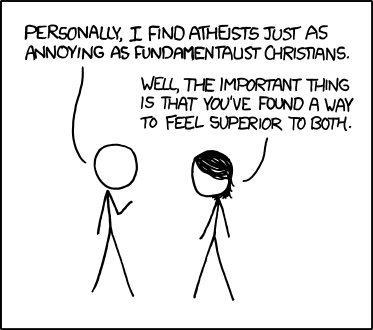
From  XKCD website. Added here because Atheism Plus and
Gnu Atheism types love to trot it out as a sort of shield, a
"no true Scotsman" claim that they're not annoying.
For those of you not too familiar with him, Chris Arnade is an atheist. Who used to work on Wall Street, with a Ph.D. Who now works with homeless people not too, too far from Wall Street.

And, via his work with them, and the seeming degree of attachment many of them have to religious belief, has led him to call atheism an "intellectual luxury for the wealthy." Which certainly isn't a life of "privilege" and, per the SJW hashtag of "social justice warriors," is working for social justice.

Here's the heart of his piece:
(The homeless) have their faith because what they believe in doesn't judge them. Who am I to tell them that what they believe is irrational? Who am I to tell them the one thing that gives them hope and allows them to find some beauty in an awful world is inconsistent? I cannot tell them that there is nothing beyond this physical life. It would be cruel and pointless. 

In these last three years, out from behind my computers, I have been reminded that life is not rational and that everyone makes mistakes. Or, in Biblical terms, we are all sinners. 

We are all sinners. On the streets the addicts, with their daily battles and proximity to death, have come to understand this viscerally. Many successful people don't. Their sense of entitlement and emotional distance has numbed their understanding of our fallibility

Soon I saw my atheism for what it is: an intellectual belief most accessible to those who have done well.   ...

I look back at my 16-year-old self and see Preacher Man and his listeners differently. I look at the fragile women praying and see a mother working a minimum wage custodial job, trying to raise three children alone. Her children's father off drunk somewhere. I look at the teenager fingering a small cross and see a young woman, abused by a father addicted to whatever, trying to find some moments of peace. I see Preacher Man himself, living in a beat up shack without electricity, desperate to stay clean, desperate to make sense of a world that has given him little. 

They found hope where they could.
I hadn't intended to write a full blog post about it. I thought it was interesting, but not something I totally agreed with, though I understood to some degree where he was coming from, or where I interpreted him as coming from.

I called it a version of Maslow's hierarchy of needs. In other words, after people get a stable, secure situation in regard to food and shelter, then safety, then social belonging, after that, they're going to feel comfortable — and have the mental energy — to question old beliefs and old values systems.

I agree with him, and against some, though not all Gnu Atheists, that H. sapiens isn't all that rational, even when we're higher up Maslow's hierarchy.

And, this is nothing new. Look at black slaves who adopted their owners' Christianity.

That said, it hasn't stopped the Atheism Plus junior subset of Gnu Atheists from jumping all over Arnade.

And, the one that has topped off the dogpile, all while insisting she's not writing about any one person?

Quelle horreur! It's Stephanie Zvan.

To refute just a couple of the hints she makes, even if at no one in particular, whether always to be believed or not:
1. Arnade never said that religion had no connection with predatory capitalism. That said, the claim of religion is usually just a fig leaf.
2. Unearned authority is a problem far outside of religious groups. Like Gnu Atheism. Besides, in many religious groups, the members of that group have no problem with believing their leaders have earned said authority.
3. I'm sure that if Gnu Atheism gets big enough, by the law of averages, it will have its own scandals. Only Gnu Atheists, even more than many an intensely inward group, will probably trot out "no true Scotsman" claims enough to earn themselves a listing in places like Skeptic's Dictionary under that entry.

Add to this somebody on Facebook using a compounded version of the magical word privilege in a post about Arnade's piece, and barf.

Meanwhile, let's ignore people like that and get back to people like Pamela J. Stubbart, with a more nuanced critique:
Frankly, Chris, I think that your piece has more to do with sig­nal­ing con­cern for the dis­ad­van­taged (and sig­nal­ing that you’re not a dick like Richard Dawkins) than it has to do with athe­ism per se. Not that these are bad things to do — but it doesn’t seem to me that your athe­ism was chal­lenged at all. As far as I can tell, you just revised your opin­ions regard­ing the dif­fer­ing value of truth in the con­text of var­i­ous kinds of people’s lives. (That would make a slightly less catchy title, how­ever). We can agree that it would be “cruel and point­less” to try to talk these peo­ple out of their the­ism. But label­ing athe­ism itself an “intel­lec­tual lux­ury” con­sti­tutes a near­sighted attempt to imbue athe­ism with the con­no­ta­tion that it’s unnec­es­sary and friv­o­lous. Please don’t for­get that in other con­texts, the non-religious do impor­tant work towards cur­tail­ing religiously-motivated harms (female gen­i­tal muti­la­tion, any­one? allow­ing chil­dren with eas­ily cured med­ical con­di­tions to die?) At those times, it is keep­ing quiet about unjus­ti­fied reli­gious claims (“think­ing dif­fer­ently” from athe­ists!) which would be cruel.
I could largely agree with that. Unfortunately, I don't think most Gnu-type atheists, and certainly not the subset of them Atheism Plusers, would agree with Stubbart.

Knowing what I do about the world of addiction, I will say that, in part because these alternatives aren't recognized by the court system, and in part for other, more sociological reasons, secular alternatives to 12-Step addiction support draw a different crowd.

Plus, also indirectly back to Zvan, and others.

Yes, atheists/secularists donate food to food pantries, and other "street level" support. However, secularists don't have their own homeless shelters, at least not that I'm aware of. Not all shelters that do exist are run by religiously oriented private organizations, of course, but many are. And, even those that aren't, in working with alcoholics and addicts, offer up the religious nostrums of the 12 Steps, in part because, again, they don't know the alternatives. 

In short, to bring out another psychological phrase, if Arnade "confronts" the homeless he helps with the illogic, and lack of empirical basis, of their beliefs, he risks giving them a massive case of cognitive dissonance. As many of the homeless are not only alcoholics or addicts, but "dual diagnosis" folks, this is about the last thing they need.

At the same time, Arnade's piece almost makes it sound like he's "deconverting." I asked him that on Twitter, and I'm putting it in here now. 

Why do I say that? The middle section of the block quote from above:
In these last three years, out from behind my computers, I have been reminded that life is not rational and that everyone makes mistakes. Or, in Biblical terms, we are all sinners.

We are all sinners. On the streets the addicts, with their daily battles and proximity to death, have come to understand this viscerally. Many successful people don't. Their sense of entitlement and emotional distance has numbed their understanding of our fallibility.
Sorry, but you, without the burden of being on the first or second level of Maslow's pyramid, have just made a logical/empirical disconnect, as I see it.

First, sinners implies sin. Sin is normally associated with religion. It's a word with all sorts of connotative overtones. It implies either a theistic god or a an impersonal karmic metaphysical force judging sin.

And, it sounds like it was written deliberately, as a face-slap, especially with the addition of the phrase "Biblical terms." (Having done that at times myself, I know it when I see it.)

Second, it seems to imply all atheists are part of the "successful people." Commenters on Zvan's page point out that's not true. And, I know that myself. I'm a community newspaper editor with extra money in the bank, but I'm nowhere near rich, and I personally know secularists worse off.

Third, per what I said before about "dual diagnosis," many of the people on the street have been sinned against much more than being sinners. Without causing them cognitive dissonance, you could at least lighten the religious chains for them by giving them some version of understanding of that, even if you have to still fertilize it with some religious manure.

Fourth, related to Nos. 2 and 3, it seems to imply most atheists are more like this than like you are.

This all said, Arnade promises a more nuanced follow-up.

I'd love to see it. I'd also love to see a more friendly reception for him from the social justice warriors, too. And, yes, I would note that, too. See three paragraphs above.


"Secret atheists" are all around you, says David Silverman.

Grandma, before you say the Lord's Prayer over that Christmas turkey, be mindful of the secret atheist in your own family who may be sitting next to you.

That's the claim of David Silverman, president of American Atheists and quite possibly the most obnoxious atheist thought leader in the U.S.
We know that a large population of 'Christians' are actually atheists who feel trapped in their family's religion.
And, you know this how?

In the same way that Gnu Atheists assume all "nones" are atheists, I guess. Since they always assume that most if not all of the surge in "nones" is due to a surge in atheism, that's the most charitable assumption I can make.

So much for the superior reasoning and critical thinking powers of Gnu Atheists, eh?

(Note to hardcore Gnus: I can certainly make less charitable assumptions if you want, like the idea that Silverman is simply pulling something out of his ass.

And, speaking of pulling things out of his add, add to that his March 2014 lament that Democrats are too liberal.)

Meanwhile, that's not the only stupid claim of Silverman's. Zvan also points out this:
“The intent here is not to convert Christians. The intent here is to get atheists going through the motions and pretending to be religious to stop, come out of the closet, and be honest with themselves.” 
Really? Putting up offensive billboards across the country, and even less than 100 percent offensive ones, which are clearly designed to say "eff you" to Christians, followed by possibly converting some of them, has as its actual goal getting atheists to come out of the closet?

Picture

And, as for "saving the lost," there's other alternatives that Zvan overlooks or tacitly dismisses, like atheist/freethought equivalents to churches, which, at least in larger urban areas, even exist, already, right now, and even in red states. The North Texas Church of Freethought, in the Dallas/Fort Worth Metroplex, has been around 20 years.

Note that name: "Freethought."

Silverman's approach, if it is trying to convert believers (and given that atheists are still just 2 percent of the population, that's surely its focus and Silverman's lying out some orifice in all likelihood) reminds me again of the old "if you want to catch flies, honey is better than vinegar" approach.

(Speaking of, Peter Manseau has some good spreading honey thoughts.)

If you're trying to get closeted atheists to come out, they're probably not the people who want to explain to Grandma at Christmas why they're associated with a nutbar like David Silverman.

Heck, people who have been atheists for some time — many of us don't use the word "atheist" in part precisely because of people like Silverman. Call us secularists, metaphysical naturalists, or per the community in Dallas "freethoughters."

Speaking of, there's one other issue, about one other word in that place's title: "church."

I don't know about Silverman, but I do know that many a Gnu Atheist, no matter how much "atheist evangelism" power such places might represent, furiously reject the idea of anything even close to an "atheist church."

Fine. Suit yourselves. Keep spraying vinegar rather than honey in the air. Just don't moan in public about the lack of results, or lie about the results by claiming "nones" are all "atheists," because I'll smack you down in public.

And, speaking of, let's be more honest on Silverman's behalf about one other thing.

Ultimately, this isn't about getting secret atheists to come out of the closet. It's about getting the money of open atheists to come out of the wallet and head to Silverman. It's a PR scheme for fundraising.