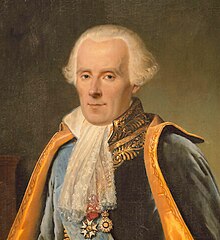
 |
| Pierre-Simon Laplace/Wikipedia |
This is the
time of year when fundamentalist-type Christians wail and moan about a
largely nonexistent “war on Christmas.” Even nonfundamentalists often talk about Jesus
being “the reason for the season.”
Some atheists,
respond that Mithra is the reason for the
season, as the Persian sun god’s holy day was celebrated Dec. 25. Yet others
refer to Saturn as the reason, with the Roman Saturnalia. And, there are other
candidates, too.
The commonality,
of course, is that all of these gods had their holy day, nativity or whatever
commemorated on or around the winter solstice.
And that’s why
I say “Laplace is the reason for the season.”
That would be
Pierre-Simon Laplace.
That would be
the scientific progenitor of the nebular hypothesis for the origin of our solar
system, which, with modern refinements, explains angular momentum of our planet
and others, which, coupled with axial tilt (caused in fair part by early solar
system microplanetary bombardments and collisions) created — seasons!
In short, Laplace explained how Earth, Gaia, Tellus or whatever name you give it, came to have its currrent seasons, including the shortest daylight of the year in the Northern Hemisphere. He explains the reason behind all of these religions having major celebrations around Dec. 25.
In short, Laplace explained how Earth, Gaia, Tellus or whatever name you give it, came to have its currrent seasons, including the shortest daylight of the year in the Northern Hemisphere. He explains the reason behind all of these religions having major celebrations around Dec. 25.
His thought was
part of his larger work on classical mechanics.
And, he is
sadly overlooked as the man who developed Thomas Bayes’ ideas into Bayesian
probability as we know it today. In fact, we really should call it Laplacean probability. The idea as we have it today owes at least as much to Laplace as to Bayes.
So, Laplace is
the reason for the season! And, per what I just wrote, someone who needs more "love" from popular science appreciators.
That said, it
appears to be apocryphal that he bluntly told Napoleon, “I have no need for
that hypothesis” when presenting his nebular theory, when Napoleon allegedly
asked about god. Rather, more narrowly, Laplace was saying, contra Newton, he
did not need to postulate god intervening at certain times and points to
maintain the solar system in equilibrium.
That said, that was a bold enough statement. Post Reign of Terror, the equilibrium in France, and in general, was swinging back away from freethought in general and definitely from outright atheism.
That said, that was a bold enough statement. Post Reign of Terror, the equilibrium in France, and in general, was swinging back away from freethought in general and definitely from outright atheism.
Anyway, Laplace
was a scientific genius who deserves more publicity.
And, starting with this point, from denizens of the northern part of the Northern Hemisphere possibly having SAD 2-3,000 years ago, just like today, there's good secular reasons to celebrate the solstice, and for taking a holiday for it, even if it's piggybacked as part of Christmas Day.
Besides Laplace, we can celebrate the technology that created light boxes to battle solstice-centered Seasonal Affective Disorder. Or the antifreeze the helps let cars run in winter. Or the human storytelling ability that developed narratives about gods, narratives centered on the solstice. Or, the historical-critical and literary tools that show today how those myths developed.
And, now, to tie celebrating Laplace into a bit of recent Gnu Atheist drivel ...
Or, you can be a Gnu Atheist Grinch about the idea of being even remotely associated with Christmas, as is Tom Flynn of the Center for Inquiry. But, to focus on Laplace here, I've got my thoughts about Flynn here.
And, per the commenter, the primary reason I edited the original end of this post was NOT because of "sniping." In fact, Flynn's blog post was in part what shaped some of the details of this one. And, if he doesn't even like our calendar because of how weeks and months are named, I doubt he will see any "light" in the future.
And, starting with this point, from denizens of the northern part of the Northern Hemisphere possibly having SAD 2-3,000 years ago, just like today, there's good secular reasons to celebrate the solstice, and for taking a holiday for it, even if it's piggybacked as part of Christmas Day.
Besides Laplace, we can celebrate the technology that created light boxes to battle solstice-centered Seasonal Affective Disorder. Or the antifreeze the helps let cars run in winter. Or the human storytelling ability that developed narratives about gods, narratives centered on the solstice. Or, the historical-critical and literary tools that show today how those myths developed.
And, now, to tie celebrating Laplace into a bit of recent Gnu Atheist drivel ...
Or, you can be a Gnu Atheist Grinch about the idea of being even remotely associated with Christmas, as is Tom Flynn of the Center for Inquiry. But, to focus on Laplace here, I've got my thoughts about Flynn here.
And, per the commenter, the primary reason I edited the original end of this post was NOT because of "sniping." In fact, Flynn's blog post was in part what shaped some of the details of this one. And, if he doesn't even like our calendar because of how weeks and months are named, I doubt he will see any "light" in the future.

