SocraticGadfly

June 06, 2015

Railroad Commission STILL in denial about #fracking and quakes

File this one under Anti-Intellectualism 101.

Texas Railroad Commission Chairman Ryan Sitton, along with some energy company execs, met Friday with representatives from SMU's geology staff, which, along with the U.S. Geological Survey, has been a leader in tying post-fracking wastewater injection to earthquakes.

And still refused to accept that conclusion:


“I have not reached the conclusion that oil and gas activity is the causal factor,” said Craig Pearson, the Railroad Commission’s staff seismologist. “While we remain concerned about seismic activity in the state, we still haven’t had a hearing where we’ve had a definite case made that a specific operator is associated with any specific earthquake activity.”
As for human-triggered quakes in other parts of Texas, he said: “I think it’s possible, but I don’t know of any proven nor widely accepted case of that. There has been anecdotal evidence in the past, but no substantial proof, to my knowledge.”

 Bullshite.

Even Oklahoma, possibly more wingnut than Texas, accepts that wastewater injection likely causes quakes:

In an April report, the USGS identified Azle and four other areas in Texas — Dallas-Fort Worth, Timpson, Fashing and the Cogdell oil field — as “induced seismicity zones,” another term for zones where man-made earthquakes are occurring.
That same month, the Oklahoma Geological Survey recognized that its surge of quakes was “very likely” triggered by the disposal of wastewater from oil and gas production into deep wells. Oklahoma has seen a 600-fold increase in its earthquake rate in the last several years, while Texas is on track to see a 20-fold increase, experts at the meeting said.
Note that last point.

And note that these Texas "induces seismicity zones" are in urban areas.

It's just like climate change denialism with folks like Pearson and Sitton. Say that "we need more data." Say that "it's not yet clear." Find some scientist, even if a 1-percenter denialist, who will shill for your point of view.

Then watch as cities like Denton get frustrated.

Then, when they act, tell them, no, we're going to retroactively change state law so you can't do that.

June 05, 2015

FDA, CDC say #BlueBell, other ice cream is safe — is it?

UPDATE, June 5: Listeria's now been traced back to Blue Bell's Alabama plant. That means that all three of its ice-cream making plants — the original in Brenham, Texas, its next in Broken Arrow, Oklahoma, and now this one in Sylacauga, Alabama, it's newest plant have had proven listeria problems. (The Alabama plant is less than 20 years old.)

The FDA now says that the Alabama plant, like the others, was not built in a way to prevent condensate from dripping in such a way as to contaminate food-contact surfaces.

In other words, if the FDA and its state inspection agent lackeys actually do their jobs now, Blue Bell shouldn't be allowed to reopen until it does extensive overhauls at its plants.

I think that, having laid off so many other people, the company needs to fire its CEO, Paul W. Kruse. It seems that Blue Bell, family-operated by the Kruses for generations, expanded too quickly and/or carelessly and coasted on family and reputational laurels. Send the company a Tweet at @ILoveBlueBell.

UPDATE, May 21: The implosion should continue to worsen. We now know that Blue Bell's listeria problems date back further, to 2009, and the problem, and its causes, weren't just at its other plants but at the Brenham home place.
About one drop of condensate per minute was observed falling into three-gallon ice cream buckets on a production line in 2009. An inspector also saw water dripping onto ice cream sandwiches. The release of the inspection documents, in response to a Houston Chronicle request under the Freedom of Information Act, follows findings by the FDA that Blue Bell knew about listeria on floors and pallets in its Oklahoma plant as early as 2013, but did not follow up with tests of food contact surfaces.
Blue Bell, meanwhile, apparently hasn’t furloughed its PR spinmeisters:
"Blue Bell has a long history of working cooperatively with regulatory agencies; we take inspections seriously and make corrections to improve our operations based on findings in those inspections," spokesman Joe Robertson said in an email Thursday. "Blue Bell is currently in the midst of a comprehensive review of all our operations, policies, employee training and cleaning procedures to help give regulatory agencies and the public confidence that when our products return to market, they will be safe."

Hey, Joe, why didn’t your “comprehensive review” happen six years ago?

==

The Food and Drug Administration, and the Centers for Disease Control, say that food shoppers shouldn't worry about listeria in ice cream despite Blue Bell's total recall of all product, followed this week by discovery of listeria in a sample of Jeni's Splendid Ice Creams, in Ohio.

Bad timing, feds.

Update, May 7: Real bad timing. Blue Bell knew about listeria at the Oklahoma plant that's the root of the current problems back in 2013. That's in addition to the already-reported news that the CDC knew about other Blue Bell listeria problems back in 2010.

Per the 2013 issues, Blue Bell also didn't do enough to fix the problems that it knew about. That's why, per the link about its 2010 knowledge, Blue Bell's claim that "they're determined to find the source of the deadly strain of listeria" sounds pretty laughable. (Listeria is not a coliform bacterium, but if you weren't trying to clean that up, why should we believe you're worried about listeria?)

Per this story, it appears the listeria was pretty widespread: Freezer floor, catwalk, filling devices for half-gallon tubs, a drain, a water hose and more.

Meanwhile, per the header of this post and the 2013 link, it seems the FDA didn't do enough follow-up work. These updates are an indictment of its lax inspection process, too. 

Jamba, the juice and smoothie king, is recalling store-sold bags of "make-at-home" smoothies. For listeria contamination.

First, we need more testing:
Sandra Eskin, director of food safety for the Pew Charitable Trusts, says she believes the U.S. ice cream supply is safe but says the outbreak linked to Blue Bell shows the need for more testing for foodborne bacteria in manufacturing facilities.President Barack Obama signed a sweeping new food safety law in 2011 that would boost some of that testing, but the FDA hasn't yet put all of the rules in place.
And, the wingnuts in Congress, surprisingly, haven’t further gutted federal regulations for stuff like this yet.

Because, if we had more testing, we wouldn’t have statements like this:
"Based upon what we know now, there is no connection between these two ice cream companies nor any reason to suspect that ice cream as a whole poses any special foodborne disease risk," said CDC's Dr. Robert Tauxe. 
Still, Tauxe said the discovery of listeria is a "wake-up call" for the industry, since the bacteria isn't very common in ice cream. While the hardy bacteria thrive in cooler environments, they can't grow at freezing temperatures.
“Wake-up call” puts it mildly. I don’t know much about Jeni’s, but I’m pretty sure Blue Bell tried to expand too quickly; that's probably part of what was behind it having listeria problems back in 2010. Given that Jamba is making these at-home products for grocery store sale, I suspect similar is true there.

Beyond that, Dr. Tauxe, can you assure us that giving dairy cows, like beef cows, antibiotics, hasn't made listeria, a bacterium, more disease-resistant?

No, you can't.

Taking this to an even more serious level, why should I trust the FDA and CDC if we've just recently heard about Blue Bell's 2010 listeria problems? And, as an FDA whistleblower like Ken Kendrick knows, we're thin on inspectors and the FDA, like USDA, outsources a lot of its inspections. So, not only do I not trust the FDA a lot, but, given Kendrick's experience with salmonella and peanuts, I don't even know what the hell the FDA actually knows. (Given that one FDA inspector reportedly asked Kendrick "What is salmonella?" whether that was a contracted or an in-house inspector, it really doesn't make one feel confident, does it?

Given that Blue Bell is America's second most popular ice cream, after store brands, it's got a long "chain of custody" to check on both milk and eggs. This could take a while. Blue Bell is to be commended for doing a total recall; they're to be dinged for them, as well as the gummint, not doing more back in 2010.

Fortunately, nobody has outsourced stuff like at-home smoothie kits to be made out of powders in China.

Yet.


That Trans-Pacific Partnership will surely bless us with that, if passed. And, the FDA or USDA has already outsourced just about all of its inspection of imported food products.

Wunderbar.


How close to toast is Robinson Cano?

Robinson Cano
When people talk about the bottom 5 or bottom 10 current worst baseball contracts, they may think of the lumbering 35-year-old Albert Pujols (or older, according to the occasional rumor), the potential and expected decline of Miguel Cabrera, and the fragile, relapse-possible Josh Hamilton.

Not mentioned in those? Mariners second baseman Robinson Cano.

Maybe he should be. (Showing that even the best sportswriters can be fallible, Jonah Keri didn't even list Cano's current contract ($24M/year through his age 40 season) on his bottom 10. He didn't even give it a dishonorable mention.

Second base, defensively, is the most grinding position other than catcher. And history shows that.

Roberto Alomar's last good season was at age 33. Bobby Grich and Lou Whitaker, both of whom should be with Alomar at Cooperstown, were only part-timers at the second sack after 35. Ryne Sandberg's last really good year was at age 32, his last semi-good one at 33, and his first retirement one third of the way into his age-34 year. Rod Carew had more WAR at second, but moved to first at age 30. Frank Frisch's last good season was at age 33, and last decent one at 36. Plus, between days off and time at third base, he was a 3/4 time second baseman by 33.

Even the cream of the cream in the Hall aren't all immune. Rogers Hornsby hit the wall at the end of his age-35 season. Nap Lajoie had a terrific year at 35, but was a two-thirds time player after that.

Eddie Collins, Joe Morgan and Charlie Gehringer are the only seeming exceptions. And, then, only by a couple of years. Collins was down to two-thirds time after age 37. Gehringer retired after a partial-play season at age 38. Morgan is the greatest outlier. After an injury-shortened age-37 year, he played through his age-40 year with more than 500 plate appearances at age 38 and 39, as a 2B.

And, Cano's slightly older contemporary, Chase Utley, has had noticeable slipping himself.

One could claim Craig Biggio as an exception, but he didn't move there until age 26. And, though he didn't totally lose his bat, he was a negative defender for most of his plus-30 seasons.

Cano is only 32, but it's 32 with a lot of mileage.

He's already No. 30 in career games played at second. He's an even higher No. 25 at career double plays by a second baseman. And of course, takeout slides by runners coming from first on potential double plays are a large part of that position's wear and tear.

How much does all of this play into what seems to be a major fielding slump this year, per Fangraphs? And, how much does it play into his batting slump? Or Utley's, for that matter?

A fair amount, I'd say. And, contra people who say short is as tough as second? I beg to disagree.

Above all, on double play attempts, you're facing straight down the runner from first. You can see the angle of a potential takeout slide, and you don't have to worry about making a pivot.

Second, Ozzie Smith, Derek Jeter, and Barry Larkin are among HOF shortstops who played semi-regularly, even regularly, to near 40 or beyond. From the classic past, Honus Wagner did past age 40. Luis Aparicio had a full season at short at 39. In the non-HOF division, Omar Vizquel had a full season at short at age 40.

June 04, 2015

#RickPerry 2.0 and #RickPerrysTexasMiracle = Kinky Friedman 1.0

Being against Dodd-Frank and attacking big banks in the same breath, as former Texas Gov. Perry did in his presidential campaign announcement, is about like Utopia dogcatcher, novelist, raconteur and independent Texas gubernatorial candidate Kinky Friedman favoring legalizing pot, on the one hand, and putting public-led prayer in public schools on the other hand.

Both represent pandering at high levels of shamelessness and low levels of artfulness.

As for his alleged economic miracles while governing Tejas? It was about oil and illegal immigration. That's why I said "hasty lumbago" to him when he announced he wasn't running for re-election. Most Republicans, including in Tejas, want to cut the immigration pipeline to zero. The oil part of that? Rick Perry didn't invent fracking, and the Saudis have now found how to undercut it on price.

So, move along, folks. Per the saying in Perry's own Texas?

All hat, no cattle.

And, let's not forget, per the picture, that abuse of power indictment hanging over his head.

Move over, #BernieSanders, as #Hillary gets 2nd challenge from left

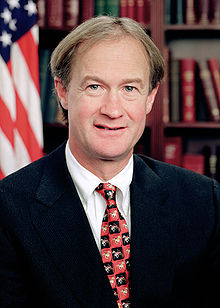
Lincoln Chafee
It admittedly sounds weird to talk about a former Republican running to the left of Hillary Clinton, but, if one looks at Lincoln Chafee's presidential campaign announcement, he's doing exactly that. (And please participate in the poll at right about actual and rumored 2016 Democratic presidential candidates.)

First, yes, it's something he throws out there all the time, but he WAS the only GOP senator voting against the Iraq War. Clinton, as a senator herself then, of course voted for it, and has been totally down with the War on Terra since, as senator, presidential candidate and Secretary of State.

Second, along with Sanders, he wants Edward Snowden to come home. He's less clear than Sanders on whether that should be without any criminal consequences, but the "allowed" certainly indicates he's closer to Sanders than to Clinton. Dan Froomkin, writing at Glenn Greenwald's outpost, seems to agree.

Third, he wants to end drone strikes, primarily in the Muslim world, of course.

Fourth, he at least wants to do something to get big money out of politics by banning political donors from becoming US ambassadors.

Fifth, he explicitly used the word torture for what the Bush Administration did, and the Obama Administration did nothing about, and says that we must stop doing.

These are all positions to the left of Hillary Clinton, per her documented political stances.

"We have to have a way to wage peace," as he said in his announcement, alone illustrates that. That's Dennis Kucinich land!

Does he have any more chance than Sanders? I don't know.

Will this split the left-of-Clinton Democratic vote? Maybe. Maybe it will get more of it to turn out in primaries.

Will he get as much media dissing as Sanders? Possibly.

Per my header, is it true? I say yes, overall.

Yes, Chafee once supported, and maybe still supports, privatizing Social Security. That said, Clinton has opposed hiking the portion of income subject to FICA, claiming it would be a "middle class" tax hike, when it would actually affect 6 percent of Americans or less. This, in turn, plays to her middle class pandering.

Yes, Chafee voted for the Patriot Act. So did Clinton. Yes, he supports free trade. So does Clinton.

The point is not that Chafee is THAT liberal.

The point is that Clinton is not even THAT liberal.

I would in no way vote for a Democratic nominee named Lincoln Chafee over a Green candidate. But, if Bernie Sanders were out of the race, I'd vote for Lincoln Chafee over Hillary Clinton.

More on Chafee here.

Why does the media hate #BernieSanders?

Sen. Bernie Sanders
I have documented some of my own concerns about Bernie Sanders. They include the fact that he's a gun nut, wants the state of Vermont to suck off the military-industrial complex teat (and in general might not be quite so progressive on foreign policy as I'd like), and that these concerns are enough that if the Green Party ran a legit candidate, like Jill Stein again, I'd likely still vote Green versus Bernie, if he were to win the Democratic nomination. (And please participate in the poll at right about actual and rumored 2016 Democratic presidential candidates.)

However, while critiquing myth vs. reality on his positions, I don't diss the man as a candidate. I wouldn't diss him if he were a Green candidate, and certainly not as a Democratic candidate.

Unlike the New York Times and others, who have dissed him indeed, as Columbia Journalism Review reports in depth.

Let's start with how the Old Gray Lady buried his official campaign announcement:
The Times, for example, buried his announcement on page A21, even though every other candidate who had declared before then had been put on the front page above the fold. Sanders’s straight-news story didn’t even crack 700 words, compared to the 1,100 to 1,500 that Marco RubioRand PaulTed Cruz, and Hillary Clinton got. So, one-half the coverage, buried wayyyy inside. 

The bigger issue is the Times, as part of the “mainstream media,” already engaging in crafting of narratives.

Chief of those? “He can’t win.” Why? Erm, he’s a “socialist”!
Sanders, of course, is Vermont’s junior senator, barber’s worst nightmare, and IKEA socialist (he favors the term “democratic socialist,” as in the Scandinavian variant), who quaintly maintains that people and the planet are more important than profit. Not long ago such beliefs fell well within the waters of the main stream where politicians swam, but the current has since been rerouted, and Sanders now paddles hard against the left bank. For not going with the flow, and for challenging Hillary Clinton, the big fish many elites have tagged as their own, Sanders’s entry into the race was greeted with story after story whose message—stated or understated, depending on the decorum of the messenger—was “This crank can’t win.”
That’s of course crowning Hillary long enough for harpyish spinster Maureen Dowd, among others, to then dethrone her.

Steve Hendricks, in this excellent piece, then notes more bullshit. First, it’s a lot of the MSM trying to horsecollar Sanders with the “can’t win” label, and thus dissing him:
Other major news organizations ignored Sanders as nearly as they could a sitting U.S. senator who entered the presidential race. ABC’s World News Tonight gave his announcement all of 18 seconds, five of which were allotted to Clinton’s tweet welcoming him to the race. CBS Evening News fitted the announcement into a single sentence at the end of a two-minute report about Clinton.
But it doesn’t stop there.

Hendricks continues:
In past races, when editors have explained why they scorned the likes of Sanders, they have tended to recite an editorial recipe for political long shots that is much like the Hollywood recipe for starlets: don’t cover them much, and don’t take them seriously. The trouble with this commonplace is that editors actually love covering long shots—certain long shots anyway. Ted Cruz, for example, received his serious, in-depth treatment in the Times’ news columns even as its analysts were writing pieces like “Why Ted Cruz Is Such A Long Shot.”
So, there you go.

Well, why not cover Sanders? Because, on the economic side, he is indeed a democratic socialist, and the NYT, other than letting Paul Krugman grace its op-ed pages, is a capitalist corporation, which is beholden to the standard capitalist narratives of the NY-DC axis. Hendricks notes:
The difference is that Cruz has not erected a platform whose planks present a boardwalk of horror to the corporate class atop the media. These same planks of Sanders’s, not at all incidentally, are the very ones on which Clinton most wobbles as she stands before Democratic voters.
Exactly.

 Can he win?

It's more likely than the mainstream media might admit.

Remember a junior state senator from Illinois who ran against a seemingly undefeatable person, name of Hillary Clinton, eight years ago? Sure, Barack Obama has more charisma than Bernie Sanders. Or does he, that much?

Besides, Hendricks notes Ted Kennedy running his front-runnerness in the 1972 run-up off an island bridge and into murky waters; Paul Wellstone's fateful 2002 plane crash, Jimmy Carter trumping favorites with shoe leather and a somewhat faked smile, and more.

He also notes that Sanders got off to a decent fundraising start and Clinton's suddenly gotten coy about details of her latest financials. Hendricks didn't even note Sanders' early crowd draws in Iowa. Hardly the sign of someone who can't win, on Sanders' part.

So, read the whole thing from CJR. It's worth it.

Beyond that, as Teddy White belatedly admitted, but only after helping create Camelot, there's a sort of ethical issue withe media getting too involved with creating "narratives" about politicians.

UPDATE, June 8: Add National Journal to the haters. Its 2014 piece implies, as have some others, that Sanders is somehow anti-black because he wants to try to get working-class whites to vote Democratic. Joan Walsh at Salon made the same claim just a week ago.

At the same time, I would bash Walsh less than Doug Henwood does. Race and class issues do overlap, but yes, they're not the same. It's kind of like environmentalism. A lot of environmental issues aren't out in national parks, but are about industrial companies building toxic plants in urban areas in neighborhoods that aren't just low-income, but are also high-minority. And yet, the environmental movement in general remains largely white.

Classism and racism overlap, in other words, but they're not the same thing. And, Walsh notes that our first post-racial president's stance that American needed to "look forward" is itself a problem.