Now that Kolten Wong has been called up by the St. Louis Cardinals, Redbird fans wonder what this means for the future of 3B David Freese, since current 2B starter Matt Carpenter is better at third than second, where Wong could start, assuming he makes the grade.
Jon Heyman at CBS has issued an initial ranking of the top 50 MLB free agents for the upcoming year. There's only one third baseman on the list, and that's perhaps using the term loosely. Michael Young is tied for No. 50 on Heyman's list.
Freese is six years younger, and even with a bit of a slip this year, is still a better power hitter and better overall.
And, of course, we all know what to look for out of that trade — a shortstop!
Pete Kozma is what he is. Ryan Jackson is not the answer; if he were, he wouldn't be in Memphis. Daniel Descalso is not enough much better as a hitter to offset his stone glove. He's a utility player backup, period, and on the glove side, SS is the worst of his three infield positions. Cards fans who think he's the answer need to think again.
If anything's the answer out of Memphis, it's Greg Garcia, anyway, since he's pretty much supplanted Jackson at SS and also is a couple years younger and with a touch more speed, perhaps.
Cards fans, by blog posts, who need to "think again" about either Jackson, Descalso, or both, include this and this among others.
If you're going to link to a site like Baseball-Reference, actually look at the stats before making comments like these. I understand the frustration with Kozma, but as Lincoln said about replacing Gen. McClellan, you can't replace Kozma with "anybody," you have to replace him with "somebody."
August 29, 2013


August 28, 2013
Is high-speed rail closer to coming to Texas?
The Dallas Morning News says yes, with word that North Texas über-insider Tom Schieffer has become an adviser to the Texas Central High-Speed Railway, a proposed private bullet-train line between Dallas and Houston.
The Snooze notes this about the former ambassador to Japan:
This sounds smarter than waiting on driblets of federal funds for high-speed rail, given wingnut opposition to Obama's push, and other issues.
It also sounds smart to focus on Dallas-Houston, rather than looking at the whole Texas Triangle.
And, per company president Robert Eckles, a former Harris County judge, it sounds like the path of the train likely would NOT follow I-45.
You could run a couple of "express" routes with no intermediate stops and a couple of nonexpress routes with those two stops added. Those trains would have a stop every 90 or so miles. You don't want anything shorter than that.
Now, this is all years, years, away, but, there's smart thinking, it sounds like.
The Snooze notes this about the former ambassador to Japan:
The Japan part of Schieffer’s résumé is key: The Texas-based company is affiliated with the Central Japan Railway, a leader in rail technology and operator of the bullet train that serves Tokyo and Osaka.Yep. Despite touting of China's recent (shoddy) bullet train construction, Japan is probably still ground zero on where to look for engineering, routing and other ideas.
This sounds smarter than waiting on driblets of federal funds for high-speed rail, given wingnut opposition to Obama's push, and other issues.
It also sounds smart to focus on Dallas-Houston, rather than looking at the whole Texas Triangle.
And, per company president Robert Eckles, a former Harris County judge, it sounds like the path of the train likely would NOT follow I-45.
“This train doesn’t perform well if you have to stop it many times," Eckels said. "It works great if you stop it midway, maybe up at College Station, maybe a couple of other places.”Given that Aggieville is on Texas 6, which splits off I-35 at Waco, a Waco stop near Baylor makes sense. And none other.
You could run a couple of "express" routes with no intermediate stops and a couple of nonexpress routes with those two stops added. Those trains would have a stop every 90 or so miles. You don't want anything shorter than that.
Now, this is all years, years, away, but, there's smart thinking, it sounds like.
Thomas Frank details the academia-big biz crackup
Those of us who are good liberals, good left-liberals, or even per the Slackhalla personality test making its way around Facebook, good communists (adjusts necktie and bowler hat, shaves full beard back to Lenin goatee) know that American academia has increasingly become a money-grubbing hog trough, starting from the president/chancellor level on down.
Thomas Frank has all the blood-spattered details of how this has wrongly played out, and is getting worse, in the latest issue of The Baffler.
Beyond the money-grubbing itself, with tuition, books, and increasingly, varieties of tack-on fees that are exceeded in their inflation-busting rate of growth only by medical costs, there's all the other ways in which Big Biz has penetrated the ivied walls.
First, there's a business management style. Professors? We only need enough to improve "the brand." For the rest, there's a growing pile of adjuncts. And, because we the Big U have fired more of the profs, the adjunct pool gets ever bigger, so we can flatten wages!
The "brand"? Ahh, here's where they can get away with it. Let's capitalize Ivied walls. At "select" universities, they overcharge because they know a "credential" in the name of a degree, with their select university's name on it, looks even better in the job market on a resume. That's why Dear Leader's idea of a White House-imprimatured college ratings list, one that would look like the U.S. News top 100 or something, not only would not lower college costs, it would likely raise them even more. Who wouldn't give their left ovary or testicle for a "credential" from such a list?
Of course, that's the next part of the Big Biz crapola. It's the idea that everything about education can, should, and will be quantified to something measurable and testable. It's why boards of regents and the new breed of presidents and chancellors, want to junk humanities departments.
I do disagree with one other thing in the essay, though, and that's Frank's claim that the typical 17-year-old going to college has little-to-no savvy of his or her own. Bull, at least when it comes to, say, the Ivies. Dear Mr. Frank: It's called "legacies." Look under "Bush, George W." There's plenty of ppl who know damned well already at 17 or 18 that it's a game to get the right collegiate name on that credential and nothing else. As for the debt amount at said places, it's not naivete but the Dunning-Kruger effect that leads said students to plunk down that much money.
Yes, it may be our neoliberal educational culture that pushes, steers, entices, or intoxicates many of said high-schoolers toward believing in the value of "the credential," but, per the old cliche: "It takes two to tango." Now, for high school kids who, as Frank says, aren't as savvy, I agree they're being exploited. But, for the young Princetonite gambling that he is indeed smarter, suaver and a better butt-kisser than anybody else? I've got a lot less sympathy for him. That's just like the largely white OWS protestors (actual Zucotti Park OWS) who, with their 25 percent grad degree percentages, were mad Wall Street didn't hire them with their MBAs and JDs, and suddenly discovered they had a socialist bone caught in their throats, which I blogged about at the height of the movement.
Here's the most pertinent information:
I'll halfway agree there that it's tough to avoid the tango. But, if you really were that liberal, you'd have gone to a different college and pursued a different career path in the first place.
A little bit of that is true for adjunct instructors, too. I mean, especially if you've been doing it for 10 years, and you've still never gotten a full-time position, I'm sorry, but that's going to be your lot for the rest of your natural born life unless you change careers. Now, if you want to keep accepting the misery, frustration AND low pay that goes with it, without looking to follow another path, then that's your problem. Now, if you're trying to get out, but still to a not-too-craptacular alternative, but haven't succeeded yet, I empathize. Remember, I'm in the newspaper biz, for now at least.
Indeed, Frank even addresses this, and the Dunning-Kruger effect, in talking about adjuncts, even if he doesn't also apply it to students, and doesn't cite the paradox by name:
Frank, near the end, agrees with me, doing a skillful tease of the is-ought error while rejecting it:
Meanwhile, add to the problem: A "citation cartel" within academic publishing.
Thomas Frank has all the blood-spattered details of how this has wrongly played out, and is getting worse, in the latest issue of The Baffler.
Beyond the money-grubbing itself, with tuition, books, and increasingly, varieties of tack-on fees that are exceeded in their inflation-busting rate of growth only by medical costs, there's all the other ways in which Big Biz has penetrated the ivied walls.
First, there's a business management style. Professors? We only need enough to improve "the brand." For the rest, there's a growing pile of adjuncts. And, because we the Big U have fired more of the profs, the adjunct pool gets ever bigger, so we can flatten wages!
The "brand"? Ahh, here's where they can get away with it. Let's capitalize Ivied walls. At "select" universities, they overcharge because they know a "credential" in the name of a degree, with their select university's name on it, looks even better in the job market on a resume. That's why Dear Leader's idea of a White House-imprimatured college ratings list, one that would look like the U.S. News top 100 or something, not only would not lower college costs, it would likely raise them even more. Who wouldn't give their left ovary or testicle for a "credential" from such a list?
Of course, that's the next part of the Big Biz crapola. It's the idea that everything about education can, should, and will be quantified to something measurable and testable. It's why boards of regents and the new breed of presidents and chancellors, want to junk humanities departments.
I do disagree with one other thing in the essay, though, and that's Frank's claim that the typical 17-year-old going to college has little-to-no savvy of his or her own. Bull, at least when it comes to, say, the Ivies. Dear Mr. Frank: It's called "legacies." Look under "Bush, George W." There's plenty of ppl who know damned well already at 17 or 18 that it's a game to get the right collegiate name on that credential and nothing else. As for the debt amount at said places, it's not naivete but the Dunning-Kruger effect that leads said students to plunk down that much money.
Yes, it may be our neoliberal educational culture that pushes, steers, entices, or intoxicates many of said high-schoolers toward believing in the value of "the credential," but, per the old cliche: "It takes two to tango." Now, for high school kids who, as Frank says, aren't as savvy, I agree they're being exploited. But, for the young Princetonite gambling that he is indeed smarter, suaver and a better butt-kisser than anybody else? I've got a lot less sympathy for him. That's just like the largely white OWS protestors (actual Zucotti Park OWS) who, with their 25 percent grad degree percentages, were mad Wall Street didn't hire them with their MBAs and JDs, and suddenly discovered they had a socialist bone caught in their throats, which I blogged about at the height of the movement.
Here's the most pertinent information:
92.1% of the sample has some college, a college degree, or a graduate degree.Whiter and much better educated than average.
27.4% have some college (but no degree), 35% have a college degree, 8.2% have some graduate school (but no degree), and close to 21.5% have a graduate school degree. 6.4% in the sample agree somewhat or strongly that they regularly use Facebook and 28.9 percent use Twitter regularly.
The data suggest that 81.3% of respondents considered themselves White, 1.3% Black\African American, 3.2% Asian, .4% Native American Indian, 2.9% Mixed, 7.7% Hispanic, and 3.2% considered themselves some other group.
I'll halfway agree there that it's tough to avoid the tango. But, if you really were that liberal, you'd have gone to a different college and pursued a different career path in the first place.
A little bit of that is true for adjunct instructors, too. I mean, especially if you've been doing it for 10 years, and you've still never gotten a full-time position, I'm sorry, but that's going to be your lot for the rest of your natural born life unless you change careers. Now, if you want to keep accepting the misery, frustration AND low pay that goes with it, without looking to follow another path, then that's your problem. Now, if you're trying to get out, but still to a not-too-craptacular alternative, but haven't succeeded yet, I empathize. Remember, I'm in the newspaper biz, for now at least.
Indeed, Frank even addresses this, and the Dunning-Kruger effect, in talking about adjuncts, even if he doesn't also apply it to students, and doesn't cite the paradox by name:
Just about everyone in academia believes that they were the smartest kid in their class, the one with the good grades and the awesome test scores. They believe, by definition, that they are where they are because they deserve it. They’re the best. So tenured faculty find it easy to dismiss the de-professionalization of their field as the whining of second-raters who can’t make the grade. Too many of the adjuncts themselves, meanwhile, find it difficult to blame the system as they apply fruitlessly for another tenure-track position or race across town to their second or third teaching job—maybe they just don’t have what it takes after all. Then again, they will all be together, assuredly, as they sink finally into the briny deep.So, both students and faculty need to be like the medievals at the University of Paris and go on strike. (Forming a union, of students, and a better one, of faculty, where it doesn't exist, will be part of that.) However, per the paradox, and the fake meritocracy, and how much strength neoliberalist hypercapitalism has gained in academia, maintaining unity in such a strike will be a hell of an uphill slog.
Frank, near the end, agrees with me, doing a skillful tease of the is-ought error while rejecting it:
What ought to happen is that everything I’ve described so far should be put in reverse. ...
But repeating this feels a little like repeating that it will be bad if newspapers go out of business en masse. Of course it will. Everyone who can think knows this. But knowing it and saying it add up to very little. ...He then mentions an alternative to the strike:
What actually will happen to higher ed, when the breaking point comes, will be an extension of what has already happened, what money wants to see happen. Another market-driven disaster will be understood as a disaster of socialism, requiring an ever deeper penetration of the university by market rationality. ...
And so we end with dystopia, with a race to the free-market bottom.
The only way out is for students themselves to interrupt the cycle. Maybe we should demand the nationalization of a few struggling universities, putting them on the opposite of a market-based footing, just as public ownership reformed the utilities in the last century.Sorry, nationalization would be worse, if anything, as long as the current political classes are in charge.
Meanwhile, add to the problem: A "citation cartel" within academic publishing.
Socrates is overrated (updated and expanded)
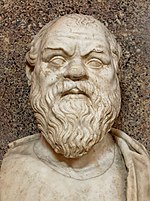
Of course, some people might accuse me of being hypocritical, if I do think he's overrated. That said, my blog name trades on the myth of Socrates, which we shall now call into account ... by using some Socratic-like questioning!
Questions
1. If he really were ignorant of so much, how could he always be right in his dialogues -- especially since he proves his opponents wrong in every one of them and therefore he couldn't have learned from them?
2. If he really were so ignorant, and knew that he were, then why didn't he follow Wittgenstein and remain silent about what he did not know?
3. If he really were so ignorant, then how can we believe he understood the Sophists' teachings so well?
Answers
The baseline answer to all of these individual questions and more is that Socrates, that is, the Socrates who is a Platonic mouthpiece (and, an ideal one for Plato, pun intended!) makes straw men out of Sophists and their thought, opposes the democratization (for money) of knowledge that they offer because it upsets his classist views and more.
But, specifically:
1A. The Platonic wordsmith hoists him by his own petard, not to mention, especially in the Cave analogy, also getting hoist on the petard of ineffability.
2A. Because it does that, Plato's Socrates only mimicked the idea of being ignorant.
3A. This builds on the "baseline" answer. In a sense, Socrates, to the degree we can really guess at who he was, DOES know the ideas of the Sophists well — and fears their democratizing strain.
Beyond that, while I don't buy into every argument Izzy Stone made in "The Death of Socrates," I do think he was anti-democratic and an elitist. Rather than the crime of affronting the gods of the polis, what he really was guilty of, in modern American legal terminology, arguably, was treason. So, contra Aristotle, mourn not his death as being in the nature of a crime against philosophy.
Besides that, from Xenophon and Aristophanes, especially the latter, we have a somewhat different version of Socrates. Indeed, Aristophanes calls Socrates, not any opponents of his (not mentioned in "The Birds") a Sophist.
Some additional thoughts:
Unfortunately, philosophical smarts, just like atheism (especially Gnu Atheism) and Professional Skepticism(TM) are no guarantors of being good secular humanists.
Both Socrates and Plato were anti-democratic elitists.
David Hume, despite all his other common sense, and being one of my favorite philosophers, was a racist. (And, Nov. 27, 2020, update, per David Harris' 2015 bio, which I've now read, in many of his Essays Moral and Political, distressingly shallow, as if le bon David followed Addison too much and acted like he was writing for the 1750s British equivalent of New Yorker readers at best.)
But, speaking of skepticism, and as a philosophy, not an investigative movement, Diogenes was, well, Diogenes! Maybe not a humanist in every way, but, he certainly was true to himself.
And here's more thoughts of mine on overrated and underrated philosophers in general.
And, this means that Plato is also overrated, for erecting such a blatant straw man in Socrates.
August 27, 2013
Pirates prove they're serious with Marlon Byrd trade
I like the move, the Pittsburgh Pirates making a waiver-wire trade for Marlon Byrd from the Mets. It's a move the team needed to make even before Starling Marte's injury. They badly needed a decent right-handed bat in the outfield. Add in that he's an above-average fielder, and there you go.
Now, he is having a career year, and he is also a free agent at the end of the year, as is add-in catcher John Buck, who's not a bad addition to give Russell Martin some rest.
As for the payout by the Bucs?
Dilson Herrera wasn't listed among their top 20 prospects at the start of the season. He's a 19-year-old having a so-so to decent season, at best, and a decent but not spectacular fielder at an important but not critical defensive position.
I say there's only 1-in-3 odds he ever plays at the MLB level.
With that alone, the deal's all Pirates, even if Buck and Byrd are both pending free agents.
But, the Bucs also owe the Mets a player to be named later. Who is it?
At the same time, the Mets gave the Pirates "cash considerations." Given that Byrd was playing for the minimum, and Buck had $1.5 million left on his contract for this year, that means the Pirates are getting them for nearly free on salaries.
Plus, this indicates to fans and the team that ownership and management has at least some degree of seriousness about making sure the team makes the playoffs. Don't forget an intangible like that.
Anyway, that should lock down the Pirates' playoff spot, and keeps them in the hunt for the Central Division title.
Now, he is having a career year, and he is also a free agent at the end of the year, as is add-in catcher John Buck, who's not a bad addition to give Russell Martin some rest.
As for the payout by the Bucs?
Dilson Herrera wasn't listed among their top 20 prospects at the start of the season. He's a 19-year-old having a so-so to decent season, at best, and a decent but not spectacular fielder at an important but not critical defensive position.
I say there's only 1-in-3 odds he ever plays at the MLB level.
With that alone, the deal's all Pirates, even if Buck and Byrd are both pending free agents.
But, the Bucs also owe the Mets a player to be named later. Who is it?
At the same time, the Mets gave the Pirates "cash considerations." Given that Byrd was playing for the minimum, and Buck had $1.5 million left on his contract for this year, that means the Pirates are getting them for nearly free on salaries.
Plus, this indicates to fans and the team that ownership and management has at least some degree of seriousness about making sure the team makes the playoffs. Don't forget an intangible like that.
Anyway, that should lock down the Pirates' playoff spot, and keeps them in the hunt for the Central Division title.
Old man drought keeps on rolling?
Unfortunately, in addition to being denialists of global warming and climate change, the folks at Texas Farm Bureau seem to think The Old Farmer's Almanac is the be-all and end-all of long-term weather forecasts. Unfortunately, they're not alone; the folks at Nice Polite Republicans repeat the claim that it's going to be generally cooler and wetter than normal this winter, not just in Texas but across most the nation.
Sadly, the National Weather Service strongly disagrees with the idea Texas will have a cool, wet winter. And, contra NPR with the Almanac, I don't "believe" what's a legitimate scientific forecasting model; I "accept" it within the bounds of probability the NWS stipulates.
That said, for the three months of winter, on average, December-February, the NWS predicts almost all the nation is likely to see above average temperatures, and a fair chunk of it, including about all of Texas and most the south central and Southwest, is very likely to see above average temps. On precipitation, most the nation is likely to see average.
That's exactly what winter Texas had this year. And, above average temps, even in winter, here in Texas, mean more evaporation.
Before that, northeast Texas has a slight to moderate chance of above-average precipitation in mid-fall, but the whole state's supposed to continue to have above-average temperatures.
And, looking beyond winter, models for early spring predict a hot one, not just an above-normal one, for much of the Southwest.
In short, don't expect any drought relief.
At the same time, don't expect any climate denial relief from the usual suspects, either.
Beyond that, the NWS' research, paid by your and my tax dollars, is free. As well as better.
Sadly, the National Weather Service strongly disagrees with the idea Texas will have a cool, wet winter. And, contra NPR with the Almanac, I don't "believe" what's a legitimate scientific forecasting model; I "accept" it within the bounds of probability the NWS stipulates.
That said, for the three months of winter, on average, December-February, the NWS predicts almost all the nation is likely to see above average temperatures, and a fair chunk of it, including about all of Texas and most the south central and Southwest, is very likely to see above average temps. On precipitation, most the nation is likely to see average.
That's exactly what winter Texas had this year. And, above average temps, even in winter, here in Texas, mean more evaporation.
Before that, northeast Texas has a slight to moderate chance of above-average precipitation in mid-fall, but the whole state's supposed to continue to have above-average temperatures.
And, looking beyond winter, models for early spring predict a hot one, not just an above-normal one, for much of the Southwest.
In short, don't expect any drought relief.
At the same time, don't expect any climate denial relief from the usual suspects, either.
Beyond that, the NWS' research, paid by your and my tax dollars, is free. As well as better.
Subscribe to:
Posts (Atom)